

An integrated picture
Chinese medicine has always understood the body and mind as inseparable. Where Western medicine has traditionally divided physical health from mental and emotional wellbeing – treating them as distinct territories requiring different specialists – classical Chinese medicine never made that separation in the first place.
The organ systems it describes are not simply anatomical structures. They are functional networks, each associated with particular physiological processes, emotional tendencies, and qualities of mind. When we talk about the Liver or the Heart in this context, we are not talking exclusively about the physical organs, though those are included. We are talking about something broader: a constellation of functions, experiences, and tendencies that tend to appear together, observed across centuries of careful clinical practice.
The five phases
One framework through which Chinese medicine organises these relationships is known as the five phases – sometimes translated as the five elements, though phases captures something the older translation misses. These are not five separate, self-contained categories but five movements or qualities that arise from and feed into one another in continuous cycle.
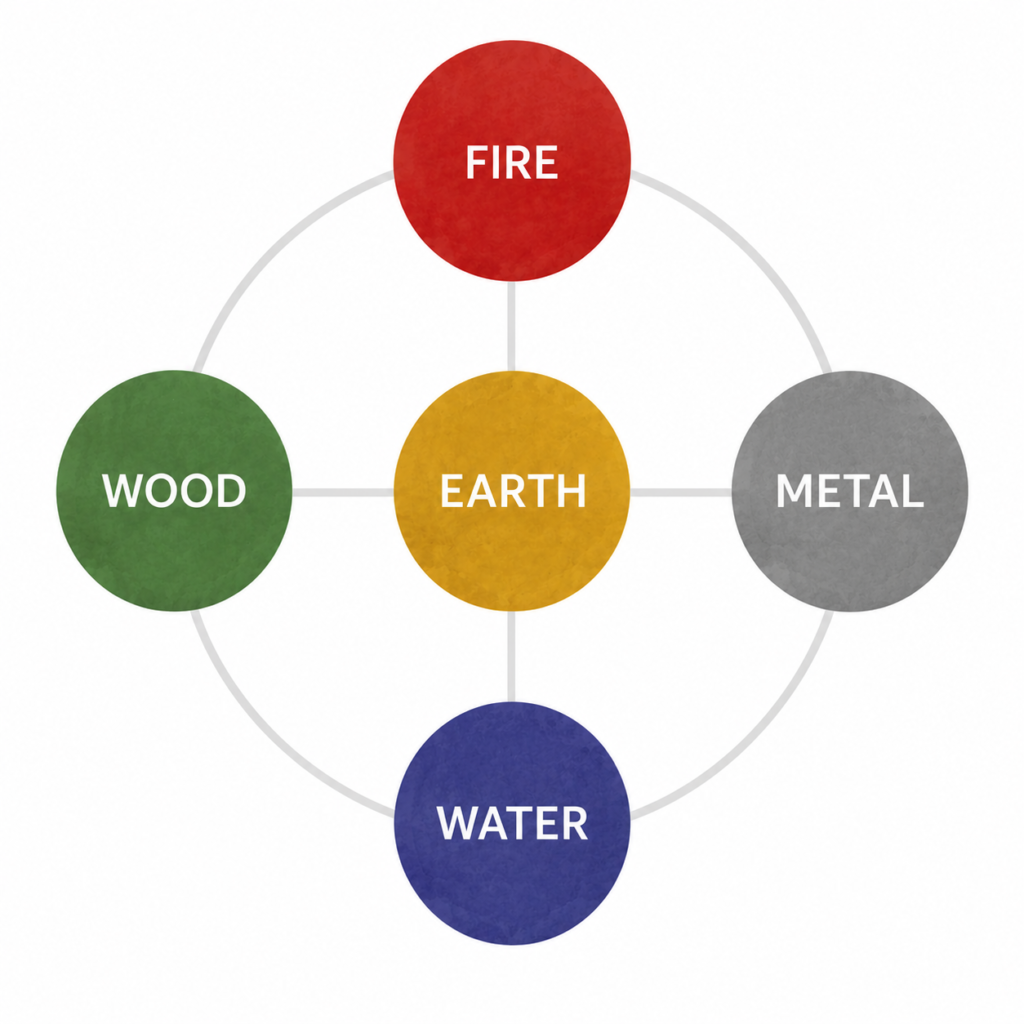
The phases are Wood, Fire, Earth, Metal, and Water, and each carries a cluster of associations built up through centuries of observation: seasons, climates, directions, tastes, colours, sounds, symptoms – and organs, emotions, and qualities of mind. The associations are not arbitrary impositions. They reflect patterns of correspondence that were noticed repeatedly across different domains of experience and gradually organised into a coherent system. That system went on to influence not just medicine but Chinese philosophy, cosmology, and even martial arts – Xing Yi Quan, one of the classical internal martial arts, structures its five fundamental techniques directly around the five phases.
The qualities associated with each phase arise from close study of the natural world. Wood is the energy of spring – the young shoot pressing upward through soil, the sapling bending in wind without snapping. Its qualities are suppleness, directionality, and the drive toward growth. Fire is the fullness of summer – warmth, expansion, the capacity to radiate outward and connect. Earth is the pivot of late summer and harvest – nourishing, stabilising, the capacity to receive and transform. Metal is autumn – the moment of letting go, of essence distilled from what is no longer needed, of clear boundaries and a sense of self-worth. Water is winter – stillness, depth, the hidden reserve from which everything else will eventually draw, and which nourishes the new seed of spring.
Everything in relationship
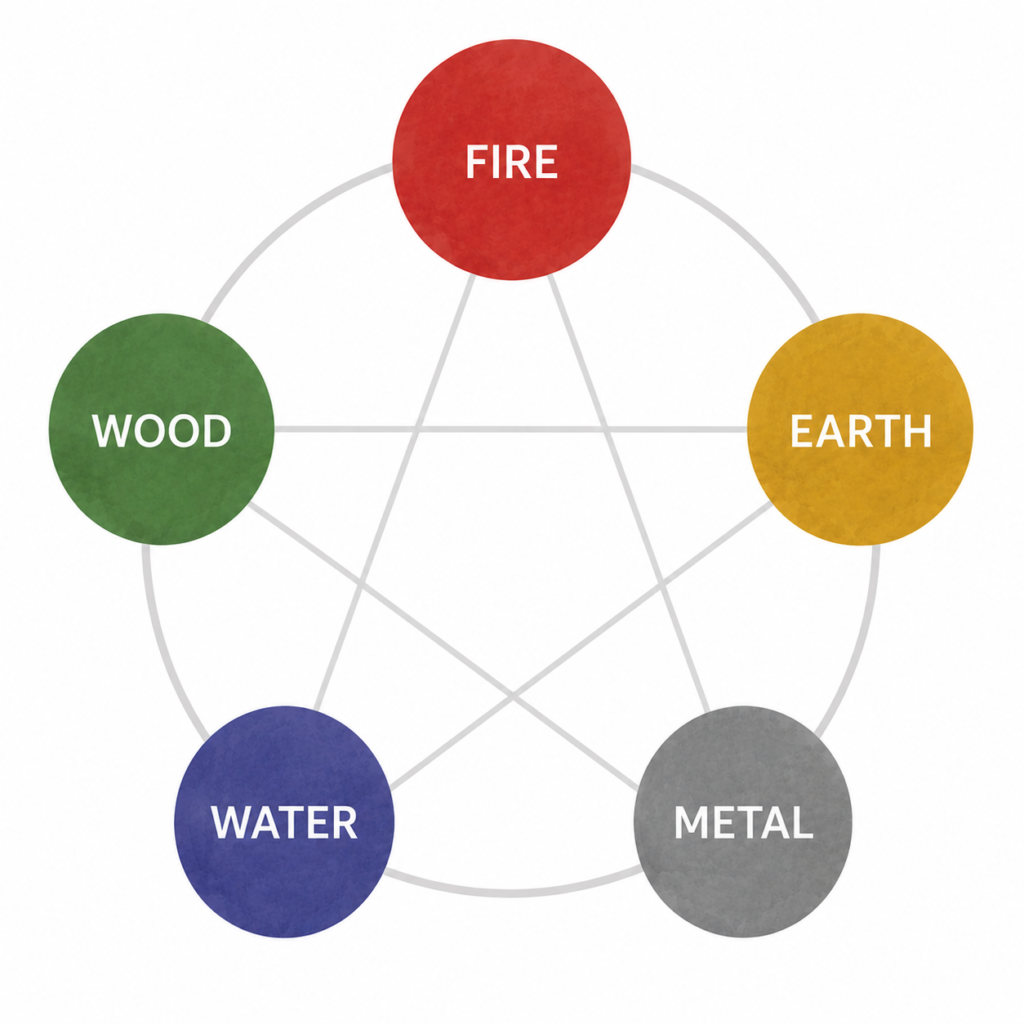
These phases do not simply sit alongside one another. They map how energy moves and transforms, and they work through two primary relationships: a generating cycle, in which each phase nourishes the next – Wood feeds Fire, Fire creates Earth in the form of ash, Earth yields Metal, Metal enriches Water, Water nourishes Wood – and a controlling cycle, in which each phase holds another in check, preventing any single one from becoming excessive. Wood anchors Earth, Earth dams Water, Water douses Fire, Fire bends Metal, Metal chops Wood.
In health, these relationships maintain dynamic balance. In disharmony, they become either deficient or excessive – a phase failing to nourish the next, or over-controlling it. A classic clinical example is Wood overacting on Earth: Liver qi, when it is constrained and builds pressure, tends to invade the Spleen and Stomach, producing the combination of stress, irritability, and digestive disruption that practitioners see regularly and that most people will recognise from their own experience of anxiety or prolonged tension.
This is not as remote from contemporary understanding as it might initially seem. Modern research into the gut-brain axis, the relationship between cardiovascular health and mood, or the links between respiratory function and anxiety, suggests that the body’s systems are far more psychologically integrated than the conventional separation of physical and mental health implies. Chinese medicine simply started from that integrated picture and never departed from it.
Function and dysfunction
Most writing on this subject tends to focus on what goes wrong – the emotional and psychological signatures of disharmony in each system. That is understandable; it is in the clinic, when things are not working well, that dysfunctional patterns become most visible and most discussed. But each of these systems also has a healthy, flourishing expression, and those positive qualities get considerably less attention. What follows is an attempt to redress that balance a little – moving through the five phases and the organ systems associated with each, looking at both sides.
The organ systems of Chinese medicine are divided into two categories: the zang organs – Heart, Pericardium, Liver, Spleen, Lung, and Kidney – which are considered yin in nature, concerned with storing and maintaining the body’s fundamental substances; and the fu organs – Small Intestine, Gallbladder, Stomach, Large Intestine, Bladder, and San Jiao – which are yang, concerned with receiving, transforming, and moving. Each zang is paired with a fu organ, the two working together as complementary aspects of the same functional network.
Wood – Liver and Gallbladder
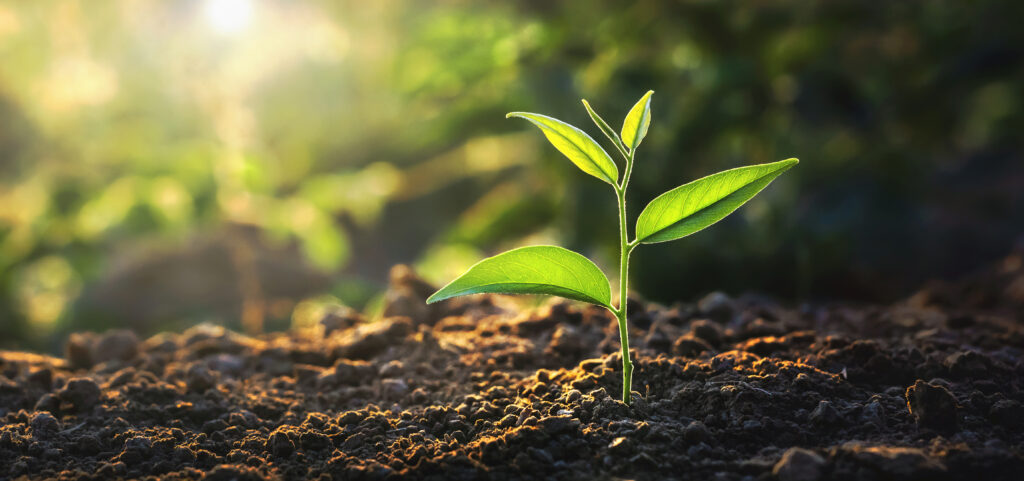
The Wood element is associated with growth, movement, and direction. Its season is spring – the moment when energy that has been held through winter begins to move outward again.
When the Liver is functioning well, there is a quality of smooth movement – not just physically (though that too) but also psychologically. Healthy Liver energy lends us our capacity to make plans and follow them through. It gives us emotional flexibility – the ability to bend under pressure without breaking, to adapt when circumstances change without losing our bearings – and a clear sense of where we are headed and why.
The Gallbladder brings decisiveness and a particular kind of quiet courage – not recklessness, but the ability to act on a judgement once it has been made, without endlessly second-guessing ourselves. Together, Liver and Gallbladder at their best describe someone who moves through obstacles rather than being stopped by them.
The dysfunctional expressions are perhaps more familiar: when Liver qi is constrained, that smooth movement becomes stuck. Frustration, irritability, a sense of things being blocked. Difficulty making decisions, or swinging between options without resolution. Tension held in the neck, shoulders, and jaw. The Wood energy that should be moving outward turns back on itself and invades other systems.
Physiologically, the Liver’s association with stress and emotional regulation maps reasonably well on to what we know about the autonomic nervous system and the HPA axis – the body’s central stress response system. Chronic stress and emotional constraint do produce measurable effects on muscle tension, inflammatory balance, and mood regulation. The correspondence isn’t exact, but it isn’t arbitrary either.
Fire – Heart, Small Intestine, Pericardium, and San Jiao
Fire is the element of summer, warmth, and connection. Its organ systems are the most explicitly psychological of all five elements, and the Heart sits at the centre of them.
In Chinese medicine the Heart houses the shen – a term often translated as spirit or mind, but in some ways better understood as our conscious presence. When the Heart is settled and nourished, there is clarity – not the analytical sharpness we might associate with intelligence, but a quality of knowing one’s own mind, of being genuinely present rather than scattered or absent. And there is warmth: the capacity for real connection with others, for being truly available rather than merely present in body.
The Pericardium – the Heart’s protector – is a second Yin organ associated with the Fire phase. It mediates that capacity for connection, maintaining appropriate boundaries without closing off. It is what allows intimacy without loss of self, and openness without vulnerability that can tip into overwhelm.
The Small Intestine’s role, as the Yang partner to the Heart, is discernment – expressed in the classical phrasing as “separating the pure from the turbid”. Physically this refers to digestion, but psychologically it describes the capacity to sort what nourishes from what doesn’t: which relationships, which ideas, which experiences are worth holding on to, and which are better released. It is a quieter, more analytical quality than the Heart’s warmth, but the two work together.
The San Jiao – the Triple Burner, one of the more abstract of the classical organ systems, more about space, conductivity, and relationship than substance and structure, and companion to the Pericardium – facilitates communication and integration across the body’s different regions. At its best it describes an ease of flow between inner and outer, between self and world, that makes social and relational life feel effortless rather than effortful.
When Fire is disturbed, the shen becomes unsettled. Anxiety, restlessness, difficulty sleeping, a sense of disconnection from others or from oneself. The warmth that should radiate outward becomes either excessive – a slightly manic sociability – or withdrawn entirely.
As the body’s “Emperor” organ, the Heart’s psychological centrality in Chinese medicine resonates with what neuroscience describes as the default mode network – the brain’s resting state activity, associated with self-referential thought, social cognition, and the sense of a continuous self. It also connects to the well-documented relationship between cardiovascular health and mood, and the vagus nerve’s role in mediating both social engagement and emotional regulation.
Earth – Spleen and Stomach
Earth is the element of late summer and of centre – the pivot around which the other elements turn, and occasionally depicted in this central position in diagrams of the five phases. Its qualities are nourishment, stability, and the capacity to process and integrate – and it is from the Spleen and Stomach that the body draws its day-to-day operational energy, transforming food and drink into the qi and blood that fuel everything else. It’s worth noting that what Chinese medicine calls the Spleen maps more closely onto the pancreas and digestive tract as a whole than on to the spleen as Western anatomy understands it – a reminder that the classical organ systems are functional descriptions rather than precise anatomical correlates.
The Spleen in Chinese medicine governs digestion, but its remit extends well beyond the physical. It is responsible for what the classics call “holding thought” – the capacity for sustained mental focus, clear thinking, and the ability to study and absorb information. When Spleen qi is strong, the mind is clear and steady. Concentration comes easily. Ideas can be turned over, examined, and integrated without effort.
The Stomach receives and ripens – taking in what comes from outside and beginning the process of transformation. Together, Spleen and Stomach describe our capacity to take nourishment from experience, not just food: to sit with something, process it, and make it one’s own.
The dysfunctional expressions are recognisable: when Spleen qi is deficient or obstructed, thinking becomes cloudy. Rumination – the same thought turning over and over without resolution – is a classic sign. Brain fog, difficulty concentrating, a sense of heaviness in the head. Worry is the emotion associated with the Spleen, and chronic worry is itself exhausting to the digestive system and beyond, creating a self-reinforcing cycle that practitioners see regularly in clinic.
This is one of the areas where the physiological parallel is most accessible. The gut-brain axis – the two-way communication between the enteric nervous system and the brain, mediated largely by the vagus nerve – is now well established in research. Gut health affects cognitive clarity, mood, and stress resilience. Blood sugar stability, which depends on digestive function, has a direct impact on concentration and mental steadiness. The Spleen’s association with thought is not metaphorical; it reflects something that was observed clinically long before the mechanisms were understood.
Metal – Lung and Large Intestine

Metal is the element of autumn – the season of letting go, of things returning to their essence after the fullness of summer and harvest.
The Lung governs breath, and breath is the most immediate interface between self and world – the most fundamental act of taking in and releasing. When the Lung is healthy, there is a quality of receptivity: the capacity to be genuinely moved by things, to let in what is beautiful or meaningful rather than keeping the world at a careful distance.
This is subtly different from the Heart’s warmth. The Heart reaches outward toward others; the Lung is more about porousness – allowing experience in, allowing ourselves to be touched by life and find meaning. Grief is the Lung’s emotion precisely because grief is what happens when we lose what is precious, although we view it as pathological only when we cannot process it and move on.
There is also a quality of self-worth in healthy Lung energy – a sense of one’s own value that doesn’t depend on external recognition. Clear boundaries, maintained not from fear or rigidity but from a settled sense of what is and isn’t one’s own.
The Large Intestine completes what the Lung begins: once the sorting has happened, once what nourishes has been received and what doesn’t has been identified, the Large Intestine releases it. Physically this is elimination; psychologically it is the capacity to let go cleanly, without holding on to what no longer serves us. When this function is healthy, there is no accumulation of what should have been released – no residue of old grievances, outworn identities, or experiences that have been processed but not yet relinquished.
When Metal is disturbed, grief becomes stuck rather than moving through. A kind of emotional constipation – holding on to loss, to the past, to a version of things that has already gone. Or we see its opposite: a defended quality, keeping the world out, unable to be moved.
The respiratory system’s relationship to the autonomic nervous system – and particularly the role of breathing in regulating stress responses – gives some physiological grounding to the Lung’s psychological associations. Breathwork’s measurable effects on anxiety and emotional regulation are increasingly well documented, suggesting the classical connection between breath, emotion, and the capacity for bounded presence is not simply poetic.
Water – Kidney and Bladder

Water is the element of winter, of depth, stillness, and reserve. The Kidney is understood in Chinese medicine as the root of constitutional vitality – the deepest store of energy from which everything else draws.
When Kidney energy is strong, there is a quality of groundedness and depth. It represents our capacity to face uncertainty without being destabilised – not because nothing is uncertain, but because there is something steady underneath. Where the Gallbladder’s courage is decisive and active, the Kidney’s is quieter: a constitutional resilience, a sense of having reserves to draw on. Wisdom in the classical sense – knowing what truly matters, being able to take the long view – is a Kidney quality.
The Bladder relates to the processing and release of what is no longer needed at this deeper constitutional level (rather then on the more superficial and immediate level of the Large Intestine) – and to the capacity for clear perception unobstructed by fear.
Kidney energy in Chinese medicine has two aspects: Kidney yin, the body’s deepest reserve of moisture and substance, and Kidney yang, sometimes called Mingmen fire – the Gate of Vitality – which is the root of all warmth and transformative activity in the body. Where Kidney yin is the still, deep water of winter, Mingmen fire is the heat hidden within it, the spark that keeps every physiological process turning. All the organ systems draw on it, and when it is depleted the result is not just coldness and fatigue but a dimming of vitality at the most fundamental level.
Fear is the negative emotion associated with Water, and Kidney deficiency – depleted constitutional reserves – shows as a particular kind of existential anxiety: a sense of groundlessness, of there not being enough, of the foundations being insecure. In contemporary life, chronic overwork, sleep deprivation, and sustained stress are among the most common ways this reserve becomes depleted. The Kidney doesn’t recover quickly; it requires rest, stillness, and time.
The physiological parallel here is perhaps the most speculative of the five. The adrenal glands – which sit atop the kidneys anatomically and govern the stress response through cortisol and adrenaline – are the most obvious correlate, and the connection between adrenal exhaustion and the kind of deep fatigue and anxiety that Chinese medicine associates with Kidney deficiency is clinically striking. But it would be overstating things to say the Kidney simply is the adrenal system. As with the other organ systems, the classical description is broader and more relational than any single physiological structure can account for.
One body
What runs through all of these is the same underlying idea: that our emotional and psychological lives are not separate from our physical health, housed in the mind while the body gets on with its own business. They are expressions of the same integrated system, shaped by the same patterns of function and dysfunction.
Chinese medicine is not claiming that clarity of thought literally resides in the spleen, or that grief is stored in the lung tissue. This is worth distinguishing from an idea that has gained currency in some circles – that particular organs, fascial layers, or areas of the body literally hold our emotions.
There is something real beneath this: the body does carry the traces of experience. The body reflects emotional states through altered tone, posture, and tissue quality. Chronic stress accumulates in the musculature; long-held grief can bow the shoulders and hollow the chest.
But Chinese medicine is not making that claim in its naïve form. It is not suggesting that discrete emotional memories are physically lodged and encoded in specific tissues, waiting to be released by the right needle or the right touch – a different claim from the observable reality that chronic stress, grief, and sustained emotional pressure leave their mark on tissue tone and how the body holds itself. Rather, it is describing functional relationships – patterns of correspondence between physical and psychological experience that were observed consistently enough to be organised into a medical system.
That those patterns are increasingly legible in physiological terms speaks less to classical medicine having anticipated modern science than to both traditions observing the same reality, through different lenses and at different scales.
Thanks for reading!
Further reading
Read more on the blog:
- How does the body respond to acupuncture? - what happens when we insert a needle
- Which kind of anxious are you? - thoughts on anxiety in Chinese medicine
- Acupuncture research - the state of the evidence
- Health without hacks - simple wellbeing advice
- A nourishing morning - looking at healthy morning routines from both a modern scientific and Chinese yangsheng perspective
- Foot health, somatic awareness, massage, and the nervous system - standing on your own two feet
- Common traditional patterns of disharmony: Liver Qi Stagnation and Spleen Qi Deficiency
- What is Qi? - an exploration of vital energy
- Why the channel system of Chinese medicine still matters today
- Chronic pain - acupuncture as a first line intervention
- Sailing the Dao - modern misuses of Daoist wisdom
- Six Divisions & TCM Pathology - a comprehensive guide to Chinese medicine
- How many needles? - contrasting styles of acupuncture
- Between freedom & form - tensions between tradition and modern individualism
- Navigating the middle ground - tensions between spiritual healing and modern biomedicine
- How diagnosis works in Chinese medicine
- The scientific mechanisms of acupuncture
- Is acupuncture really "alternative"? - how Chinese medicine stands apart from other alternative therapies
- When wisdom becomes a soundbite - how modern culture uproots classical ideas from their proper context
- Acupressure points for anxiety and migraine relief
- Acupuncture: pseudoscience or evidence-based practice?
- What is tuina? - a look at Chinese massage
- Qi is not quantum - debunking a popular acupuncture myth
- Supporting lymphatic health with acupuncture, tuina, and qigong
- Sleep is sacred: natural ways to ease insomnia
- Is dairy really bad for you? - a Chinese medicine perspective
- Qi in the Age of AI - why Chinese medicine matters more in the information age
- The Chinese body clock - parallels with our modern understanding of circadian rhythms
- Year of the Fire Horse - transitioning into 2026
- How does acupuncture work? - exploring fascia, embryology, and systems science
- Can acupuncture help with hayfever and rhinitis?
- Will the treatment work? A look at how we estimate outcome probabilities in living, responsive, complex bodies.