

Preface

When studying Chinese medicine, one of the greatest challenges is the potential for fragmentation. Students are asked to hold in mind the Six Divisions, the Eight Principles, the Five Phases, the Fundamental Substances, the Zangfu, the pathogenic factors, the Five Spirits, the Seven Emotions, a myriad patterns, hundreds of point actions... Each framework makes sense on its own, but what can get lost is how they all fit together.
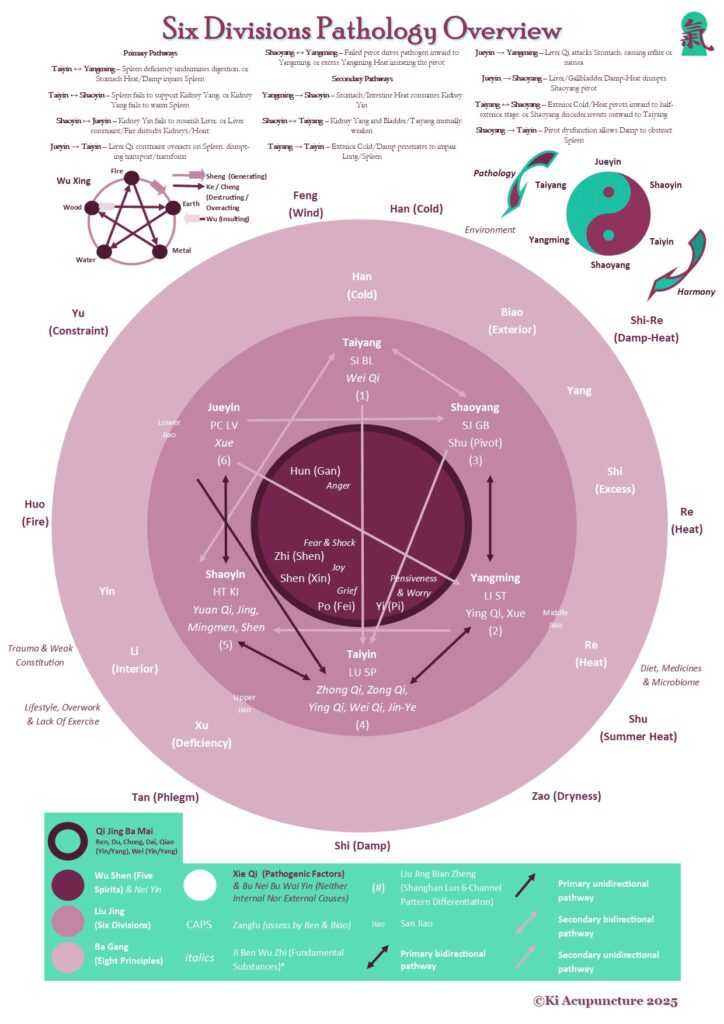
This article is built around a single diagram that attempts to bring the pieces together. It is not a substitute for detailed study of each system (and assumes foreknowledge of the subject matter) but is meant as a way of seeing the terrain as a whole – a “big picture” view of the complex yet elegant edifice that is classical Chinese medicine. The Six Divisions sit at the heart of this effort as an indispensable concept for pattern diagnosis, for grouping channels, Zangfu, and body regions, and even for reflecting the layered development of the body in embryology.
The aim is twofold: to make the diagram a practical study tool, for both students and new practitioners, and to show how it can guide diagnosis and treatment in clinic. To that end, we will move through the diagram layer by layer, from the centre outward, explaining the rationale behind each placement, and then expand into diagnosis, differential reasoning, tongue and pulse, and point selection. Along the way, examples and case studies will bring the framework to life. Finally, we bring the discussion to a close with a word on what really matters, beyond all the theory and technique: the therapeutic relationship.
A Note on Rationale: The Six Divisions as a Structural Map of Physiology and Pathology
While most modern teaching approaches Chinese medicine through the Zàng-Fǔ organs and the Eight Principles, these frameworks evolved from older philosophical roots. The Five Phases (Wǔ Xíng) arose first as a cosmological model describing cycles of transformation in nature, society, and the body. The Six Divisions, meanwhile, offer a still more structural view: they trace how physiological and pathological movement occurs through paired channels and organ systems.
In this sense the Six Divisions preserve a classical logic of connection that underlies, but also extends beyond, later models. Whereas the Zàng-Fǔ and Eight Principles describe internal conditions, the Six Divisions show how those conditions interact dynamically, revealing the broader framework of balance and disease. Thus, they serve as the earliest coherent lens through which to view Chinese medicine, because they organise both physiology and pathology according to depth, interaction, and movement: the very principles that later models would elaborate in finer detail.
Therefore, the Six Divisions reveal the underlying architecture from which later models emerged. They show how Yin and Yang, interior and exterior, cold and heat, and depth of pathology interrelate dynamically. Studying through this model helps students recognise that every pattern and organ relationship arises from the same fundamental movements of Qì. It gives a more integrated understanding of the living structure that gives rise to both physiology and pathology, rather than one based on isolated organ functions, syndromes, or point lists.
The diagram thus acts not just as a list of correspondences but as a lens through which students can see the underlying organisation of Chinese medicine. It links classical physiology, pathology, and even embryological layering into one picture, so the reader can grasp the relationships rather than memorising isolated facts. It is a map by which we can orientate ourselves to the concept of the Six Divisions and see how the rest of the terrain relates.
Introduction: The Six Divisions
Classical Roots and Conceptual Framework
The Six Divisions (Liù Jīng 六經) form one of the oldest structural frameworks in Chinese medicine. Their roots reach back to the Huángdì Nèijīng, where they describe the alternating movement of Qi between interior and exterior, and to the Shānghán Lùn, where they chart the stages of disease transmission. To read them only as febrile patterns is to miss their deeper purpose: they describe how the body organises itself, how defences meet the outer world, and how regulation is maintained at depth.
Early Development in the Nèijīng
In the Sùwèn, statements such as “Tàiyáng governs the exterior, Shàoyīn governs the interior” establish a logic of depth and polarity. Qi is said to circulate through successive yin–yang layers, entering and emerging in rhythm with day and night, work and rest. The Língshū expands this into a channel-based model: six paired divisions, each linking a Zàng (yin) organ with its corresponding Fǔ (yang) equivalent. These pairs are not merely anatomical; they express complementary physiological tendencies of activity and restoration.
At this stage, the Six Divisions were not a disease taxonomy but a model of organisation. They explained how life processes move inward and outward, how nourishment and defence cooperate, and how imbalance in one sphere may cascade into another.
From Structure to Pathology: the Shānghán Lùn
Centuries later, Zhāng Zhòng-jǐng’s Treatise on Cold Damage applied the Six Divisions to clinical observation. He described how Cold, entering from the surface, could penetrate through successive layers when unresisted. The same sequence could also reverse during recovery, as pathogenic Qi was expelled from interior to exterior. The divisions thus became stages of pathology, but their logic remained physiological: each stage manifests a particular mode of Qi movement.
• Tàiyáng (BL + SI): the outer defensive layer; disorders show stiffness, fever, aversion to wind, and floating pulses.
• Shàoyáng (GB + SJ): the pivot between interior and exterior; symptoms alternate between hot and cold, expressing a struggle of direction.
• Yángmíng (ST + LI): the inner surface layer; fullness, dryness, and excess Heat mark retention of pathogenic Qi within.
• Tàiyīn (SP + LU): the first true Yin sphere; weakness of transformation produces Dampness and fatigue.
• Shàoyīn (KI + HT): the deep axis of Fire and Water; deficiency or Cold here undermines vitality and consciousness.
• Juéyīn (LR + PC): the terminal layer, yet also regenerative; pathologies here show reversal of flow, Heat above with Cold below.
By mapping both invasion and resolution, the Shānghán Lùn portrayed illness as a dynamic negotiation of depth, not a static diagnosis.
Yin–Yang Axes and Functional Logic
Each pair of divisions forms an axis that represents a particular domain of regulation:
- Tàiyáng ↔ Shàoyīn – protection and preservation (surface ↔ core).
- Shàoyáng ↔ Juéyīn – coordination and mediation (pivot ↔ integration).
- Yángmíng ↔ Tàiyīn – nourishment and transformation (metabolism ↔ assimilation).
The Six Divisions therefore describe three fundamental systems: defence, communication, and sustenance. Their alternation of Yin and Yang expresses the perpetual balancing act between outward engagement and inward maintenance.
When the Nèijīng speaks of “the dynamic circulation of Qi through yin–yang divisions,” it refers to this continuous movement. Qi flows outward through Yang layers to interact with the environment, then returns inward through Yin layers to consolidate resources. Health depends on that oscillation.
Embryological and Physiological Parallels
The Six Divisions can also be viewed as archetypal layers of human organisation. They describe depth, function, and interaction. This layered perspective reflects how life unfolds: from outer exchange with the world to the inner processes that sustain it.
Layered Physiology and Development
In embryological terms, the body forms through successive differentiations. The outermost layer becomes the skin and sensory surfaces, the middle layers form movement and circulation, and the innermost layers generate the organs of digestion and reproduction. The Six Divisions follow a similar logic. They represent progressive depth and specialisation, each with a characteristic way of engaging with its environment.
• Tàiyáng represents the outermost, ectodermal layer. It governs defence, boundary, and sensory awareness. The Bladder and Small Intestine channels protect and filter contact with the external world.
• Shàoyáng occupies an intermediate position, coordinating transitions. Its physiology is dynamic and oscillating, mediating between inner and outer conditions. The Triple Burner and Gallbladder perform functions of regulation, decision, and distribution.
• Yángmíng represents the body’s active metabolic surface. The Stomach and Large Intestine digest, assimilate, and eliminate. This layer corresponds to the endodermal and epithelial linings of the digestive tract.
• Tàiyīn mirrors the nutritive and absorptive systems. The Spleen and Lung circulate nourishment, manage fluids, and maintain the integrity of internal space. This layer resonates with circulatory and lymphatic networks.
• Shàoyīn forms the deepest stabilising axis. The Kidney and Heart regulate the body’s homeostatic rhythm and coordinate the Fire–Water balance that underlies all adaptation. This parallels the endocrine and renal–adrenal systems.
• Juéyīn completes the cycle as the regenerative and circulatory foundation. The Liver and Pericardium store, renew, and redistribute Blood and Essence, maintaining continuity between growth, repair, and emotional vitality.
Each layer, like a germ sheet or fascial envelope, carries both physical and functional meaning. It reflects how Qi manifests at different depths of interaction: defensive, transformative, nutritive, or reproductive.
Function over Anatomy
To equate these layers with organs alone would miss their purpose. The Six Divisions describe relationships of process. They show how energy moves from exterior to interior, from activity to restoration, from survival to renewal. The body’s systems do not exist in isolation but communicate through gradients of depth.
From a physiological standpoint, these classical layers anticipate the idea of networked regulation. The outer layers mirror the sensory–nervous interface that detects change. The middle layers correspond to metabolism and distribution. The inner layers resemble the hormonal and regenerative systems that preserve internal constancy.
In this sense, the Six Divisions represent an early systemic model. They show that life is sustained by interaction between layers of defence, communication, and preservation, not by any single organ acting alone.
Movement of Qi and the Chinese Clock
The movement of Qi through the Six Divisions follows a different logic from the circuit of the Chinese clock. The familiar twelve-channel sequence describes how Qi circulates through the Zàng–Fǔ in a daily rhythm, following the order of organ activity over twenty-four hours. This cycle expresses temporal movement: a rotation through time, showing when each channel and organ reaches its energetic peak.
The Six Divisions, by contrast, describe spatial and functional movement. Their circulation is not confined to time but reflects relationships of depth, polarity, and physiological coordination. Qi moves between paired yin–yang layers, entering and exiting, ascending and descending, according to the needs of balance and adaptation.
Two Models, Two Perspectives
The Chinese clock represents Qi as a continuous circuit of activity: Lung begins the cycle with dawn inhalation; Liver closes it with night restoration. This view teaches rhythm, flow, and diurnal balance. The Six Divisions reveal something different: how Qi shifts in depth and quality between exterior and interior, between yang surfaces and yin cores. Where the clock shows succession, the Divisions show structure.
In practice, both systems describe the same organism from complementary angles. The clock gives a vertical rhythm through time; the Divisions give a horizontal layering through space and function. Together they explain why certain times of day aggravate particular pathologies, or why disease can appear to move inward or outward through the body.
The Dynamic of Depth
Within the Six Divisions, Qi flows through three primary yin–yang axes:
• Tàiyáng ↔ Shàoyīn – from surface defence to deep preservation.
• Shàoyáng ↔ Juéyīn – from pivot and mediation to renewal and regulation.
• Yángmíng ↔ Tàiyīn – from active transformation to nourishment and storage.
These pairs represent rhythmic exchange rather than linear order. Qi does not travel in a single direction but oscillates according to need. When the body is challenged from outside, Qi rises to the surface through Tàiyáng. When rest and restoration are required, Qi returns inward to Shàoyīn. In this way the Shén (Spirit) is said to return to the Heart at night, settling within the Heart Blood, with disrupted or fragmented sleep resulting if this process is disturbed. The alternation maintains equilibrium.
Disruption in these movements explains why certain diseases follow characteristic pathways. A pathogen that fails to vent through Tàiyáng may penetrate to Shàoyáng or Yángmíng; internal stagnation in Juéyīn may push outward into Shàoyáng or Tàiyáng. The model offers both diagnostic insight and treatment strategy by showing how the system rebalances through depth rather than merely through time.
Integrating the Two Views
For students and practitioners, understanding both perspectives clarifies the larger unity of Chinese medical thought. The Chinese clock shows the pulse of daily life: breathing, eating, and sleeping. The Six Divisions show the architecture that makes such rhythm possible. Together they portray a living organism in motion, simultaneously layered and cyclical, adjusting constantly to maintain harmony.
Visualising the Six Divisions Through the Taiji
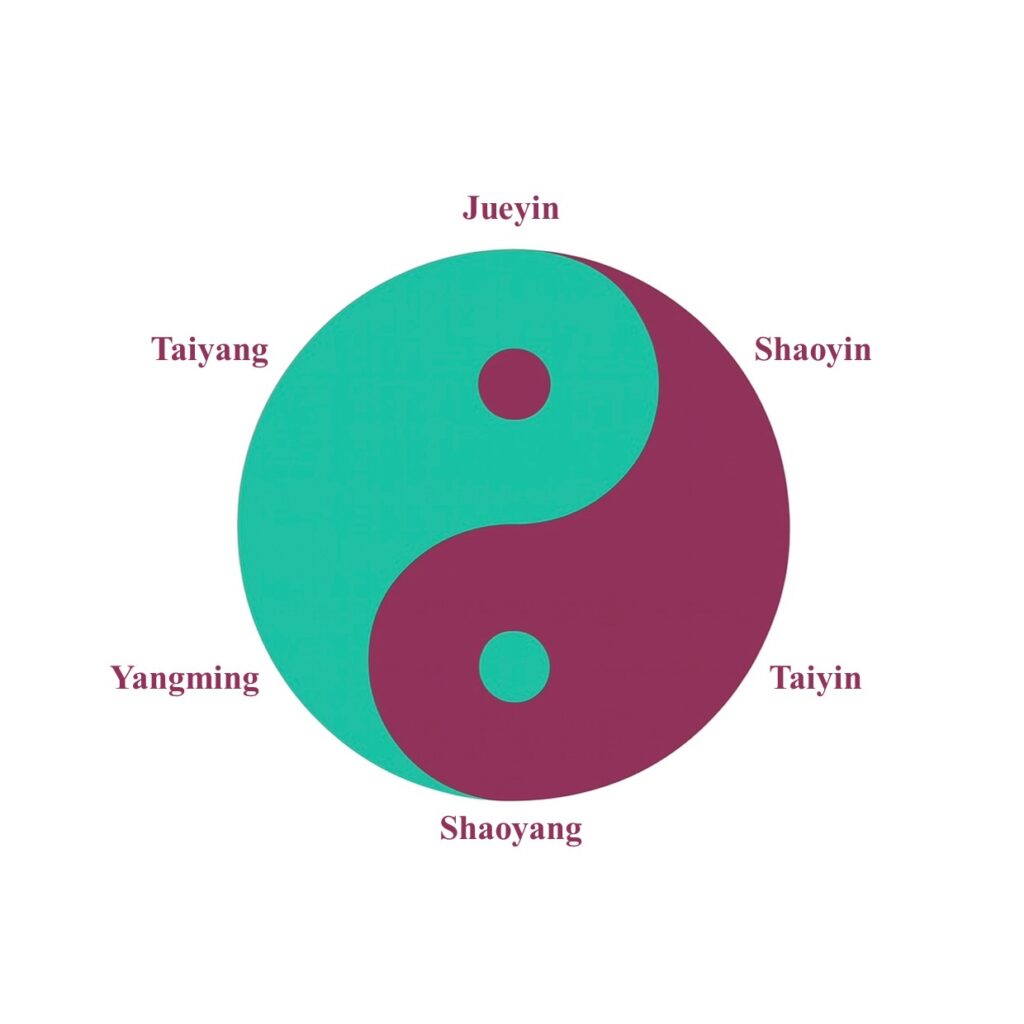
When visualised around the Taiji (the yin-yang symbol), the Six Divisions can be arranged to show the continuous movement of qi between yin and yang. This has been depicted to the top right of the main diagram.
Juéyīn sits at the upper junction, where deep yin gives rise to emerging yang: the moment of renewal. From there, qi moves anticlockwise through Tàiyáng (pure external yang, active defence), Yángmíng (transformative yang, digestion and assimilation), and Shàoyáng (the pivot where yang begins to yield to yin).
Crossing into the yin half of the cycle, qi continues through Tàiyīn (nourishment and absorption), Shàoyīn (deep storage and conservation), and returns to Juéyīn (regeneration and ascent).
The yin-yang axes are also shown by the S-curve linking Juéyīn to Shàoyáng (regulation and pivot), and by the horizontal axes threading through the fish eyes (yú yǎn), or dots, that link Tàiyáng to Shàoyīn (exterior defence to interior preservation) and Yángmíng to Tàiyīn (assimilation to nourishment).
This circular layout mirrors the natural rhythm of expansion and return: yang rising and dispersing, yin gathering and restoring. It illustrates the Six Divisions not as a hierarchy of layers but as a living current of movement, transformation, and balance.
Visualising Qi Flow Through the Taiji
Although the diagram moves anticlockwise to show the order of engagement between the Six Divisions, this path represents the transmission of influence: how external factors penetrate inward or how internal disharmony may surface.
The natural flow of Qì itself can be understood as moving in the opposite direction: from deep within Shàoyīn, where stillness and essence reside, outward through Juéyīn as life begins to stir, expanding into Tàiyáng as full expression and defence at the surface, before returning again through the Yang and Yin phases to restore balance.
This clockwise current symbolises the generative cycle of activity and rest, mirroring the pulse of yin and yang in nature. Thus, one rotation describes the movement of pathology, while the reverse shows the movement of life and harmony.
Integrative Interpretation
The Six Divisions can be read as both a structural map and a living process. They show not only how the body is arranged, but how it responds, adapts, and recovers. Each pair of divisions mirrors a major principle of regulation: outer defence and inner preservation, transformation and nourishment, coordination and renewal. This framework describes how health is sustained through constant adjustment between surface and core.
When seen in motion rather than as fixed zones, the Six Divisions express the same adaptive intelligence that the Neijing describes as the “movement of Heaven and Earth within the body.” Qi rises and falls, contracts and expands, responding to temperature, emotion, food, rest, and effort. This circulation preserves life by keeping the system flexible. Disease occurs when movement becomes blocked, excessive, or reversed.
From a clinical perspective, the Divisions unify physiology and pathology. They reveal how the body’s natural defences, metabolic processes, and deep reserves relate to one another. For instance, when exterior defences fail to expel a pathogen, it moves inward to the pivot or metabolic layers; when deep depletion weakens the root, internal disharmony may appear on the surface as reactivity or inflammation. Treatment guided by this understanding does not chase symptoms, but restores coherence across levels.
Philosophically, the model also speaks to the continuity between human beings and the natural world. The alternation of yin and yang within the body reflects the same rhythm that governs seasons, weather, and tides. Taiyang mirrors sunlight and protection, Shaoyin the fertile depth of the soil; Shaoyang mediates the exchange between them, as wind or growth connects earth and sky. In this way, the Six Divisions describe both anatomy and cosmology.
Modern physiology increasingly recognises the value of such layered, network-based thinking. Systems such as the neuroendocrine axis, immune regulation, and fascial continuity correspond closely with the ancient idea of interacting fields rather than isolated parts. Increasingly, it being realised that fascial planes and the channels of Chinese medicine demonstrate remarkable overlap. There is more to this than a direct correspondence, with other connections and systems being involved too, but fascia is now understood to be an important medium in acupuncture practice. You can read more on these ideas here. But the Six Divisions prefigure these insights, offering a way to understand the body as a coordinated whole where function and structure are inseparable.
For the modern student, they provide a foundation for pattern recognition that is both structural and dynamic. They encourage the practitioner to see how local symptoms may reflect deeper shifts in regulation, and how supporting the proper movement of Qi, whether through acupuncture, touch, breathwork, or herbs, can restore connection between inner and outer layers.
Ultimately, the Six Divisions are not only a diagnostic framework but a philosophy of balance. They remind us that health is not a static state, but a dialogue between levels of being: between what protects and what nourishes, what acts and what rests, what changes and what endures.
The Six Divisions Pathology Diagram
With this in mind, let us move towards a progressive discussion and interpretation of the diagram, which serves both as a map and as a metaphor. It gathers the relationships described throughout the classical texts into a single visual field, showing how the Six Divisions express depth, polarity, and movement.
Each line and correspondence reflects not only a theoretical concept but a living process: the circulation of Qi between surface and core, nourishment and defence, and the body’s functional axes. By tracing these movements, the diagram makes visible the coherence between classical physiology and pathology, helping us see how every pattern and transformation arises from the same integrated web of relationships.
The Centre: The Five Spirits (Wǔ Shén 五神)

At the heart of the diagram are the Five Spirits: Shén, Hún, Pò, Yì, and Zhì. This placement is deliberate, as they are central to our being. Spiritual disharmony is arguably at the root of all disease, while spiritual harmony is the foundation of health, happiness, and wisdom.
- The spirits are not abstract, but represent the lived functions of consciousness, intention, memory, courage, and resilience.
- Each is rooted in a Zang organ:
• Shén (Mind-Spirit) in the Heart (classically also Líng*)
• Hún (Ethereal Soul) in the Liver
• Pò (Corporeal Soul) in the Lungs
• Yì (Intellect/Intention) in the Spleen
• Zhì (Will) in the Kidneys
- The seven emotions (Qì Qíng) that disturb the spirits are also seen as internal causes of disease. Fear and fright/shock affect the Kidneys and Heart respectively, anger unsettles the Liver and Hún, grief/sadness burdens the Lung and Pò, pensiveness/overthinking and worry entangle the Spleen and Yì, and joy in excess scatters the Heart Shén. Intense or longstanding negative emotions lodge in their respective organ and set the stage for pathology to manifest. It’s important to note that all emotions are natural and non-pathological when expressed normally, but become pathological when Shi, Xu, or obstructed/stuck.
- Each of the Seven Emotions moves Qi in a distinctive way. Anger makes Qi rise, joy slows it, pensiveness knots it, worry binds it, grief consumes it, fear makes it descend, and fright first scatters then sinks it. These movements explain how emotions create disorder when they are intense, prolonged, or arise out of balance with a person’s constitution.
- We don’t treat the Wǔ Shén directly; we influence Qi and Blood to treat Shén disharmonies.
* In older or more esoteric traditions, particularly those influenced by early Daoism, or shamanic thought, the Heart’s spirit was sometimes described as Líng rather than Shén. Líng carries the idea of numinous awareness, a kind of ineffable spiritual responsiveness that connects the human spirit to the cosmos, whereas Shén refers more to individual divinity or animating forces of consciousness and vitality within the body. Only in later medical usage has Shén become a collective term for all five Spirits.
Why in the centre of the diagram?
Because in Chinese medicine the spirit is not an afterthought, or something separate from our material selves. It is the organising core of human life. Disease is not just physical imbalance, but an underlying disturbance of how the spirit inhabits the body. When qi is strong and smooth, blood is moving, and spirit is bright, illness cannot enter. And it is disharmony of spirit that is almost always at the root of imbalance.
The Next Layer: The Extraordinary Vessels (Qí Jīng Bā Mài 奇经八脉)
Encircling the spirits are the Eight Extraordinary Vessels. These are placed next because they provide the structural scaffolding through which the essence and the spirit are expressed. If the Spirits are our foundations, the Ba Mai are the framework through which the rest of our being is structured.
The extraordinary vessels are often called the “oceans” of Qi and Blood. They link and regulate the twelve primary channels but also act as reservoirs and deep regulators. Their significance is both practical and embryological. Classical writings describe the extraordinary vessels (qí jīng bā mài 奇經八脈) as the first channels to form. They are not paired like the regular channels, but act as reservoirs and regulators. At conception, the essence of the parents gathers in the Chōng mài (冲脉), the “Sea of Blood” and “Sea of the Twelve Channels.” This vessel is central, both literally and figuratively, said to nourish all later development.
From this root, the Rèn mài (任脉) and Dū mài (督脉) arise along the anterior and posterior midlines, dividing the body into Yin and Yang domains and establishing the basic vertical axis of human form. The Dài mài then encircles the waist like a belt, stabilising upper and lower and binding the vertical currents together. The pairs of Qiāo and Wéi vessels extend to the limbs, regulating balance, stance, and timing, weaving the body into a coherent whole.
On this prenatal scaffold, the twelve primary channels take shape. They distribute Qi and Blood into the organ systems and the surface, forming the pathways that allow interior and exterior to resonate. For clinical clarity these twelve are grouped into the Six Divisions (liù jīng 六经), which express their organisation as Yin and Yang, hand and foot, interior and exterior.
The Six Divisions therefore represent not just a diagnostic framework, but a continuation of the body’s earliest ordering. From the vast sea of the Chōng, through the midlines of Rèn and Dū, to the stabilising belt of the Dài and the balancing Qiāo and Wéi, the body unfolds its structure. The divisions and vessels show how those early principles remain present in physiology and pathology, giving practitioners a way to trace imbalance back to its roots.
To understand their ongoing clinical relevance, especially for resolving deeper imbalances, it helps to look more closely at the Eight Extraordinary Vessels themselves, each with its own image, function, and sphere of influence:
- Ren Mai (Conception Vessel): Sea of Yin, governs reproduction, menstruation, and nourishment. Master: LU7, Couple: KI6.
- Du Mai (Governing Vessel): Sea of Yang, spine and brain, directs Yang circulation. Master: SI3, Couple: BL62.
- Chong Mai (Thoroughfare Vessel): Sea of Blood, link between Yin and Yang, fertility, and ancestral channel. Master: SP4, Couple: PC6.
- Dai Mai (Girdling Vessel): Encircles the waist, binds upper and lower, stabilises transitions. Master: GB41, Couple: SJ5.
- Yin Qiao and Yang Qiao (Yin/Yang Motility): Control movement and balance, left–right harmony. Yin Qiao Master: KI6, Couple: LU7; Yang Qiao Master: BL62, Couple SI3.
- Yin Wei and Yang Wei (Yin/Yang Linking): Integrate and connect Yin and Yang channels, maintaining internal–external balance. Yin Wei Master: PC6, Couple: SP4; Yang Wei Master: SJ5, Couple: GB41.
Why here in the diagram?
Because they stand deeper than the primary channels yet outward from the spirit. They are the bridge into the physicality of form, and the framework through which Jing is carried, Qi is stored, and the rhythms of Yin and Yang are organised.
The Inner Ring: The Six Divisions (Liù Jīng 六经)
Here we discuss the next level: the organs (Zangfu) and channel network (Jingluo) that store and distribute the basic ingredients of life. These fundamental substances move and transform through dynamic relationships, each bound up with the functions of yin and yang, and expressed through the six divisions that shape how interior and exterior, surface and depth, connect with one another, how the organ networks relate to physical form, and how pathological patterns progress.
Fundamental Substances (Jīběn Wùzhì 基本物质)
Around the extraordinary vessels sits the domain of the fundamental substances: Qì, Blood (Xuè), Fluids (Jīn-Yè), Jīng, and Shén. In the diagram, they are distributed according to the Six Divisions. This makes visible the relationship between each division and the substance it is most closely responsible for.
The fundamental substances form the basis of all physiological activity. They transform into one another, and their circulation sustains life. Qì drives movement and transformation, Blood nourishes and houses the Shen, Fluids moisten and transport, and Jing anchors growth, reproduction, and the potential for renewal.
- Qi generates and moves Blood, while Blood nourishes and anchors Qi.
- Blood is nourished and moved by Qi, anchors the Shen (in the Heart Blood) and Hun (in the Liver Blood), moistens the tissues, and in turn replenishes and steadies Qi.
- Jing (essence) produces Qi and Blood, but is also replenished by them in turn.
- Body Fluids depend on Qi for transformation and transport, and in turn support Blood and Yin.
- Shen (spirit) is rooted in the vitality of Qi, Blood, and Jing, yet also influences their harmony.
At the heart of these transformations lies the Kidney system, where Jing is stored and Yuan Qi arises. Here, too, resides the concept of Mìngmén Fire (命門火), the Gate of Life. Though not a substance itself, it represents the spark of Yang that animates and warms all processes. Without it, transformation falters: Qi loses strength, Blood stagnates, and Fluids congeal.
Together, these substances create a dynamic web: Qi generates Blood and moves Fluids, Blood carries Qi and houses the Spirit, Fluids support the transport of both, and Jing provides the root. Clinical patterns emerge when one becomes deficient, stagnant, or overabundant, and treatment seeks not only to restore the substance in question but also to rebalance its relationship with the others.
Qi: the vital forms
Qi is not a single, uniform substance but an expression of process and organisation in different forms according to source and function. Classical theory distinguishes several kinds of Qi, each with its own role in sustaining life, protecting the body, and guiding transformation. Understanding these categories helps link the abstract idea of Qi to the tangible processes of physiology and pathology.
- Yuán Qì (Original Qi): rooted in Shaoyin, sustained by Kidney Jing and Mingmen fire, driving all vital activity. Yuán Qì is “the spark from conception” and is closely tied to life-span and vitality, since depletion of Yuan Qi means the body’s ability to recover is limited.
- Zōng Qì (Gathering Qi): produced in the chest by combining Gu Qi (Food Qi) from the Spleen/Stomach with Qing Qi (Air Qi) from the Lungs; supports voice, breathing, circulation. It resides in the chest and supports both the Lungs and Heart, explaining its link to voice projection and circulation.
- Zhōng Qì (Central Qi): the functional Qi of the Spleen, raising and holding; failure leads to prolapse and fatigue. It is a functional aspect of Spleen Qi and as such is responsible for lifting and holding the organs in place.
- Yíng Qì (Nutritive Qi): refined Qi that flows with Blood in the vessels, nourishing the tissues. It is also closely linked with Shen (mind/spirit) because it flows in the channels and blood, carrying nourishment not only to tissues but also to the mind.
- Wèi Qì (Defensive Qi): circulates on the surface, protecting from invasion, warming the body, regulating pores. Wei Qi, arises from the combined work of the Kidneys, Spleen, and Lungs. The Kidneys provide the driving spark through Yuan Qi, the Spleen supplies the raw material by transforming food and drink into Gu Qi, and the Lungs draw in fresh air and combine it with Gu Qi in the chest to form Zong Qi. With the support of Yuan Qi, the Lungs then refine this into Zhen Qi, which divides into Ying Qi for nourishment and Wei Qi for defence. In this way the Kidneys give the motive force, the Spleen the fuel, and the Lungs the refining and dispersing role that spreads Wei Qi over the body’s surface.
- Zhen Qi (True Qi) is the refined vital energy that the body produces once food, air, and the Kidney’s deep reserves have all been combined. The Spleen extracts Gu Qi from food and drink, and the Lungs mix this with Qing Qi from the air to form Zong Qi in the chest. With the support of Yuan Qi from the Kidneys, this Zong Qi is transformed into Zhen Qi, the usable form of Qi that drives all physiological functions. Zhen Qi then circulates through the body in two main expressions: Ying Qi, which flows with the blood to nourish the organs and tissues, and Wei Qi, which guards the surface and protects against external influences. In this sense, Zhen Qi is the body’s true, vital energy, the source from which nourishment and defence both arise.
We have already seen how the emotions influence the directional movement of Qì. Each Zàng and Fǔ also has its own natural Qì movement, which reflects and supports its physiological role. When this movement is smooth, function is harmonious; when obstructed, excessive, or reversed, disharmony arises.
Lung (Zàng)
• Natural movement: Qì should descend and spread, regulating breath and dispersing fluids to the skin.
• If Qì fails to descend: cough, wheezing, chest fullness, or retention of fluids in the upper body.
• If spreading is weak: dry nose and throat, dry skin, or spontaneous sweating.
• If dispersal is excessive: spontaneous sweating and susceptibility to Wind from loss of regulation.
• Links with: Large Intestine (downbearing), Kidney’s grasping of Qì. When the Kidney fails to grasp, there is shortness of breath on exertion.
Large Intestine (Fǔ)
• Natural movement: Qì moves downward to expel waste.
• If obstructed: constipation, abdominal distension, or painful defecation.
• If transformation is weak or descent is dysregulated: loose stools or urgency; in deficiency, possible soiling or incontinence.
• If afflicted by Heat: dry stools, burning at the anus.
• If afflicted by Damp-Heat: urgency with incomplete evacuation.
Spleen (Zàng)
• Natural movement: Qì rises, lifting clear essences to the Lung and Heart, keeping Blood in the vessels, and supporting the upright position of the organs.
• If Qì fails to rise: diarrhoea, fatigue, prolapse (stomach, uterus, anus), or heaviness in the body.
• If transport falters: Dampness accumulates, producing sluggishness and fullness.
• If it fails to contain Blood: easy bruising or uterine bleeding.
• Commonly pressed upon by: Liver constraint, which worsens digestive irregularity.
Stomach (Fǔ)
• Natural movement: Qì descends, receiving and ripening food.
• If Qì rebels upward: nausea, vomiting, belching, hiccup, or reflux.
• If descent is blocked: fullness, epigastric distension, or sluggish digestion.
• If afflicted by Heat: thirst, gum inflammation, rapid hunger, swollen or bleeding gums, foul breath.
• If afflicted by Cold: dull epigastric ache, slow digestion.
• Interaction: closely paired with the Liver. Liver constraint can drive counterflow, while a hot or rebelling Stomach can provoke Liver reactivity. Clinically, Juéyīn (Liver) often pushes into Yángmíng (Stomach). The reverse may occur transiently in acute counterflow and usually eases once descent is restored.
Heart (Zàng)
• Natural movement: Qì moves outward, driving Blood circulation and expressing Shén.
• If Qì is disturbed: palpitations, chest oppression, restlessness, anxiety, or insomnia.
• If Qì is weak: poor circulation, lassitude, or lack of shén brightness.
• If Heat agitates: vivid dreams, irritability, disturbed sleep.
Small Intestine (Fǔ)
• Natural movement: separates clear from turbid, sending clear upward and turbid downward.
• If disordered: abdominal pain, diarrhoea, scanty, painful urination with burning, or turbid urine (often Damp-Heat).
• Interaction: linked with the Heart, allowing Heat or agitation to pass between chest and lower burner.
Pericardium (Zàng, Xinbāo)
• Natural movement: protects the Heart and governs the centre of the chest, extending circulation outward.
• If free: Ying Qì and Blood circulate well, chest feels open.
• If blocked: chest oppression, anxiety, stagnation of emotion.
• If afflicted by Heat: clouded spirit, restlessness, disturbed sleep, especially in warm disease.
Sanjiao (Fǔ, Triple Burner)
• Natural movement: Qì transforms and moves fluids through upper, middle, and lower regions.
• If coordination fails: fluids may pool above while dryness appears below, or the reverse.
• Upper: diffuses and vents; Middle: transforms and transports; Lower: separates and excretes.
• Clinical disharmony: alternating chills and fever, rib-side tension, sense of blockage when pivot fails.
Kidneys (Zàng)
• Natural movement: anchors and draws downward, securing breath and stabilising essence.
• If Qì fails: shortness of breath, chronic asthma, urinary leakage, or lumbar weakness.
• If Yáng is weak: cold limbs, oedema, profuse clear urination.
• If Yīn is weak: empty Heat, night sweats, tinnitus.
• Interaction: grasping Lung Qì to stabilise breathing, regulating water pathways.
Bladder (Fǔ)
• Natural movement: transforms and excretes fluids downward.
• If impaired: urinary difficulty, dribbling, or retention.
• If deficient: incontinence.
• If afflicted by Damp-Heat: burning, urgency, dark urine.
Liver (Zàng)
• Natural movement: disperses and ensures free coursing throughout the body.
• If constrained: rib-side distension, sighing, mood swings, depression, breast tenderness, menstrual irregularity.
• If Qì rises excessively: dizziness, headaches, red eyes, anger.
• If constraint turns to Heat: bitter taste, irritability, agitation.
• If Qì counterflows: disrupts Stomach or Spleen, producing nausea, reflux, diarrhoea.
• If Blood is deficient: cramps, dry eyes, scant menses.
Gallbladder (Fǔ)
• Natural movement: assists Liver in coursing Qì, supports decision-making, and harmonises Shaoyang pivot.
• If stagnant: hypochondriac pain, nausea, bitter taste, yellow greasy coat.
• If Qì rises excessively: alternating chills and fever (Shaoyang disorder), insomnia, restlessness.
• If weak: timidity, hesitation, indecision.
The Six Divisions diagram shows how disharmony can pass from one sphere to another. These shifts are underpinned by the natural directional movements of Qì in each organ. For example, if Kidney Qì fails to anchor Lung descent, breathlessness and cough appear. When Liver constraint presses on the Spleen’s rising function, fatigue and diarrhoea result. Or when Stomach Qì fails to descend, it may push back into the Liver’s rising movement, producing nausea and rib-side distension.
Occasional counterflow, such as this last example of Stomach Qì pressing back into the Liver, can arise in practice, though for clarity the diagram focuses on the more stable, recurring pathways.
Taken together, the Zàng–Fǔ show that health depends on Qì rising, descending, entering, and exiting in the right places. When one system fails, another often compensates or is thrown off course. Treatment often works best when it restores both the local direction of Qì and the broader harmony of movement. For more on the functions of the Zangfu, see the chapter on Within-Division Organ Relationships.
Blood and Fluids
- Xuè (血, Blood): Anchored with Jueyin (Liver and Pericardium), storing the Hún and supporting the Shén. Blood nourishes the sinews, moistens the body, and carries the Qi that animates tissues and organs. It circulates with Qi through the channels, ensuring that vitality and form are inseparable.
- Jīn-Yè (津液, Body Fluids): Anchored with Taiyin, governed by the Spleen and Lung. Jīn are the lighter, clearer fluids (such as sweat, saliva, tears, urine) that moisten the skin and orifices. Yè are the denser, turbid fluids (such as synovial, cerebrospinal, and marrow fluids) that nourish the joints, brain, and sense organs. Together, they ensure lubrication, cooling, and the internal circulation of moisture.
Blood and Fluids are mutually dependent. Fluids enter the vessels to replenish Blood, while Blood carries Fluids through the channels to distribute moisture. When Blood is deficient, Fluids may dry up; when Fluids are impaired, Blood can become thick and stagnant. Their balance is essential for health, and disturbances often present together in clinical patterns.
Jīng and Shén
Shén (Spirit): Shén is listed under Shàoyīn because the Heart governs it, yet it radiates through all the Five Spirits at the centre. Shen gives consciousness, clarity, presence, and the capacity for connection. It animates thought, governs sleep and dreams, and reflects in the brightness of the eyes.
While each of the other spirits carries a specific function – Yì (intellect), Zhì (will), Hún (ethereal soul), and Pò (corporeal soul) – Shen integrates them into a coherent whole. It depends on the nourishment of Yíng Qì (nutritive Qi) and Blood to remain rooted and calm, and it also requires the steadiness of Kidney Jing as its constitutional anchor.
In clinic, Shen is observed in vitality of expression, responsiveness, and the patient’s capacity for insight or coherence. Disturbance of Shen may appear as anxiety, agitation, confusion, dullness, or loss of orientation, while its harmony is seen in joy, composure, and balanced emotional life.
Just as Jing requires the spark of Mingmen Fire to unfold into life, Shen too needs this warmth and vitality to shine outward; without it, spirit withdraws, and brightness dims.
Jīng (Essence): Also belonging to Shaoyin; the constitutional foundation, inherited and conserved. Jīng underpins the production of both Qì and Blood. While post-heaven (postnatal) sources such as food and air provide the immediate material, it is the strength of Kidney Jing that enables their transformation.
Jing supports Yuán Qì (Original Qi), which drives the conversion of Gu Qì (from food) and Zong Qì (from air) into Yíng Qì (nutritive Qi) and Xuè (Blood). In this way, Jing is not itself transformed day to day, but serves as the constitutional foundation without which Qi and Blood cannot be generated or maintained.
The warming and activating power of Mìngmén fire ensures this process has the vitality to function, binding Jing to the continual production of Qi and Blood. Jīng is the deepest ocean current of life, and Shén is the light it projects; together they show how substance and spirit interdepend, one providing the root and the other the radiance.
Mìngmén Fire (命門火)
The Mìngmén, or “Gate of Life,” the fire that animated Jing and Yuan Qi, sits between the Kidneys (belonging to Water) and represents the spark of vitality inherited at conception. Classical texts describe it as the residence of original Yang, the root of Yuan Qi, and the furnace that warms all physiological activity. Without its fire, transformation cannot take place: digestion slows, fluids fail to circulate, and the Shen becomes dim.
Clinically, Mingmen Fire is invoked when Yang is deeply depleted. Symptoms include exhaustion, cold limbs, infertility, weak sexual function, and decline of spirit. It is also understood as the hidden flame that fuels resilience and adaptation. Supporting Mingmen Fire does not always mean aggressively tonifying Yang; it may involve gently rekindling the spark with moxa, lifestyle adjustments, or cultivation practices such as qigong.
For students, the concept of Mingmen Fire is best seen as the body’s core pilot light. It is what makes warmth, clarity, and vitality possible. To guard it is to guard life itself.
Why this distribution in the diagram?
Because it reflects the classical pairing of each division with its related substances: Taiyin as the source of postnatal Qi and fluids, Yangming with Blood and Ying Qi, Taiyang with Wei Qi, Shaoyin with Yuan Qi and Jing (along with the Shen and Mingmen fire), Jueyin with Blood regulation, and Shaoyang as the pivot of Qi (meaning the hinge between interior and exterior where balance is negotiated: in health it regulates circulation and transformation, in illness it becomes the crossroads where pathogenic factors may be turned back or driven deeper).
The Fundamental Substances each have distinct qualities, yet in practice they do not act in isolation. Together they form the body’s integrity and resilience. They interweave to generate the body’s Upright Qi (Zhèng Qì), the dynamic expression of how Essence and Qi combine to defend, nourish, and maintain harmony.
Zhèng Qì (正氣, Upright Qi)
Zheng Qi is a collective term for the body’s overall strength in resisting illness. It draws on Jing (Essence), Yuan Qi (Source Qi), Ying Qi (Nutritive Qi), and Wei Qi (Defensive Qi), integrating constitutional vitality with the nourishment and protection of daily function. Its opposite is Xié Qì (邪氣, Pathogenic Qi) – the external or internal factors that disrupt harmony. Illness arises when Xie Qi overwhelms Zheng Qi, or when Zheng Qi is too weak to contain it.
The Substances show us what the body is made of; the Six Divisions reveal how those resources are organised and expressed through channels and organs…
The Six Divisions (Liù Jīng 六经)

The Six Divisions are often introduced through the Shānghán Lùn, where they describe the stages of Cold Damage. However, they also serve several additional and more widely applicable purposes: they group the channels into Yin or Yang pairs, they link hand and foot meridians, they map onto body regions, they describe functional resonances, and they can even be read as layers of physiological development.
Each division contains one Hand channel and one Foot channel, expressed in the classical notation of Shǒu (Hand) or Zú (Foot). For example, the Small Intestine is Hand Taiyang (Shǒu Tàiyáng), while the Bladder is Foot Taiyang (Zú Tàiyáng). The Large Intestine is Hand Yangming (Shǒu Yángmíng), and the Stomach is Foot Yangming (Zú Yángmíng). Becoming fluent in this notation makes it easier to track the flow of Qi and to understand how the Six Divisions operate as a network rather than isolated organs.
The names of the Six Divisions are not arbitrary. Each carries both a literal meaning and an image that reflects its role in physiology and pathology – both its physical location and its character:
- Tàiyáng (Greater Yang, 太阳): the most external, like the broad back turned to the outside world. It is strong and protective, but also the first to meet external wind and cold.
- Yángmíng (Bright Yang, 阳明): the brightness of the face and chest, open to sunlight. It describes the front of the body, warm and exposed, where Yang reaches its peak.
- Shàoyáng (Lesser Yang, 少阳): the pivot between exterior and interior, neither fully in nor fully out. It corresponds to the flanks and sides, the “hinges” of movement and transition.
- Tàiyīn (Greater Yin, 太阴): the substantial interior, the body’s central storehouse. Like the earth, it is receptive and nourishing, but prone to dampness and heaviness.
- Shàoyīn (Lesser Yin, 少阴): the hidden reserves deep inside, associated with the Heart and Kidney. It is the quiet Yin at the core, vulnerable to cold and decline.
- Juèyīn (Reverting Yin, 厥阴): the terminal Yin, where extremes meet and turn back. It governs circulation through the Liver and Pericardium, and can show paradoxical states — heat above with cold below, or reversal of flow.
These evocative names remind us that the Six Divisions are more than technical categories: they describe positions in space, movements of Qi, and archetypes of vulnerability and strength.
Taiyang (BL, SI)
- Region: back, posterior neck, occiput, bladder, urinary system.
- Role: the first line of defence, the domain of Wei Qi and the exterior.
- Patterns: Wind-Cold or Wind-Heat invasion, neck stiffness, headaches, floating pulse.
- Hara findings: tightness across the upper back zone.
- Tongue/Pulse: thin white coat, floating pulse.
- Go-to points: BL12, SI3, DU14 for exterior release.
- Aetiology: invasion by Wind and Cold.
Yangming (ST, LI)
- Region: anterior body, face, large intestine, stomach.
- Role: rich in Qi and Blood, transforms food, source of strength but also of excess heat.
- Patterns: Four Bigs (high fever, profuse sweat, thirst, big pulse), constipation, toothache.
- Hara findings: fullness or hardness in the epigastrium.
- Tongue/Pulse: red body with yellow coat, surging pulse.
- Go-to points: ST44, LI11, ST25 for clearing heat and regulating bowels.
- Aetiology: Heat accumulation, dietary excess.
Shaoyang (GB, SJ)
- Region: sides of the body, rib-sides, temporal region.
- Role: pivot between exterior and interior, regulates movement between Taiyang and Yangming.
- Patterns: alternating chills and fever, bitter taste, rib-side discomfort, wiry pulse.
- Hara findings: tension along the hypochondrium.
- Tongue/Pulse: thin yellow coat, wiry pulse.
- Go-to points: SJ5, GB41 for harmonising Shaoyang, LV14 for rib-side tension.
- Aetiology: unresolved pathogenic factors at the half-exterior, half-interior.
Taiyin (SP, LU)
- Region: abdomen, chest, spleen, lungs.
- Role: source of postnatal Qi, transformation and transport of food and fluids.
- Patterns: abdominal fullness, poor appetite, loose stools, fatigue, phlegm.
- Hara findings: softness or emptiness in upper abdomen.
- Tongue/Pulse: pale body with teeth marks, weak pulse.
- Go-to points: ST36, SP6, LU9 for tonification.
- Aetiology: diet, overwork, Damp invasion.
Shaoyin (KI, HT)
- Region: deep interior, heart, kidney axis.
- Role: root of Yin and Yang, governs Essence, Mingmen fire, and spirit.
- Patterns: cold limbs, deep weak pulse (Yang deficiency); insomnia, night sweats, red tongue tip (Yin deficiency).
- Hara findings: emptiness or cold sensation in lower abdomen (Kidney) or epigastrium (Heart).
- Tongue/Pulse: pale swollen or red peeled, depending on Yin/Yang imbalance.
- Go-to points: KI3, HT7, REN4 for nourishing; moxa on REN8 for Yang.
- Aetiology: constitutional weakness, chronic illness, overwork, ageing.
Jueyin (LV, PC)
- Region: interior deepest layer, Liver, Pericardium.
- Role: regulates Blood, stores Hun, manages wind and heat at the terminal stage.
- Patterns: vertex headache, reversal cold of limbs with heat above, wiry pulse.
- Hara findings: tension in epigastrium (Pericardium) or lateral lower abdomen (Liver).
- Tongue/Pulse: varied, often pale with thin coat, or red edges in Liver heat.
- Go-to points: LV3, PC6 for regulating Liver Qi and harmonising Blood.
- Aetiology: constraint, heat, blood deficiency, internal wind.
Classical Frameworks of Pathology
Six Divisions (Liù Jīng):
Along with being hand/foot pairs mapping body regions (anterior, medial, posterior), the Six Divisions also describe the progression of externally-contracted disease as set out in the Shāng Hán Lùn. The numbers in parentheses on the diagram show the order in which a pathogen may penetrate: from Tàiyáng on the exterior, to Yángmíng and Shàoyáng at the next depth, and inward to Tàiyīn, Shàoyīn, and Juéyīn.
In practice, few illnesses follow the sequence neatly, but the framework is still invaluable: it shows how Cold may first obstruct at the exterior, then transform into Heat, then lodge more deeply as Deficiency or internal Wind. Understanding which division is most involved helps the clinician decide whether to release the exterior, clear heat, transform damp, or support deficiency.
- Tàiyáng (Greater Yang): aversion to cold, stiff neck, headache, floating pulse, possible fever without sweating. Wind-Cold lodged at the surface.
- Yángmíng (Bright Yang): high fever, profuse sweating, thirst, irritability, big surging pulse. Heat from Cold transforming inward.
- Shàoyáng (Lesser Yang): alternating chills and fever, bitter taste, dry throat, dizziness, wiry pulse. Cold and Heat pivoting between exterior and interior.
- Tàiyīn (Greater Yin): abdominal fullness, poor appetite, loose stools, fatigue, pale tongue. Cold weakening Spleen and dampness accumulating.
- Shàoyīn (Lesser Yin): two possibilities:
• Cold transformation: aversion to cold, cold limbs, listlessness, deep faint pulse (Kidney Yang decline).
• Heat transformation: irritability, insomnia, dry mouth, red tongue (Yin deficiency with empty heat).
- Juèyīn (Reverting Yin): collapse and reversal: cold hands and feet, thirst with urge to drink, paradoxical hunger but inability to eat, wasting, spasms, wiry pulse. Terminal confusion of Heat and Cold.
Four Levels (Wèi–Qì–Yíng–Xuè):
Whilst the Six Divisions demonstrate the progression of Cold, the Four Levels describe the penetration of Heat disorders, from the superficial to the deepest strata.
- At the Wèi (Defensive) level the pathogen is still on the surface, with fever, aversion to wind, and mild thirst.
- At the Qì level, Heat moves inward with high fever, profuse sweating, and strong thirst.
- At the Yíng (Nutritive) level, the pathogen reaches deeper, disturbing Shen and causing night fever or delirium.
- At the Xuè (Blood) level, bleeding, tremors, and collapse may occur.
While this framework was codified in the Wēn Bìng tradition, it complements the Six Divisions by providing another way of tracing the depth of invasion, particularly for febrile and warm diseases.
Three Burners (Sān Jiāo):
The Three Burners describe pathology by region rather than depth. The Upper Burner is most affected by Wind and Heat, often obstructing the Lung and Pericardium. The Middle Burner is the terrain of Damp, Phlegm, and Food Stagnation, affecting Spleen and Stomach function. The Lower Burner is where Cold, Deficiency, and Damp tend to lodge, involving Kidneys, Bladder, Liver, and Intestines. Recognising which burner is implicated allows treatment to be targeted: releasing the exterior in the upper, transforming and regulating in the middle, or warming and tonifying in the lower.
The Sanjiāo itself (三焦, Three Burners) is described in classical texts as an “organ without form.” Unlike the other Zangfu, it is not a discrete structure but a functional system that integrates and regulates. It is the passageway for Yuan Qi, the network that distributes fluids, and the pivot that harmonises Fire and Water. The Neijing calls it the “official of irrigation,” because it ensures the waterways remain open and clear. The Sanjiao also links the upper and lower poles of the body: connecting Lung and Kidney, controlling the descent of fluids, and balancing the ascent of clear Qi. By dividing the trunk into three regions, it provides a framework for understanding how disease manifests differently above, within, or below. Because it facilitates the correct direction of qi flow and opening of passages, impairment of its function can cause blockages and stagnation of Qi, Blood, and Fluids.
The Outer Ring: The Eight Principles (Bā Gāng 八纲)
The pale pink outer circle houses the Eight Principles, which give structure to diagnostic thinking. Here we leave the terrain of physiology and turn toward pathology: if the Fundamental Substances provide the grammar of function within the Six Divisions, the Eight Principles offer the grammar of disease, the framework through which imbalance and diagnosis are first discerned. They are the velocity of disharmony; the nature and direction of imbalance.
- Yin and Yang: the broadest polarity. Yin relates to cold, deficiency, interior. Yang relates to heat, excess, exterior.
- Exterior (Biǎo) and Interior (Lǐ): location of disease. Exterior shows in skin, hair, Wei Qi, acute onset. Interior involves Zangfu and deeper layers.
- Cold (Hán) and Heat (Rè): the nature of the imbalance. Cold: aversion to cold, pale tongue, slow pulse. Heat: fever, thirst, red tongue, rapid pulse.
- Deficiency (Xū) and Excess (Shí): the balance between Zheng Qi and Xie Qi. Deficiency reflects weakness of the body, whilst Excess reflects strength of a pathogenic factor or obstruction.
In clinical work, the Eight Principles serve as a map for organising symptoms into a coherent picture. A patient with fever, thirst, red tongue, and rapid pulse may first appear as a Heat pattern, but deciding whether it is Exterior or Interior, Excess or Deficiency, refines the diagnosis. Likewise, chronic fatigue with spontaneous sweating might at first look like simple Deficiency, but if the pulse is floating and the onset sudden, an Exterior invasion may also be present.
By holding the four pairs in mind, the practitioner weighs contradictions. Signs rarely point in one direction only: an illness can present as both Interior and Exterior, or Cold at the surface with Heat lodged deeper within. The Eight Principles help sort these mixed presentations into primary and secondary aspects, clarifying which layer should be addressed first.
Treatment principles arise directly from this logic. If Excess is strong, dispersing methods are used; if Deficiency predominates, tonification restores strength. If Cold obstructs, warming and moving methods are chosen; if Heat flares, cooling and draining techniques bring balance. In this way, the Eight Principles do not just categorise, but provide the skeleton on which point selection, needling method, and adjunct therapies are built.
Cold and Heat also appear in the outer ring of pathogenic factors. In the Eight Principles they describe the nature of a disorder, while in the outer ring they represent climatic causes. The repetition highlights how Cold and Heat can be both qualities of imbalance and external agents that drive disease.
The Eight Principles describe the qualities and movement of disease. The pathogenic factors identify the agents that drive those qualities into the body…
In Orbit: Pathogenic Factors (Xié Qì 邪气)

Beyond the outer ring are the climatic and pathogenic factors that enter from outside or arise within. Their placement around the circle reflects their classical associations. When Zhèng Qì is compromised, Xié Qì can enter, disrupt, and take root. The emotions (already discussed) are considered the internal causes of disease, whereas the following climatic factors are termed the external causes:
- Wind: uppermost, linked to Taiyang and Jueyin, moving and changeable.
- Cold: also at the top, linked with Taiyang, and through it with Shaoyang, blocking Yang Qi.
- Heat: near Yangming and (as the pivot, often combined with Damp) Shaoyang – the divisions most prone to heat accumulation.
- Fire: between Shaoyin and Jueyin, damaging Yin, stirring wind, consuming Blood, and agitating the Shen with internal and empty Yin heat.
- Dryness (Zào): between Yangming and Taiyin, affecting Lung and Large Intestine.
- Damp: at the base, sinking into Taiyin.
- Phlegm: between Shaoyin and Taiyin, misting the mind and obstructing Qi.
- Summer Heat: opposite Yangming, seasonal, exhausting fluids.
- Damp-Heat: opposite Shaoyang, where heat and moisture can often be trapped.*
- Constraint: associated with Jueyin, linked to Liver Qi stagnation (mood swings, irritability, distension, sighing, breast tenderness, digestive upset). May also refer to the Stomach (fullness, oppression, belching, reflux), Lung (chest tightness, sighing, difficulty breathing), Gallbladder (timidity, nausea, hypochondriac discomfort), San Jiao (emotional stuckness, inability to express emotions, oedema, urinary issues), and Intestines (constipation due to qi not moving the bowels).
Other miscellaneous factors are grouped together as neither internal nor external…
- Neither internal nor external causes: diet, medicines, trauma, weak constitution, environment (climate, dwelling, pollution), lifestyle (habits, sleep and rest patterns, sexual activity), overwork and exertion, lack of exercise, and microbiome imbalance (classically, parasites).
*Damp-Heat is included because it is uniquely structural to Shaoyang, marking the pivot between interior and exterior where such mixtures readily lodge. Other compound factors, such as Cold-Damp or Wind-Heat, are common but belong to specific stages of invasion or surface pathology. They are therefore implied within the broader principles of Cold, Damp, Wind, and Heat already represented on the diagram, rather than shown separately.
The struggle between Zhèng Qì (正氣, Upright Qi) and Xié Qì (邪氣, Pathogenic Qi) underlies all pathology. Disease rarely arises from an external factor alone: it preys on imbalance. When Upright Qi is unsettled, weakened, or dispersed, pathogenic influences can find the gap in our armour, penetrate more deeply, linger, and transform. What begins as a subtle disruption in the flow of Qi and Blood may then manifest in tangible physical signs.
Conversely, when Upright Qi is harmonised and strong, even significant exposure to pathogens may cause only brief or superficial symptoms. Illness therefore represents not only the presence of pathogenic influence but also the state of the body’s inner balance, showing how internal cultivation and clinical treatment alike serve to restore the capacity to expel or transform what would otherwise take root.
Pathology of Full and Empty Conditions
As noted above, all disease is viewed as a disturbance in the balance between upright (zhèng) qi and pathogenic (xié) qi. Their relative strength determines whether a condition is classified as full (excess) or empty (deficiency), and how deeply it manifests in the body. These distinctions are fundamental expressions of the wider Yin–Yang relationship and lie at the heart of the Eight Principles framework that underpins diagnosis.
A full condition (shí zhèng) arises when a pathogenic factor invades the body while the upright qi remains strong enough to resist. The resulting struggle generates congestion, overactivity, or stagnation. Symptoms are intense and often acute: pain that worsens with pressure, distension, agitation, a thick tongue coat, and a strong, forceful pulse. The body is fighting back. Classic examples include Wind–Heat invasion, Damp accumulation, or Liver Qi constraint. In each case, qi and blood become obstructed or move counter to their proper direction, creating local or systemic tension.
An empty condition (xū zhèng) reflects weakness or depletion of the body’s own qi, blood, yin, or yang. Here, the upright qi lacks the strength to maintain balance or expel pathogens. Symptoms tend to be chronic, mild, or alleviated by rest, warmth, or pressure: dull pain, spontaneous sweating, shortness of breath, fatigue, or a weak pulse. Empty conditions may develop gradually through overwork, poor diet, emotional strain, chronic illness, ageing, or constitutional weakness.
The relationship between Yin and Yang is one of dynamic balance. When one becomes relatively deficient or excessive, the other is affected in turn. If Yang is deficient but Yin is even more so, cooling is insufficient to anchor the remaining Yang, producing empty Heat: sensations of heat, night sweating, or a dry throat arising from Yin deficiency rather than true excess. If Yin is deficient but Yang is the weaker partner, warming and movement decline, creating empty Cold from deficient fire. When Yang is excessive and Yin cannot restrain it, there is full Heat, marked by fever, agitation, and a strong pulse even if Yin itself is normal. Conversely, when Yin accumulates and constrains a relatively weak Yang, there is full Cold, with heaviness, pallor, and deep, slow qualities. In every case, the pattern reflects the relative proportion and interaction of the two, not their absolute quantity.
Pathogenic factors and upright qi exist in continuous dynamic relationship. When upright qi is strong, the body mounts a full, defensive reaction; when weak, pathogenic influences may linger or sink deeper, giving rise to mixed patterns where both excess and deficiency coexist. For instance, a lingering Damp–Heat disorder after prolonged illness may represent residual Heat lodged within a system already depleted of fluids – an interplay of excess and deficiency.
The Eight Principles (Interior–Exterior, Hot–Cold, Full–Empty, Yin–Yang) provide a framework for understanding these interactions. Full and empty express the relative strength of opposing forces; hot and cold describe their thermal and metabolic nature; interior and exterior describe depth and location; yin and yang describe the overarching dynamic of movement, activity, and consolidation. All eight reflect facets of the same underlying relationship: when yin and yang are in balance, the qi mechanism moves smoothly; when they lose harmony, pathology arises.
Pathology of Yin–Yang Imbalance
Every disorder ultimately involves some form of yin–yang disharmony. Excess yang manifests as heat, agitation, dryness, or hyperactivity; excess yin as cold, stagnation, damp, or stillness. Deficiency of yang weakens transformation, leading to cold limbs, oedema, or lassitude; deficiency of yin leads to dryness, insomnia, night sweats, and internal heat. Because yin anchors and nourishes while yang activates and propels, loss of coordination between them can cause either collapse or reckless movement: qi may surge upward, sink abnormally, or fail to circulate at all.
Pathology of the Qi Mechanism (Qì Jī)
Qi mechanism refers to the rhythmic ascending, descending, entering, and exiting of qi throughout the body. It is this dynamic flow that ensures harmony between the organs, maintains respiration and digestion, and regulates emotional balance. When the mechanism is obstructed, counterflow, stagnation, or collapse occur. For example, Liver Qi constraint may cause qi to rise excessively, producing headaches or irritability; Spleen Qi failing to ascend leads to heaviness, diarrhoea, or prolapse; rebellious Stomach Qi produces nausea or hiccup.
These disruptions often interact with the state of yin and yang. Excess yang may drive qi upward uncontrollably, while deficient yin fails to anchor it. Similarly, cold and damp slow the movement of qi, creating fullness, while heat and dryness scatter it, creating depletion. The body’s ability to restore balance depends on the resilience of upright qi and the capacity of yin and yang to re-establish mutual support.
In practice, distinguishing between full and empty conditions, and understanding how they arise from imbalances of yin, yang, and the qi mechanism, is what guides treatment. Full conditions call for dispersing, draining, or clearing methods to relieve obstruction and release excess. Empty conditions require nourishing, supporting, or warming methods to strengthen what is weak and restore movement to the whole system. Most real-world patterns combine elements of both, and effective treatment requires recognising which predominates and restoring harmony through both direct intervention and support of the body’s natural intelligence.
Seen through the frameworks of the Six Divisions and the Five Phases, these dynamics take on greater depth. The movement of full and empty, yin and yang, and the flow of qi are not random fluctuations but expressions of underlying structural relationships: Fire warms and moves, Earth transforms, Metal governs descent, Water anchors, and Wood spreads. Each Division reflects these tendencies in motion, showing how imbalance travels between paired systems and how excess in one sphere may produce deficiency in another. Understanding full and empty conditions through these broader patterns allows treatment to address not only symptoms but the deeper rhythm of regulation that sustains the whole body.
Bì-Syndrome (Obstruction):
Bì-syndrome describes pain, stiffness, or numbness caused by pathogenic factors obstructing the channels and collaterals. Wind leads to wandering pain, Cold to fixed and severe pain, Damp to heavy and swollen joints, and Heat to redness and inflammation. In practice, these factors often combine, and chronic obstruction may generate Blood stasis. Treatment focuses on opening the channels, dispelling the obstructing factor, and restoring the free flow of Qi and Blood.
Bì most often affects the joints, muscles, and connective tissues, but may also involve the tendons or peripheral nerves. Clinically, this syndrome includes many conditions recognised in biomedicine as arthritis, bursitis, tendinitis, fibromyalgia, or neuropathy. The key feature is obstruction: the channels become blocked and circulation slows, leading to pain and loss of movement. Over time, stagnation of Qi and Blood can cause swelling, contracture, or deformity of the joints.
Chronic Bì patterns often combine internal and external factors, such as constitutional weakness, emotional constraint, or lingering Damp, making treatment a matter of both expelling and nourishing.
The nature of pain reveals the predominating pathogenic influence:
• Wind-Bì (Moving Bì): pain that shifts location, often with mild stiffness; movement eases symptoms.
• Cold-Bì (Painful Bì): severe, fixed pain relieved by warmth; joints feel cold or stiff.
• Damp-Bì (Fixed Bì): heavy, swollen limbs with a sense of fullness or numbness; worsened by damp weather.
• Heat-Bì (Hot Bì): red, swollen, burning joints with sharp pain and limited motion.
• Chronic or Mixed Bì: prolonged obstruction with deformity, thickened joints, or bony nodules, often blending Damp and Phlegm with Blood stasis.
At the root of every struggle between Upright and Pathogenic Qi lies Yīn and Yáng, the most fundamental polarity. Their dynamic interplay provides the framework through which all patterns of balance and imbalance are understood...
Yin–Yang: The Universal Grammar
The Yin–Yang (Tàijí) symbol placed beside the diagram reminds us that every framework in Chinese medicine is an elaboration of this most basic principle. Yin and Yang are the underlying concepts that describe polarity, balance, interconnection, and also the constant transformation of one into the other.
Yīn and Yáng are not absolutes but relative qualities. Night is Yīn compared with day’s Yáng, water is Yīn compared with fire’s Yáng, and even the same thing can shift depending on context. For example, the Liver may be seen as Yīn when compared with the Heart, yet Yáng when contrasted with the Kidneys. The Heart is fiery, active, and located in the upper body, so it is relatively Yáng beside the Liver’s storing and moderating functions. By contrast, the Kidneys anchor Essence and fluids more deeply, so the Liver’s activity and movement make it relatively Yáng in that pairing.
Key dynamics:
- Interdependence: Yin cannot exist without Yang; Yang cannot exist without Yin.
- Mutual consumption: when Yang is strong, Yin may be consumed; when Yin is weak, Yang may flare.
- Transformation: Yin can turn into Yang under certain conditions, and Yang into Yin.
- Balance: health arises when Yin and Yang remain in proportion.
Even in extreme Yang, a kernel of Yin is present and waiting to flourish, and even in extreme Yin, a mote of Yang is ready to kindle, hence the fish eyes (yú yǎn) or dots of Yin within Yang, and Yang within Yin. In clinical terms this relationality explains why high fevers can damage fluids and create Yin deficiency, or why deep Cold can congeal Qi and Blood yet also generate Heat as stagnation transforms.
The Six Divisions (Liù Jīng 六經) are themselves an extension of Yīn–Yáng thinking. The three Yáng divisions (Tàiyáng, Yángmíng, and Shàoyáng) represent different expressions of exterior, activity, and defence. The three Yīn divisions (Tàiyīn, Shàoyīn, and Juéyīn) express depth, storage, and conservation. Within each group the dynamic is graded: Greater (Tài), Lesser (Shào), and Terminal (Jué) mark degrees of depth and intensity. This structuring allows us to see how pathology moves between divisions, following the logic of Yīn and Yáng: from surface to depth, from activity to stillness, from excess to deficiency. In this way the Six Divisions can be read as the clinical unfolding of the Yīn–Yáng polarity.
Yīn–Yáng theory does not stand alone. To understand its depth, Chinese medicine often turns back to its cosmological roots, where medicine and philosophy meet. The movements of health and illness are seen as reflections of the same principles that govern the cosmos. Just as balance arises from the play of opposites in nature, so too does harmony in the body. The human being is often described as a meeting point of Heaven, Man, and Earth: Heaven provides clarity and movement, Earth offers nourishment and stability, and Man embodies the dynamic balance between them. The model of Heaven, Man, and Earth situates the human being in a living continuum of cosmic forces.
To see where these forces arise, Chinese thought looks further back to the undifferentiated state before movement began. From the stillness of Wújí (無極), the state of undifferentiated potential, movement arises and gives birth to Tàijí (太極), the Great Polarity (literally, ridgepole). In that first movement, polarity appears as Yīn (陰) and Yáng (陽), the two fundamental qualities. Their ceaseless interaction gives rise to a third aspect: the dynamic balance that sustains life and generates transformation. This “three” is often understood as Qì (氣), the living breath that links Yin and Yang and enables creation. From this triad flow the “ten thousand things” of the manifest world, the countless patterns of nature and the body alike.
In practice, every division, every organ system, and every diagnostic principle is a refinement of this interplay. Cold and Heat, Empty and Full, Interior and Exterior, all arise from this root relationship between Yin and Yang. It is the ground concept of both classical Chinese medicine and Daoism.
The next refinement of this cosmology is the theory of Wǔxíng (五行, Five Phases). Where Yīn–Yáng describes polarity, the Five Phases describe movement and transformation through a network of interrelationships, offering another lens to understand both health and pathology. Together they provide a framework for mapping change in both the natural world and the human body.
Wu Xing (Five Phases)
The Five Phases, Wǔxíng (五行), describe dynamic processes of growth, restraint, and balance. They do not replace the Six Divisions but provide another lens for understanding physiology and pathology, based on both yin-yang pairs and relationships between the Zangfu. Each phase describes a yin-yang pair, e.g., Metal = Lung + Large Intestine. Fire contains two pairings – Sovereign (Emperor) Fire: Heart + Small Intestine, and Ministerial Fire: Pericardium + Sanjiao.
Emperor, Minister, and Officials in the Five Phases
The Five Phase model is often described through a political metaphor that likens the organs to an imperial court. The Heart is the Emperor, housing the Shen and issuing the commands that maintain order throughout the body. The Lungs are the Prime Minister or Chancellor, regulating Qi and overseeing the dissemination of vital resources. The Liver acts as the General, planning and ensuring smooth movement. The Gallbladder is the Judge or Decision Maker, providing clarity and resolve. The Spleen is the Granary Official, responsible for storing, transforming, and distributing food and drink. The Stomach is the Officer of Provision, receiving and beginning the breakdown of nourishment. The Kidneys are the Foundation Officials, holding the archives of Jing and governing growth, reproduction, and willpower.
This metaphor underscores hierarchy and interdependence: each official has its own role, but all serve the Emperor. Disorder arises when one official oversteps, becomes weak, or fails to carry out its duty, and this political imagery gives students a vivid way to understand systemic disharmony. Clinically, it highlights why emotional states, lifestyle choices, or external pathogens can ripple through the entire network. If the Heart loses its calm authority, for example, the court becomes chaotic. Physiologically, emotionally, and metaphorically, if the emperor is weak, the whole system becomes unstable. Treatment restores both hierarchy and harmony, so that each organ returns to its rightful role.
Just as the imperial court depends on each official fulfilling its role, the Five Phases also interact through cycles of generating, controlling, overacting, and insulting, which describe how balance is maintained or disrupted.
The Generating Cycle (Shēng 生):
This is the nourishing sequence, where each Phase gives rise to the next. The element that provides support is called the “mother”, and the element that receives it is the “child”.
- Wood (Liver, Gall Bladder) generates Fire (Heart, Small Intestine, Pericardium, Sanjiao). Like kindling feeding a flame, the growth and movement of Wood supports the warmth and activity of Fire.
- Fire generates Earth (Spleen, Stomach). Ashes enrich the soil, just as the Heart’s warmth supports digestion and transformation.
- Earth generates Metal (Lung, Large Intestine). From the soil, minerals are formed; the Spleen supports the Lungs by providing refined Qi.
- Metal generates Water (Kidney, Bladder). Condensation forms on metal; the Lungs descend fluids to the Kidneys.
- Water generates Wood. Nourishment of rain allows plants to grow; the Kidneys store essence that feeds Liver vitality.
The Controlling Cycle (Kè 克):
Each Phase also restrains another to prevent excess. Here we talk about “controller” and “controlled”.
- Wood controls Earth. Roots stabilise and penetrate soil; the Liver regulates Spleen function.
- Earth controls Water. Dykes and soil contain rivers; the Spleen transforms and regulates fluids.
- Water controls Fire. Rain quenches flames; the Kidneys balance Heart Fire.
- Fire controls Metal. Heat melts and softens metal; the Heart regulates the Lungs.
- Metal controls Wood. The axe fells the tree; the Lungs restrain Liver excess.
The Overacting Cycle (Chéng 乘):
When one Phase exerts too much control, pathology results.
- Excess Wood “overacts” on Earth: Liver Qi stagnation disrupting Spleen digestion.
- Excess Earth on Water: dampness obstructing Kidney function.
- Excess Water on Fire: Kidney Yin overwhelming Heart Yang.
- Excess Fire on Metal: Heart Fire flaring and consuming Lung Qi.
- Excess Metal on Wood: rigid Lung Qi suppressing Liver movement.
The Insulting Cycle (Wǔ 侮):
When the controlled element “rebels” against its controller.
- Wood insults Metal: Liver attacking Lungs, producing cough or asthma.
- Earth insults Wood: Spleen dampness obstructing Liver Qi.
- Water insults Earth: Kidney dysfunction impairing digestion.
- Fire insults Water: Heart Fire agitating the Kidneys.
- Metal insults Fire: Lung deficiency failing to restrain Heart activity.
Integration with the diagram:
· Generating (Shēng): Water (Kidneys/Shaoyin) nourishing Wood (Liver/Jueyin), showing how Kidney Jing and fluids support Liver Blood and renewal. Sometimes this nourishing relationship becomes disrupted. If the mother fails to nourish the child, the flow of support is weakened (for example, Kidney water not generating enough Liver blood). In other cases, the child drains the mother, taking too much from its source (for instance, excessive Liver activity depleting the Kidneys). Both patterns are ways of describing imbalance within the generative cycle.
· Controlling (Kè):Tàiyīn (Spleen) restraining Shuǐ (Kidney/fluids) illustrates Earth controlling Water, keeping fluid metabolism in check.
· Overacting (Chéng):Jueyin (Liver) overacting on Taiyin (Spleen), the Wood–Earth dynamic, seen clinically in digestive disruption from Liver Qi stagnation.
· Insulting (Wǔ):Wood (Liver/Jueyin) insulting Metal (Lung/Taiyin), when Liver Qi rebels against Lung descent, producing cough or asthma.
The diagram also suggests subtler interactions: dryness between Yangming and Taiyin shows Metal’s vulnerability, while Yangming overfiring and consuming Lung fluids illustrates Fire overacting on Metal.
The Five Phases illustrate the movement and transformation that underpins both health and disease. They show how harmony depends on cycles of support and control, and how pathology arises when one element grows too strong or too weak. The Six Divisions, meanwhile, map these dynamics into channel groupings and clinical presentations, giving us complementary ways of seeing the same reality.
Clinical example 1 (overacting cycle): a patient with stress and irritability (Liver Qi constraint) develops bloating, loose stools, and fatigue. This is Wood overacting on Earth — the Liver disrupting the Spleen’s ability to transform food and fluids. Treatment would focus on soothing the Liver while strengthening the Spleen, restoring balance between the phases.
Clinical example 2 (insulting cycle): a patient with chronic Kidney weakness shows signs of digestive difficulty, poor appetite, and diarrhoea. This is Water insulting Earth — Kidney deficiency undermining Spleen function. Treatment would support the Kidneys while simultaneously tonifying the Spleen, preventing further disharmony.
Channel Qi Flow

The discussion of Wǔxíng (Five Phases) highlights how Yin and Yang can be arranged into dynamic cycles of generation, control, overaction, and insult. Each Phase itself is expressed as a Yin–Yang pair: Wood is divided into Liver (Yin) and Gallbladder (Yang), Fire into Heart (Yin) and Small Intestine (Yang), and so on. Yet the cyclical movements of Wǔxíng do not follow the sequential flow of channel Qi through the body (in fact they follow: Metal, Earth, Emperor Fire, Water, Ministerial Fire, Wood). This brings us to another way of organising relationships: the Yin–Yang paired channels.
These pairings link Yin and Yang channels running along the same limb. Yin channels travel the anterior and inner surfaces, Yang channels the posterior and outer surfaces. The Six Divisions instead group channels into broader systemic categories that describe depth, region, and pathological movement, whereas the Five Phases outline cycles of generation and control between organ systems. The Yin–Yang pairs therefore offer a more immediate anatomical model, while the Six Divisions and Wu Xing show broader patterns of systemic organisation and pathology. All three are useful, but in different ways.
According to the Yin-Yang model, qi circulates through the twelve channels in a fixed sequence over 24 hours, in a linked cycle that can be traced around the body and forms the basis of shun jing (channel brushing). The flow follows a yin to yang to yin sequence: Lung → Large Intestine → Stomach → Spleen → Heart → Small Intestine → Bladder → Kidney → Pericardium → Sanjiao → Gall Bladder → Liver, then back to Lung.
Flow: chest → hand → head → foot → chest.
Clinical significance:
- Symptoms often worsen at the hour of the affected channel.
- Channel Qi flow reflects Yin–Yang alternation through day and night.
- Divisions are reflected in this cycle:
• Taiyang = Bladder and Small Intestine hours in late afternoon and early evening.
• Yangming = Stomach and Large Intestine hours in morning.
• Shaoyang = Gall Bladder and Sanjiao hours at night.
• Taiyin = Spleen and Lung in morning.
• Shaoyin = Heart and Kidney in midday and evening.
• Jueyin = Liver and Pericardium late at night.
Understanding this cycle helps align treatments with natural rhythms, choosing points at times when channels are most open. You can find more depth on the Chinese clock and scientific support for circadian organ activation here.
Yin–Yang Channel Pairs
These Yin–Yang pairs offer more than surface organisation. They are linked internally by the luò-connecting vessels, which bind each Yin channel to its Yang partner. Across both Yin and Yang channels, the progression from jing-well through ying-spring, shu-stream, jing-river, and he-sea points shows how Qi gathers momentum, consolidating before sinking to greater depth. The hand-to-foot transitions of the channel circulation likewise demonstrate how Yin and Yang continually re-emerge in relation to each other. Seen together, this dual view reflects both the deepening of Qi through successive point categories and the alternation of its polarity between Yin and Yang, a logic that guides point choice in practice: using shallow points to release the surface, deeper points to regulate organs, and paired channels to harmonise interior with exterior.
It is striking that none of the Wǔxíng (Five Phases) cycles map directly onto the channel flow. The generating, controlling, overacting, and insulting patterns describe resonance and function between organ systems, while the Yin–Yang channel sequence describes continuity in circulation. They are complementary but not interchangeable: one charts functional influence, the other movement of Qi. The fact that they do not coincide reminds us that Chinese medicine preserves multiple frameworks for representing the body’s order. Seen alongside the Six Divisions, these pairings emphasise that no single model explains everything. Each lens, whether phases, divisions, or Yin–Yang pairs, highlights a different layer of connection, and together they enrich both diagnosis and treatment. This demonstrates the versatility and richness of traditional medicine.
Functionally, the Yin-Yang pairs are unified by shared themes that reflect the Five Phases:
• Lung / Large Intestine (Metal): both concerned with letting go, one of breath and one of waste.
• Spleen / Stomach (Earth): both transform and transport nourishment.
• Heart / Small Intestine (Sovereign Fire): both process and integrate, one at the level of Shen and one at the level of sorting pure from impure.
• Kidney / Bladder (Water): both govern storage and release of fluids and Jing.
• Liver / Gallbladder (Wood): both provide direction and decisiveness, one in planning, the other in action.
• Pericardium / Sanjiao (Ministerial Fire): one protects the Heart, the other distributes resources through the three burners.
The Six Divisions, by contrast, do not follow the same-limb symmetry of Yin and Yang, instead following matching aspects of hand and foot, arm and leg. They also group channels by shared qualities of depth, defensive function, and pathological progression. Taiyin (Lung and Spleen) both deal with interface and nourishment. Yangming (Stomach and Large Intestine) both process and contain abundance. Shaoyin (Heart and Kidney) root Yin and Yang. Jueyin (Liver and Pericardium) mediate extremes and regulate Blood and Wind. Taiyang (Bladder and Small Intestine) defend and separate. Shaoyang (Gallbladder and Sanjiao) act as pivots between inner and outer.
For clinical work, both frameworks matter. The Yin–Yang pairs allow treatment by balancing the two channels on a limb, often through luò–yuán combinations (described below). The Six Divisions allow you to see how disease penetrates or resolves, and how systemic groupings move together. In practice, these perspectives overlap. Constipation, for example, might be understood through the Yin–Yang lens as Large Intestine excess with Lung deficiency, or through the Six Divisions as Yangming Heat. Both perspectives guide treatment, offering different routes to restore balance.
Pathological Pathways: The Arrows
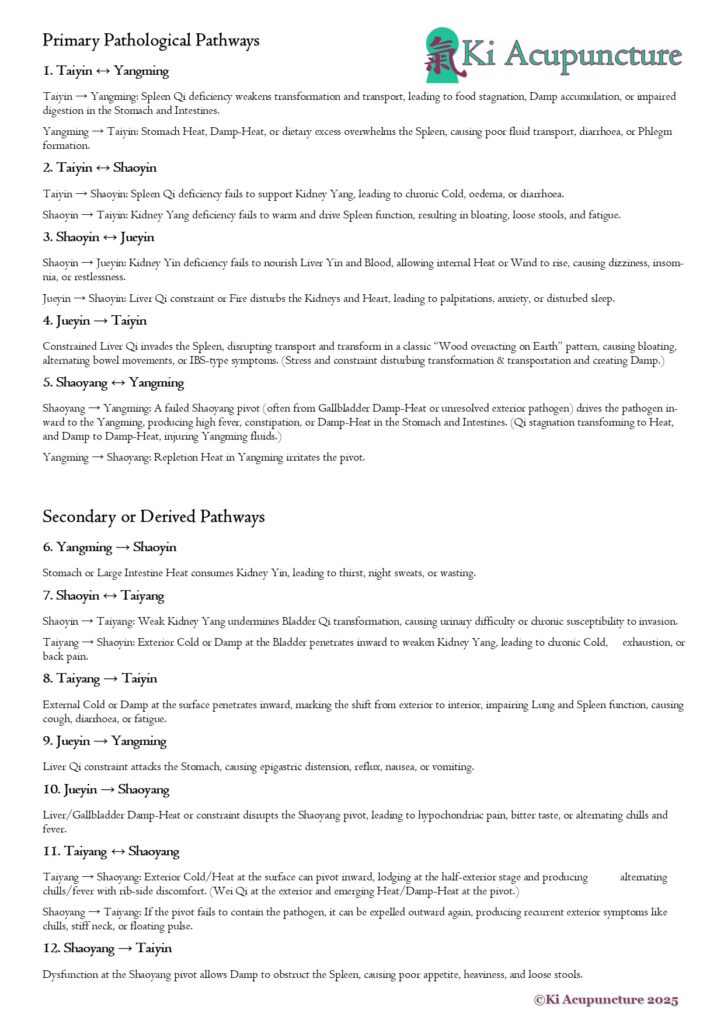
The arrows on the diagram represent how disharmonies move through the Six Divisions. Some are bidirectional, reflecting mutual influence, while others are one-way, reflecting a more common direction of progression. The burgundy arrows show primary pathways: routes most frequently seen in clinic, where dysfunction in one division predictably generates pathology in its partner.
For example, Tàiyīn (Spleen–Lung) weakness often leads to Damp encumbering Yángmíng (Stomach–Large Intestine), a classic Earth-to-Metal pattern. The pink arrows show secondary pathways: less direct but still clinically significant routes. An instance is Tàiyáng (Bladder–Small Intestine) Cold draining inward to Shàoyīn (Kidney–Heart), where it consumes Yang and drives the pathology deeper. Distinguishing primary from secondary, and recognising when influence is reciprocal or one-way, helps practitioners interpret both the usual trajectories of disease and the possible detours it may take when Zhèng Qì is weak or the pathogenic factor unusually strong.
It is worth pausing to explain why some connections are drawn as primary and others as secondary. The distinction is not imported wholesale from any single classical source; it reflects a synthesis of classical ideas, modern teaching, and clinical observation. The classical foundations here include the Huángdì Nèijīng Sùwèn and Língshū, which describe how the divisions govern Qi, Blood, fluids, and Zàng-Fǔ function. The sequential, vertical progression of Cold Damage described in the Shanghan Lun is represented separately in the diagram by the numbered brackets beneath each division, whereas the arrows show the lateral inter-relationships of pathology.
The primary arrows represent those relationships that form the backbone of pathology. They connect divisions that are functionally inseparable in physiology and that show up again and again in practice when illness develops. Examples include the mutual influence between Taiyin and Yangming in the transformation of qi and fluids, the link between Taiyin and Shaoyin in the cascade from digestive weakness into Kidney yang decline, the Shaoyin–Jueyin axis where blood, yin, and shen are intertwined, and the one-way impact of Jueyin on Taiyin that underlies Liver overacting on Spleen. These are relationships so fundamental that they can almost be considered archetypal. They are supported by classical descriptions, reinforced in modern teaching, and constantly encountered in clinic.
The secondary arrows represent connections that are entirely possible and often clinically relevant, but which are less universal. They may occur in particular contexts, or when specific triggers are present, such as stress, constitutional weakness, or damp accumulation. They often describe how pathology can spill over or complicate an existing condition rather than defining the central axis of disease.
This way of distinguishing primary and secondary routes is intended to give the framework both clarity and flexibility. The primary arrows highlight the deep structures of pathology that every practitioner meets repeatedly, while the secondary arrows remind us that illness rarely follows a single track. Together they create a map that is both faithful to the traditions and responsive to the realities of clinical practice.
Primary arrows:
- Taiyin ↔ Yangming: Spleen and Stomach mutually support and constrain; weakness in one affects the other.
- Taiyin ↔ Shaoyin: Earth and Water interdependence; Spleen Qi deficiency affecting Kidney Yang, or Kidney deficiency undermining Spleen.
- Shaoyin ↔ Jueyin: Heart and Liver Blood, Yin, and Fire interacting deeply.
- Jueyin → Taiyin: Liver Qi stagnation overacting on Spleen, leading to digestive symptoms.
- Shaoyang ↔ Yangming: unresolved Shaoyang disorders turning to Yangming Heat, or Yangming excess disturbing Shaoyang pivot.
Secondary arrows:
- Yangming → Shaoyin: Stomach Heat consuming Yin, drawing on Kidney fluids.
- Shaoyin ↔ Taiyang: Kidney deficiency leading to Bladder dysfunction, or Bladder disorders straining Kidney.
- Taiyang → Taiyin: exterior Cold sinking inward to Spleen.
- Jueyin → Yangming: Liver Qi constraint transmitting to Stomach, causing reflux or nausea.
- Jueyin → Shaoyang: Liver overacting on Gall Bladder, rib-side pain.
- Taiyang ↔ Shaoyang: Exterior Cold/Heat pivoting inwards, or being expelled outward again.
- Shaoyang → Taiyin: Gall Bladder/Sanjiao dysfunction impairing Spleen transformation.
Clinical example:
A patient with fatigue, loose stools, and poor appetite may show a Tàiyīn (Spleen) pattern. If uncorrected, damp accumulation and weak transformation of fluids can sink into the lower body, leading to urinary difficulty or oedema, a Tàiyīn → Shàoyīn arrow.
Why the arrows matter:
They illustrate not only how illness may progress but also how treatment can be shaped. In this case, failure of Spleen Qì to transform fluids leaves Damp obstructing, which taxes the Kidneys and their role in regulating water metabolism. Supporting the Spleen to move and refine, while simultaneously warming and strengthening Shàoyīn (Kidney) function, addresses both the immediate stagnation and the deeper weakness. This reflects the holistic nature of Chinese medicine: treatment often balances two divisions at once, harmonising Qì, Blood, and fluids to prevent further progression while easing present symptoms.
Cross-Checking the Arrows
The pathways shown between the Six Divisions reflect classical principles that appear again in other frameworks of Chinese medicine. By viewing them through both the Zàng–Fǔ axes and the cycles of the Five Phases, their coherence becomes clearer.
Core Zàng–Fǔ Axes
• Heart–Kidney (Fire–Water): contained within Shàoyīn. Their balance is central, and disturbance here often extends outward via the Shàoyīn ↔ Juéyīn and Shàoyīn ↔ Tàiyīn routes.
• Spleen–Liver (Earth–Wood): expressed by the Juéyīn → Tàiyīn arrow, showing Liver Qì pressing on Spleen digestion in the overacting dynamic.
• Lung–Liver (Metal–Wood): reflected around Tàiyīn and Juéyīn, since Lung belongs to Tàiyīn. This axis shows the tension between restraint and movement, often manifesting as alternating constraint and release.
• Spleen–Kidney (Earth–Water): represented by Tàiyīn ↔ Shàoyīn, showing how fluid metabolism rests on both transformation and storage.
• Lung–Kidney (Metal–Water): also carried by Tàiyīn ↔ Shàoyīn, through the dynamic of Lung descent and Kidney grasp.
Five Phase Correspondences
• Wood generating and overacting on Earth: the Juéyīn → Tàiyīn pathway shows both nourishment and strain.
• Water controlling Fire: the Shàoyīn axis keeps Heart Fire and Kidney Water in mutual check.
• Metal controlling Wood: the restraining dynamic between Lung (Metal, in Tàiyīn) and Liver (Wood, in Juéyīn) is represented at their shared interface, where the moderating influence of Metal on Wood helps regulate emotional and Qi movement balance (although the specific direction of pathology is not depicted – see below*). This reflects how Metal’s downward and inward movement moderates Wood’s outward expansion, maintaining balance between control and expression.
• Earth generating Metal: the Spleen’s support of Lung function appears in Tàiyīn links with Yángmíng.
*It is also worth noting that not every theoretical relationship between organs is shown. The Five Phases (Wǔxíng) describe cycles of generation and control that operate continuously in physiology, but many of these are functional rather than inherently pathological.
For example, Metal’s restraint on Wood represents the normal balance between Lung and Liver, preventing excessive upward movement of Qì. Yet if that restraint becomes too forceful or too weak, the same relationship can produce irritability, mood disturbance, or constraint of the chest and flanks.
Similarly, Yangming can insult Jueyin (such as Stomach or Large Intestine Fire, Heat, or Rebellion aggravating Liver Qi and Blood or drying fluids), reversing the usual dynamic, but again this relationship is implied rather than directly represented as it is clinically less common. Liver attacking Stomach is a much more common dynamic.
In this diagram, only the broader and recurring pathological routes of movement between the Six Divisions are shown. The ongoing regulatory cycles of the Five Phases remain implicit: they form the background order that sustains physiological harmony.
Within-Division Organ Relationships
The Six Divisions describe channels in pairs of the same polarity: yin with yin, yang with yang. So far we have looked at pathways between divisions, but within each pairing there are also some important physiological links and potential pathological tensions. These internal connections enrich the way we read patterns through the Divisions.
Taiyin (Lung and Spleen)
• The Spleen transforms food and fluids, sending pure essence upward. The Lung disperses and regulates this Qi through the body.
• When the Spleen fails, Damp and Phlegm accumulate, clogging the Lung and leading to cough, breathlessness, or heaviness.
Shaoyin (Heart and Kidney)
• The Heart governs Fire and Spirit, the Kidney governs Water and Essence. Healthy function depends on their communication: Fire descending, Water ascending.
• Disharmony produces anxiety, insomnia, palpitations, night sweats, or oedema. This “water–fire miscommunication” is a central axis of many chronic conditions.
Jueyin (Liver and Pericardium)
• The Liver stores Blood and ensures free movement of Qi. The Pericardium protects the Heart and anchors Shen.
• If Liver Qi stagnates or Blood is deficient, the Pericardium is easily disturbed, producing palpitations, emotional volatility, or menstrual irregularity.
Yangming (Stomach and Large Intestine)
• Both organs manage transformation of food and fluids. Their Yang nature makes them prone to Heat.
• Excess Heat may cause foul breath, toothache, abdominal pain, constipation, or bleeding from the bowels. Damp-Heat in this pair is a frequent clinical pattern.
Shaoyang (Gallbladder and Triple Burner)
• Shaoyang is the body’s pivot. The Gallbladder contributes decisiveness and stores bile; the Triple Burner harmonises water pathways and distributes Yuan Qi.
• Blockage here creates alternating chills and fever, rib-side fullness, bitter taste, ear disorders, or irregular fluid distribution. Damp-Heat in the Gall Bladder is associated with bile rather than the digestive and intestinal Damp-Heat of Yangming.
Taiyang (Small Intestine and Bladder)
• Both protect the surface against invasion and manage separation of clear from turbid fluids. The Bladder regulates water excretion, while the Small Intestine sorts pure from impure.
• Wind-Cold often enters first through Taiyang, producing stiff neck, occipital headache, fever and chills, as well as urinary difficulty or painful urination.
Zàngfŭ Functions in Context
It is helpful to pause here and recall the essential functions of the Zàngfǔ. These functions form the foundation of pattern identification: when one becomes deficient or overactive, the characteristic symptoms ripple through the system. Understanding them makes it easier to see how different combinations of imbalance give rise to clinical patterns and pathologies.
Functions of the Zàng (臟, Zàng – Yin Organs)
• Heart (Xīn, 心): governs Blood, houses the shén (spirit), maintains joy, opens to the tongue.
• Lung (Fèi, 肺): governs Qi and respiration, disperses and descends, regulates water, maintains connectedness, opens to the nose.
• Spleen (Pí, 脾): governs transformation and transportation, controls Blood, holds organs in place, maintains lightness, opens to the mouth.
• Liver (Gān, 肝): stores Blood, ensures smooth flow of Qi, capacity for control, houses the hún, opens to the eyes.
• Kidney (Shèn, 腎): stores jīng (essence), governs growth, reproduction, and bones, produces marrow to nourish the Sea of Marrow (Brain), houses the zhì (will), dominates water, is the root of Yin and Yang, warms via Mìngmén fire, dominates the Lower Jiāo, opens to the ears.
• Pericardium (Xīn Bāo, 心包): protects the Heart, governs the centre of the chest, influences circulation of Blood, relates to joy and emotional balance.
Functions of the Fǔ (腑, Fǔ – Yang Organs)
• Small Intestine (Xiǎo Cháng, 小腸): separates clear from turbid.
• Large Intestine (Dà Cháng, 大腸): governs transmission and excretion of waste.
• Stomach (Wèi, 胃): receives and ripens food and drink, origin of fluids.
• Gallbladder (Dǎn, 膽): stores and excretes bile, supports decision-making.
• Bladder (Páng Guāng, 膀胱): stores and excretes urine.
• Sanjiao (Sān Jiāo, 三焦): coordinates Qi and water pathways across the Upper, Middle, and Lower Burners.
Functions of the Extraordinary Fǔ (奇恒之腑, Qí Héng Zhī Fǔ)
• Brain (Nǎo, 腦): Sea of Marrow, governs memory and concentration.
• Marrow (Suǐ, 髓): fills Brain and spinal cord, nourishes bones.
• Bones (Gǔ, 骨): support structure, house Marrow.
• Vessels (Mài, 脈): circulate Blood and Qi.
• Gallbladder (Dǎn, 膽): classed as both fu and extraordinary fu because it stores a pure substance.
• Uterus (Zǐ Gōng, 子宮): governs menstruation, fertility, and reproduction.
General Aetiology of the Zang–Fu
In Chinese medicine, each organ system has characteristic vulnerabilities. These may come from lifestyle, emotions, diet, environment, or constitutional factors. Knowing these tendencies helps us understand not only how disease develops, but also how to prevent it.
Heart
• Emotional extremes, especially joy, shock, or prolonged anxiety
• Overwork or excessive mental activity
• Febrile or heat conditions that injure Heart yin
• Blood loss or deficiency affecting circulation and Shen
Lung
• Invasion by external pathogenic factors (wind, cold, heat, dryness)
• Grief, sadness, prolonged worry
• Overuse of the voice or poor breathing patterns
• Weakness of qi due to chronic illness or constitutional factors
Spleen
• Irregular diet: eating at odd times, excessive cold or raw food, greasy food
• Overthinking or excessive mental strain
• Dampness, either from environment or diet
• Blood loss leading to deficiency of Spleen qi
Stomach
• Diet in quantity and quality: overeating, poor food choices, irregular meals
• Conditions of eating: rushing, eating while stressed, eating late at night
• Emotional strain, especially worry or pensiveness, affecting appetite
• External pathogenic factors (cold, heat, damp) directly affecting the middle jiao
Liver
• Emotional strain, especially anger, frustration, resentment, depression
• Blood loss, leading to Liver blood deficiency
• Dietary excess of alcohol, rich, or greasy food
• External pathogenic factors (particularly wind or heat)
• Constrained lifestyle or lack of movement impairing qi flow
Kidneys
• Constitutional weakness, hereditary factors
• Ageing — natural decline of Kidney essence
• Overwork, lack of rest, chronic illness
• Excessive sexual activity
• Emotional strain, especially fear and insecurity
• Environmental cold or damp seeping into the lower jiao
Gallbladder
• Emotional strain, particularly timidity, indecision, or chronic anger
• Poor diet, especially greasy or fatty foods
• Damp-heat pathogens affecting bile flow
Bladder
• External damp-cold invasion
• Chronic Kidney weakness failing to support Bladder function
• Emotional strain, particularly fear
• Damp-heat from diet or environment
Small Intestine
• Heat pathogens (often from the Heart) disturbing separation of clear and turbid
• Excessive heat from diet or environment
• Emotional strain, especially anxiety or lack of discernment
Large Intestine
• Diet: insufficient fluids, excessive cold or drying foods, or overeating
• Emotional strain, especially worry, grief, or rigidity
• Heat or damp-heat pathogens
• Kidney yin or yang deficiency failing to moisten or warm the bowels
San Jiao
• External damp or heat affecting fluid pathways
• Emotional constraint, especially affecting circulation of qi
• Chronic illness disturbing fluid transformation and transport
From Framework to Patterns
The diagram does not directly name the classical patterns of disease, such as Liver Qi stagnation, Spleen Qi deficiency, or Yin deficiency with Heat. Instead, it provides the scaffolding from which those patterns are derived. Each pattern represents a convergence: a Zàng or Fǔ function gone awry, a fundamental substance or functional quality of Yīn–Yáng affected, or a pathogenic factor at work, whether as an external agent, an internal disturbance, or a deficiency creating vulnerability. The qualities of this imbalance can be further clarified through the Eight Principles, and the Six Divisions and other models like the Five Phases help situate these patterns in relation to one another, showing how imbalance in one sphere can spill into another.
For example:
- Spleen Qi deficiency reflects weakness of Taiyin. The Spleen fails to transform fluids, leading to Damp accumulation, which the diagram shows pooling in Taiyin’s zone.
- Liver Qi stagnation belongs largely to Jueyin. The Liver’s role in free coursing is blocked, creating constraint that can push into Taiyin (affecting digestion) or Yangming (generating Heat).
- Kidney Yin deficiency falls within Shaoyin. The depletion of Jing and Yin leaves Yang unchecked, which can be traced along the Water–Fire axis.
- Phlegm and Damp arise when transformations in Taiyin or Shaoyang are impaired, visible in their placement at the base of the circle and at the pivot.
In this way, the familiar textbook patterns are not separate from the Six Divisions but applications of them: concrete clusters of signs and symptoms named for teaching and clinical use, arising from the same network of relationships the diagram illustrates.
Functional Zàng-Fǔ Disharmonies
Not every relationship between the organs can be understood through the Six Divisions or Five Phase (Wǔxíng) models. These frameworks describe how movement and transformation occur through distinct layers or elemental cycles, but many interactions within the body arise instead from the functional interdependence of the Zàng-Fǔ themselves. The Zàng-Fǔ reflect living physiology: how each organ transforms, stores, and circulates substances in ways that sustain the whole system. Their disharmonies often develop through loss of support or nourishment rather than direct transmission of Qì or elemental control.
On the diagram, such relationships are not shown as arrows. They represent internal dependencies rather than movements between spheres: one organ failing to sustain another, rather than one disturbing or invading it.
A clear example is the relationship between the Spleen and the Liver. When the Spleen (Tàiyīn) is deficient, its ability to transform and generate Qì and Blood falters. The Liver (Juéyīn), which stores and regulates Blood, is then under-supplied. This gives rise to secondary Liver Blood or Yin deficiency. The pattern originates not from a channel movement or phase interaction, but from a breakdown in the body’s internal economy: the Spleen’s production failing to meet the Liver’s demand.
This distinction is important. In the Six Divisions, the arrow from Juéyīn → Tàiyīn shows Liver constraint pressing on Spleen digestion: an active, directional influence. The reverse situation—Spleen failing to nourish the Liver—does not involve any transmission of Qì or pathology, but rather a lack of nourishment. It is a functional dependency, not a channel pathway.
Nor does this belong to the Five Phase cycles. The Earth–Wood relationship within that model is one of control – Wood restrains Earth, or Earth insults Wood – not of generation. Spleen deficiency leading to Liver depletion is therefore not a reversal or overacting dynamic in the Five Phase sense. It is simply a reflection of shared physiology: the transformation of nutrients into Blood (Spleen) and the storage and regulation of that Blood (Liver).
A similar principle applies within Shàoyīn (Heart–Kidney) itself. When Kidney Yin is weak, it fails to anchor and cool Heart Fire, resulting in restlessness, insomnia, or anxiety. Again, this is not a reversal of the Water–Fire balance in the Five Phases, nor a Six Division transmission, but a functional shortfall occurring within a single Division: the lower source of Yin no longer supporting the upper aspect of Shen. These patterns illustrate how deficiency and interdependence within the Zàng-Fǔ can lead to disharmony even without movement along the usual channel or elemental routes.
Understanding these distinctions helps to clarify why certain arrows appear – or do not appear – on the diagram. The Six Divisions show the movement of imbalance; the Five Phases show cycles of control and support; the Zàng-Fǔ show the functional logic of the organs themselves. Some relationships, like the Spleen’s failure to nourish the Liver or the Kidney’s failure to anchor Heart Fire, exist only within this latter framework: they describe how physiology weakens, not how pathology moves.
These functional relationships form the inner network of supportive balance that maintains harmony between the divisions. They form a complex web of interdependence, describing failures of function, control, harmonisation, or nourishment – whether through the fundamental substances or direct organ relationships. Attempting to include them all would create a bloated, unreadable diagram. They are best understood through a reasoned, and ultimately intuitive, grasp of Zàng-Fǔ functions and their mutual support. Here are the most clinically encountered examples:
Spleen-centred
• Spleen failing to nourish Liver – deficiency of Qi or Blood leading to secondary Liver Blood or Yin deficiency.
• Spleen failing to control Blood – Blood leakage (bruising, menorrhagia, prolapse) through weak transformation and holding function.
• Spleen failing to raise clear Yang – fatigue, diarrhoea, prolapse; affects postural tone and cognitive clarity.
• Spleen failing to assist Lung in fluid distribution – oedema or Damp accumulation in upper body.
• Spleen failing to nourish Heart – insufficient Blood production causing palpitations, insomnia, anxiety.
Stomach-centred
• Stomach Yin deficiency – chronic dryness, thirst, or poor digestion without Heat; may affect Heart or Kidney through lack of fluids.
• Stomach failing to harmonise with Spleen – poor appetite, bloating, heaviness; often due to cold or dietary strain.
Liver-centred
• Liver failing to store Blood – menstrual irregularity, dizziness, muscle spasm, numbness.
• Liver failing to nourish Heart – emotional volatility, dream-disturbed sleep, anxiety; often follows Blood deficiency.
• Liver failing to ensure smooth Qi flow – mechanical and emotional stagnation affecting digestion, chest, or menses.
• Liver Qi constraint affecting Stomach or Spleen – disrupts middle burner, producing nausea, bloating, alternating constipation and diarrhoea. (This one sits on the border between functional and Six Division transmission.)
• Liver and Gallbladder failing to coordinate – timidity, indecision, poor judgment, hypochondriac tension.
Heart-centred
• Heart failing to govern Blood – palpitations, poor memory, pale complexion; due to Qi deficiency or emotional exhaustion.
• Heart failing to house Shen – insomnia, restlessness, emotional fragility.
• Heart and Spleen failing to interact – weak Blood production and mental overactivity, causing palpitations, insomnia, poor concentration.
• Heart and Kidney miscommunication – Yin–Yang imbalance within Shaoyin: anxiety, night sweats, palpitations, insomnia.
• Heart and Lung Qi disharmony – breathlessness, chest oppression, weak voice; especially post-illness or grief.
Lung-centred
• Lung failing to descend fluids to Kidney and Bladder – upper oedema, cough with thin phlegm.
• Lung failing to diffuse Wei Qi – vulnerability to colds, spontaneous sweating, fatigue.
• Lung and Spleen failing to coordinate – chronic tiredness, weak digestion, shortness of breath, phlegm.
• Lung and Large Intestine failing to link – skin dryness or constipation due to disrupted descending function.
Kidney-centred
• Kidney Yin failing to nourish Liver and Heart – irritability, insomnia, tinnitus, dryness, or tremor.
• Kidney Yang failing to warm Spleen and Bladder – cold limbs, oedema, diarrhoea, incontinence.
• Kidney failing to grasp Lung Qi – shortness of breath on exertion, asthma, chronic cough.
• Kidney failing to consolidate Essence – reproductive weakness, premature ageing, weak bones or teeth.
• Kidney and Spleen Yang deficiency – cold, diarrhoea, fatigue; chronic depletion of post- and pre-natal Qi.
• Kidney and Liver Yin deficiency – blurred vision, tremor, insomnia, dryness; systemic Yin depletion.
Other integrative or paired functional patterns
• Pericardium failing to protect Heart – emotional vulnerability, chest tightness, easy agitation.
• Gallbladder failing to assist Liver Qi flow – hesitation, fearfulness, alternating Heat/Cold in Shaoyang.
• Bladder failing to transform Qi – dribbling, urgency, or retention without obvious obstruction.
• San Jiao Qi disharmony – imbalance in fluid distribution between upper/middle/lower burners.
Key distinctions
• These relationships express functional physiology, not directional pathology.
• They arise when an organ’s generative or regulatory role weakens, not when one invades another.
• They can coexist with Six Division or Five Phase interactions but operate on a different plane: the coordination of functions, not the movement of disturbance.
Understanding both the pathways between Divisions and Phases, and the Zangfu relationships within them, lays the groundwork for diagnosis, where theory meets the lived presentation of the patient…
Diagnosis

Diagnosis in Chinese medicine does not rely on a single sign or symptom. Patterns are deduced through a combination of observation, questioning, listening, and palpation. The diagram shows the frameworks, but to apply them we must engage with the patient directly.
The Four Examinations (Sì Zhěn 四诊)
- Looking (Wàng): facial colour, eyes, posture, tongue, skin tone, visible Shen.
- Listening and Smelling (Wén): voice, breathing, cough, odours.
- Asking (Wèn): history, sensations, lifestyle, sleep, diet, emotions.
- Palpating (Qiè): pulse, abdomen (Hara), channels, areas of tension or cold.
Each method gives a different perspective, and the pattern emerges when they are considered together.
Observation (望 wàng)
Observation encompasses looking, listening, and smelling. It includes the patient’s overall appearance, complexion, posture, gait, voice, respiration (quality of breathing), and odour. The tongue is central, reflecting the state of Qi, Blood, fluids, and organs. Eyes reveal Shen, body shape and facial structure reveal constitutional tendencies, skin may show colour or texture changes that reflect patterns of disharmony, and body movement or bearing can also indicate underlying characteristics. Observation sets the stage before any words are spoken.
Facial regions and organ reflections (Mian Xiang):
(Examining shape, texture, and firmness)
• Forehead: Heart & circulation/mental activity
• Nose, mouth & lips: Spleen & digestion
• Left cheek: Liver & constitution/emotional state
• Right cheek: Lung & vitality/immune strength
• Chin: Kidney & reproductive/urogenital system
Complexion:
• Bright and moist: healthy Qi and Blood
• Pale: deficiency of Qi, Blood, or Yang
• Red: Heat (excess or deficiency)
• Yellow: Damp or Spleen dysfunction
• Dark or purple: stasis, Cold, or severe disorder
Body shape and constitution:
• Thin, wiry build: more prone to Liver disharmonies
• Full, soft build: tendency to Damp or Spleen deficiency
• Tall and lean: often associated with Yin deficiency
• Rounded face and body: Earth constitution
• Angular or sinewy: Wood constitution
Posture and gait:
• Upright, steady gait: sufficient Qi
• Slumped or lethargic: deficiency or Damp obstruction
• Restless or fidgeting: internal Heat or agitation
• Slow, heavy movement: Cold or Damp predominance
Skin and hair:
• Lustrous and hydrated: adequate Blood and fluids
• Dry, brittle, scaly: Blood or Yin deficiency
• Oily, greasy: Damp or Phlegm
• Loss of hair or premature greying: Kidney weakness or Blood deficiency
Eyes and Shen:
• Clear, bright, alert: strong Shen and adequate Essence
• Dull, lifeless, clouded: weakness of Shen or exhaustion of Qi and Blood
• Red or bloodshot: Heat, often affecting Heart or Liver
Voice and speech:
• Strong, resonant: sufficient Lung Qi and Shen
• Weak, low, hesitant: Qi deficiency or lack of Shen
• Rapid, loud: excess Heat or Yang
• Slurred or unclear: Phlegm misting the Heart orifices
Respiration:
• Smooth, even: healthy Lung Qi and Kidney support
• Short, shallow: Lung Qi deficiency
• Laboured, noisy: Phlegm or Heat obstructing
• Weak, quiet: severe deficiency of Qi or Yang
Odour:
• Absence of foul smell: generally healthy
• Strong, unpleasant, or fetid odour: Heat, Damp, or putrefaction
• Absence of odour in severe disease: Yang collapse or extreme deficiency
Asking (问 wèn)
Questioning builds on observation to refine diagnosis. Common areas of inquiry include:
• Sleep (quality, dreams, waking, difficulty falling or staying asleep). Difficulty falling asleep: Blood Xu; frequent waking: Yin Xu; early waking: Gallbladder timidity; dream-disturbed: Blood Xu, Fire, or food retention.
• Energy levels and fluctuations, fatigue, and clarity of mind (concentration, memory, and acuity).
• Pain: site, onset, duration, severity, character, change over time, and referral.
• Dizziness (severity and triggers), headaches (location, frequency, character), and sensory function (vision, hearing, smell, taste, throat). Tinnitus: sudden onset – full condition; gradual onset – empty condition; high-pitched: Liver disharmony; low-pitched: Kidney disharmony. Eyes: dryness/pressure – Yin Xu; floaters – Blood/Yin Xu; redness – Wind-Heat or Fire.
• Chest: breathing, coughing, oppression, and palpitations.
• Temperature, cold extremities (Blood Xu, Yang Xu, or Qi stagnation), chills, fever, and thirst (for hot/cold).
• Skin changes and sweating (spontaneous/oily – Yang Xu, night sweats – Yin Xu, absence of sweat – exterior Cold or Yang/fluid deficiency); dryness, rashes, itching, and numbness.
• Appetite, digestion (bloating, reflux, nausea), stool (frequency, form, colour, odour, ease of passage), and urination (frequency, colour, ease).
• Sexual function, libido, and reproductive health.
• Menstrual cycle: flow, pain, clotting, timing, regularity, PMS.
• Fertility, pregnancy, childbirth and miscarriage, postpartum recovery, and menopause (hot flushes, mood, sleep).
• Medical history: previous illnesses, injuries, operations, hospitalisations, or chronic conditions that may shape current health, along with raising any cautions or contraindications to treatment.
• Medication: prescription drugs, over-the-counter remedies, alcohol, recreational drugs, supplements, or herbs that may mask, mimic, or alter patterns.
• Emotional state, resilience, and stress.
• Lifestyle: physical activity, rest, diet. Food is considered through its energetic qualities of temperature and taste, and how these may contribute to patterns of disharmony.
The answers are interpreted within the framework of patterns, linking symptoms into a coherent picture rather than isolating them as individual complaints.
Tongue Diagnosis
The tongue is a visible mirror of the internal state and a cornerstone of observational diagnosis. It is divided into regions that correspond to the internal organs. The tip reflects the Heart and, just behind it, the Lung. The centre of the tongue corresponds to the Spleen and Stomach, with the Spleen more to the left and the Stomach to the right in some traditions. The sides reflect the Liver and Gall Bladder, while the root shows the Kidneys, Bladder, and Intestines. This distribution allows the practitioner to localise imbalance: for example, a red tip may suggest Heart Fire, a swollen centre Spleen deficiency with damp, or a pale root Kidney Yang deficiency.
- Colour: pale (deficiency, cold), red (heat), purple (stasis), red tip (Heart Fire).
- Shape: thin (Yin or Blood deficiency), swollen (damp, Spleen Qi deficiency), stiff (heat or stasis).
- Coating: thick (damp, food retention, phlegm), thin (deficiency), greasy (phlegm-damp), peeled (Yin deficiency).
- Moisture: wet (Cold or Damp), dry (Heat damaging fluids), cracks (Yin deficiency or constitutional patterns, interpreted according to location).
- Spirit (Shén, 神): a tongue with vitality is bright, moist, and lively; a tongue lacking spirit is dull, dry, or lifeless, reflecting depletion of Qi, Blood, or Yin.
- Movement: trembling (Qi or Yang deficiency, interior Wind), quivering (Spleen Qi deficiency, shock), deviated (Wind, often with stroke), flaccid (severe deficiency of Qi and Blood), rigid (extreme Heat or internal Wind).
Examples linked to divisions:
- Tàiyáng Invasion: normal or slightly pale body, thin white coat (may be moist).
- Tàiyīn Damp: pale body with teeth marks, moist or greasy white coat.
- Yángmíng Heat: red body, thick yellow coat (often dry).
- Shàoyáng: unilateral or alternating yellow/white coat, especially on the sides.
- Shàoyīn Deficiency: pale, swollen body with white coat (Yang vacuity), or red body with peeled coat (Yin vacuity).
- Juéyīn Heat: red body with thin yellow coat, edges often more pronounced.
Pulse Diagnosis
Whereas the tongue mirrors longer-standing patterns, the radial pulse can reveal the body’s present state of imbalance. Pulse qualities reflect Qi, Blood, and organ states. Each pulse position corresponds to specific organs, assessed at two depths. On the left wrist, cun reflects the Heart and Small Intestine, guan the Liver and Gall Bladder, chi the Kidney (Yin) – or Pericardium in some Japanese traditions. On the right wrist, cun reflects the Lung and Large Intestine, guan the Spleen and Stomach, chi the Kidney (Yang), or Mingmen Fire. The superficial level shows the state of Qi and the exterior, while the deeper level reveals Blood, Yin, and the Zang. Reading both position and depth together allows the practitioner to link pulse findings directly with organ function and fundamental substances.
• Depth: floating (exterior), deep (interior).
• Strength: strong (excess), weak (deficiency).
• Rate: slow (Cold), rapid (Heat).
• Quality:
• Wiry = Liver constraint, pain, malaria, interior Wind.
• Slippery = Phlegm, Damp, food stagnation, pregnancy.
• Choppy = Blood stasis, Blood deficiency.
• Thin = Blood or Yin deficiency.
• Surging = Yangming Heat.
• Soggy = Damp, Qi deficiency.
• Faint/Minute = collapse of Qi, severe deficiency.
Classical texts describe 28 pulse qualities, but in practice students will usually start with a smaller core set. These include floating, deep, rapid, slow, slippery, choppy, wiry, tight, full, and empty. Each gives insight into the balance of Qi, Blood, Yin, and Yang, as well as the presence of pathogenic factors like heat, cold, or damp. Learning to distinguish them is less about memorisation and more about cultivating sensitivity through repeated practice. Depth, strength, and rate are sufficient to gain a good insight into a patient’s health, along with assessing the primary deficiency and excess.
Seen through the Six Divisions, the pulse positions echo the classical pairings. For example, a floating pulse at the right cun may indicate a Taiyang invasion affecting the Lung, while a wiry left guan often reflects Jueyin or Shaoyang involvement through the Liver. The chi positions, read deeply, are key for identifying Shaoyin weakness in the Kidneys. In this way the pulse becomes not only a measure of strength and depth, but also a map that links directly into the divisions themselves.
Examples linked to divisions:
• Taiyang invasion: floating.
• Yangming Heat: big, surging.
• Shaoyang: wiry.
• Taiyin: weak, soggy.
• Shaoyin Yang deficiency: deep, faint.
• Jueyin: wiry, thin.
You can find a full list of the 28 classical pulses, arranged in their eight traditional diagnostic groupings (Bā Gāng Mài), in the appendices to this article.
Hara Diagnosis
The abdomen reflects the state of the organs. Japanese-style Hara diagnosis maps zones to Zangfu.
- Epigastrium: Stomach and Yangming.
- Upper abdomen: Spleen and Taiyin.
- Below umbilicus: Kidney and Shaoyin.
- Hypochondrium: Liver and Jueyin.
- Chest and diaphragm: Lung and Pericardium.
Tenderness, tension, or emptiness in these zones support differentiation. A soft, empty lower abdomen may suggest Kidney deficiency. Tension in the hypochondrium may suggest Liver Qi constraint.
Channel Palpation
Palpation of the channels is an often underemphasised but highly revealing diagnostic method. Running the hands along the trajectory of a meridian may uncover nodules, tenderness, depressions, or areas of tightness and cold. These findings can signal excess, deficiency, stagnation, or obstruction within the channel, and by extension, the Zàng or Fǔ associated with it.
In clinical practice, palpation helps confirm or refine pattern differentiation. A patient with digestive complaints may show epigastric hardness along the Stomach channel or softness along the Spleen; someone with respiratory issues may present tenderness along the Lung or Large Intestine pathways. Channel findings can also point towards latent conditions: sensitivity at a Luò-connecting point may reveal early imbalance before symptoms manifest. Mu (Front Alarm) points often show acute or surface-accessible organ disharmony, while Shu (Back Transporting) points tend to reflect deeper or chronic burdens. Xi-cleft points, where Qi and Blood gather, can be tender in acute disorders or when blood pathology is present.
Therapeutically, palpation guides point selection and technique. Areas of hardness may call for dispersing, areas of emptiness for tonifying, and regions of heat or sensitivity for harmonising. Combined with pulse, tongue, and Hara findings, palpation of the channels provides a tactile, immediate picture of Qi and Blood in motion, linking theory directly to the body under the practitioner’s hands.
Common palpatory findings:
• Tight: Cold
• Spongy: Damp
• Wiry: constraint or stagnation
• Nodular: Phlegm or congealed stasis
• Tender: latent pathogenic factor or active channel involvement
• Empty or hollow: deficiency
Clinical Example: Channel Palpation in Practice
A patient presents with alternating constipation and diarrhoea, bloating, and stress-related tension. On palpation, the Stomach channel along the shin feels tight and resistant, while the Spleen channel along the medial leg is soft and empty. The pulse is wiry, and the tongue shows teeth marks with a redder edge.
These findings confirm a mixed pattern: constraint of Liver Qi overacting on Spleen, with secondary Stomach excess. Treatment focuses on soothing the Liver, supporting the Spleen, and harmonising the Middle Jiao. Palpation not only supports the diagnosis but also highlights the immediate channel imbalances, guiding point selection towards LV3, SP6, and ST36, with additional regulation through PC6.
Differential Diagnosis
When many signs point in different directions, how do we decide which pattern lies at the root? Symptoms often overlap across patterns. The art of diagnosis is to weigh contradictions and identify the dominant dynamic.
- Ben and Biao (Root and Branch): diagnosis weighs what is primary and what is secondary. Addressing the root ensures treatment has depth and lasting effect, yet at times the branch must be treated first to relieve symptoms or create the conditions for deeper change.
- Key aetiologies:
• Emotions: anxiety → Heart, irritability → Liver, pensiveness → Spleen, grief → Lung, fear → Kidney.
• Climate: cold invasion, damp weather, dry autumn air.
• Lifestyle: overwork, irregular diet, trauma, environment.
- Pattern clues:
• Fatigue and brain fog → Spleen deficiency (Taiyin).
• Anxiety and palpitations → Heart and Shaoyin.
• Stress and inflexibility → Liver and Jueyin.
• Constipation, foul breath → Stomach heat (Yangming).
• Cold limbs and lassitude → Kidney Yang deficiency (Shaoyin).
The decision is reached by triangulating tongue, pulse, Hara, symptoms, and the likely pathological pathways illustrated by the diagram.
Selecting Concise and Elegant Point Prescriptions
Point selection is most effective when it is minimal and coherent. A small number of well-chosen points will always achieve more than a long list aimed at covering every symptom and without a clear overarching rationale. The diagram supports this by showing how divisions, substances, and pathogenic factors relate, but the choice of points comes from applying the strategies below.
We may select distal, adjacent, local, or ashi points (painful or trigger points) according to the needs of the pattern, as well as considering Ben and Biao (Root and Branch). It is crucial to avoid opening too many channels, or the treatment becomes diluted and fails to provide a clear message to the nervous system. Needling no more than two or three primary channels, supported by Ren or Du points if appropriate, is a good rule of thumb. A prescription is like a short poem: few words, carefully chosen, with the power to move deeply.
All of the classical approaches to point selection can be understood as ways of categorising points. Some are based on the channel pathway (Shu-Transporting, Yuan–Luo), others on anatomical mapping (Back-Shu, Front-Mu, holographic systems), others on cosmological principles (Five Phases, Extraordinary Vessels), and some on special clinical functions (Xi-Cleft, Hui-Meeting, Window of Heaven).
Another classical method is to needle unilaterally according to gender. Yin points are taken on the right for women and Yang points on the left, while for men Yin points are taken on the left and Yang points on the right. This approach reflects the resonance of Yin and Yang within the body and can make treatments more precise while keeping prescriptions concise.
Shu-Transporting Points
The Five Shu-Transporting points (Jing-Well, Ying-Spring, Shu-Stream, Jing-River, and He-Sea) are important because they describe how Qì moves through the channels from the surface toward the interior, linking the extremities with the organs.
Each category marks a different depth and dynamic of Qì transformation, allowing the practitioner to select points according to the stage or nature of disease: Wells for acute or surface conditions, Springs for clearing Heat, Streams for disorders of heaviness or joints, Rivers for changes in voice and sinews, and Seas for internal or organ-level disharmony.
Each channel has five points between the fingers or toes and the elbows or knees: Jing-Well, Ying-Spring, Shu-Stream, Jing-River, and He-Sea.
- Jing-Well: acute conditions, clearing heat, restoring consciousness.
- Ying-Spring: febrile diseases, clearing heat, regulating complexion.
- Shu-Stream: heaviness, pain, disorders of Zang.
- Jing-River: cough, asthma, voice disorders.
- He-Sea: digestive illness, counterflow, disorders of Fu.
Example: ST36 (He-Sea of Stomach) regulates the middle and tonifies Qi; LU9 (Shu-Stream point of the Lung) tonifies Lung qi and yin, transforms Phlegm, and regulates the vessels.
- In the Yin channels, the Yuan-Source points and Shu-Stream points overlap. For example, SP 3 (Taibai) is both the Shu-Stream and the Yuan-Source point of the Spleen channel.
- In the Yang channels, the Yuan-Source point is distinct, and it is always located one point proximal to the Shu-Stream point. For example, on the Small Intestine channel, SI 4 (Wangu) is the Yuan-Source point, while SI 3 (Houxi) is the Shu-Stream point.
Yuan–Luo Pairing
Each channel has a Yuan-Source point and a Luo-Connecting point. Yuán-Source points connect directly with the body’s Original Qì (Yuán Qì), the deep motive force that sustains all physiological activity.
Each Zàng’s Yuán point can be used to tonify or regulate its core function, while the Fǔ Yuán points help to clear stagnation or excess along their channels. They are especially valuable for restoring balance at the constitutional level, supporting both diagnosis and treatment by revealing and regulating the strength of the organ’s innate vitality.
The Luo are like canals connecting the primary channel rivers. Used together, Yuan-Source and Luo-Conncting points harmonise interior–exterior relationships.
- Yuán-source points (Yuánxué 原穴) are the sites on each channel where the body’s Original Qi (Yuán Qì) surfaces and communicates with the organ, making them key for regulating the Zàng-fǔ at a fundamental level.
- Luò-connecting points (Luòxué 絡穴) are where each channel sends a branch to link with its paired Yin–Yang partner, making them important for balancing relationships between channels and treating disorders that cross those pairings.
- Combining Yuan of one channel with Luo of its pair (host-guest combination) strengthens communication and treats imbalances affecting both.
Example: LU9 (Yuan-Source of Lung) with LI6 (Luo-Connecting of Large Intestine) regulates upper body fluids and opens the Lung–Large Intestine pair. LI4 (Yuan-Source of Large Intestine) releases the exterior and moves Qi.
Back-Shu and Front-Mu Points
Back-Shu points on the Bladder channel correspond to each Zangfu. Front-Mu points are located on the chest and abdomen. Both can be tender if there is disharmony in the related organ. Together they provide a powerful way to access organs directly.
- Back-Shu points are often used for chronic or deficiency conditions.
- Front-Mu (“alarm”) points are used for acute or excess presentations.
Back-Shū and Outer Back-Shū Points
The points marked in bold are the classical Back-Shū points, each corresponding to a Zàng or Fǔ organ. The remaining entries belong to the Bladder channel and are included as useful anatomical references, showing neighbouring or associated points that help locate the Back-Shū line according to their associated spinal vertebra and offer additional clinical context.
· T1: BL11 Dàzhù (Influential of Bones)
· T2: BL12 Fēngmén (Wind Gate) • BL41 Fùfēn
· T3: BL13 Fèishū (Lung) • BL42 Pòhù (Door of the Corporeal Soul)
· T4: BL14 Juéyīnshū (Pericardium) • BL43 Gāohuāngshū (Vital Region)
· T5: BL15 Xīnshū (Heart) • BL44 Shéntáng (Hall of the Spirit)
· T6: BL16 Dūshū (Governor) • BL45 Yìxī
· T7: BL17 Géshū (Diaphragm & Influential of Blood) • BL46 Géguān
· T8: —
· T9: BL18 Gānshū (Liver) • BL47 Húnmén (Gate of the Ethereal Soul)
· T10: BL19 Dǎnshū (Gall Bladder) • BL48 Yánggāng
· T11: BL20 Píshū (Spleen) • BL49 Yìshè (Abode of Thought)
· T12: BL21 Wèishū (Stomach) • BL50 Wèicāng (Stomach Granary)
· L1: BL22 Sānjiāoshū (Triple Burner) • BL51 Huángmén (Vitals Gate)
· L2: BL23 Shènshū (Kidney) • BL52 Zhìshì (Residence of the Will)
· L3: BL24 Qìhǎishū (Sea of Qi)
· L4: BL25 Dàchángshū (Large Intestine)
· L5: BL26 Guānyuánshū (Gate of Origin)
· S1: BL27 Xiǎochángshū (Small Intestine)
· S2: BL28 Pángguāngshū (Bladder)
· S3: BL29 Zhōnglǔshū (Mid-Spine)
· S4: BL30 Báihuánshū (White Ring)
(BL31 – BL34 relate to the four sacral foramina; BL35 is level with the tip of the coccyx.)
• Light palpation assesses superficial tone, temperature, and tenderness: often reveals acute or Qi-level imbalance.
• Heavy palpation explores for nodules, fullness, or dullness beneath the muscle layer: these may indicate chronic or deeper organ disturbance.
Front-Mù (Alarm) Points
• LU 1 Zhōngfǔ (Middle Palace) – Front-Mù of the Lung
• Rèn 17 Shānzhōng (Chest Centre) – Front-Mù of the Pericardium
• Rèn 14 Juéquè (Great Gateway) – Front-Mù of the Heart
• Rèn 12 Zhōngwǎn (Middle Cavity) – Front-Mù of the Stomach
• Rèn 5 Shímén (Stone Gate) – Front-Mù of the Sanjiao (Triple Burner)
• Rèn 4 Guānyuán (Gate of Origin) – Front-Mù of the Small Intestine
• GB 24 Rìyuè (Sun and Moon) – Front-Mù of the Gallbladder
• LV 14 Qímén (Cycle Gate) – Front-Mù of the Liver
• GB 25 Jīngmén (Capital Gate) – Front-Mù of the Kidney
• ST 25 Tiānshū (Heaven’s Pivot) – Front-Mù of the Large Intestine
• LV 13 Zhāngmén (Screen Gate) – Front-Mù of the Spleen
• Rèn 3 Zhōngjí (Central Pole) – Front-Mù of the Bladder
• Light palpation assesses superficial tension and sensitivity. Tenderness to gentle touch often indicates excess or repletion patterns, such as Qi stagnation or Heat accumulation in that organ.
• Heavy palpation explores the deeper layers. A dull or empty sensation under firm pressure often points to deficiency or vacuity, such as depleted Qi, Blood, or Yin within the related organ system.
Five Phase Point Use
Each channel has points corresponding to the Five Phases. Tonification and sedation can be applied according to mother–child or controlling cycle rules.
- Tonify the mother phase point if the organ is deficient.
- Reduce the child phase point if the organ is in excess.
Example: For Spleen deficiency, tonify the Wood point on the Spleen channel (SP1). For Liver excess, reduce the Fire point (LV2).
Balance, Mirroring, and Holographic Systems
Point selection may also follow structural logic: treating upper for lower, left for right, or distal points reflecting whole-body regions.
- Distal points on hands and feet can treat the head and trunk.
- Mirroring (as in Tan, Tung, and Yijing balance methods) is used to select points opposite the affected area. Points may be ipsilateral or contralateral, selected by Ashi response, and by various relationships: Six Division pairs, Biao Li (Yin/Yang interior/exterior pairs), Yin/Yang Six Division pairs, Bie Tong (branching & connecting channels), Bie Jing (clock opposites), or Yin-Yin neighbours.
- Holographic systems (ear, scalp, hand, abdomen) provide microcosmic maps of the body.
Extraordinary Vessel Strategies
The Eight Extraordinary Vessels are accessed through master–coupled point combinations.
- Ren Mai: LU7 + KI6.
- Du Mai: SI3 + BL62.
- Chong Mai: SP4 + PC6.
- Dai Mai: GB41 + SJ5.
- Yin Qiao: KI6 + LU7.
- Yang Qiao: BL62 + SI3.
- Yin Wei: PC6 + SP4.
- Yang Wei: SJ5 + GB41.
These are used when conditions involve deep, systemic patterns such as fertility, constitutional weakness, or unresolved chronic illness:
1. Rèn Mài (Conception Vessel)
• Governs Yīn; connects all the Yīn channels.
• Nourishes Blood, Essence, and body fluids.
• Regulates menstruation, fertility, and pregnancy.
• Balances the front of the body and supports abdominal function.
• Commonly used in gynaecology, digestion, and disorders of Yīn deficiency.
2. Dū Mài (Governing Vessel)
• Governs Yáng; connects all the Yáng channels.
• Strengthens the spine, brain, and central nervous system.
• Regulates mental and emotional stability.
• Warms and mobilises Yáng Qì throughout the body.
• Used for back pain, spinal rigidity, neurological issues, and Yáng deficiency.
3. Chōng Mài (Penetrating Vessel)
• Known as the “Sea of Blood.”
• Links the twelve primary channels and influences all the Zàng-Fǔ.
• Harmonises the Stomach and Intestines; connects Qì and Blood of the trunk and legs.
• Deeply involved in reproductive and menstrual function.
• Used for menstrual irregularity, abdominal fullness, counterflow Qì, and emotional surges.
4. Dài Mài (Girdling Vessel)
• Encircles the body like a belt, binding the vertical channels.
• Regulates balance between upper and lower body, interior and exterior.
• Controls the movement of Qì in the legs and genitals.
• Helps contain prolapse and leakage.
• Used for lower-body heaviness, genital discharge, lumbar weakness, and balance problems.
5. Yīn Qiāo Mài (Yin Motility Vessel)
• Regulates movement and tone of the Yīn aspect of the body, especially the lower limbs.
• Balances sleep and wakefulness (with Yang Qiao Mai).
• Draws Yīn fluids upward to the eyes.
• Used for sleep disorders (especially insomnia), tightness of the inner legs, and ocular problems.
6. Yáng Qiāo Mài (Yang Motility Vessel)
• Governs movement and tone of the Yáng aspect, especially outer legs.
• Brings Yáng to the head and eyes; influences alertness and activity.
• Balances right–left symmetry of the body.
• Used for muscular tension, eye disorders, insomnia, and motor imbalance.
7. Yīn Wéi Mài (Yin Linking Vessel)
• Connects and supports the Yīn channels internally.
• Regulates the Heart and emotional depth.
• Harmonises the interior, particularly Blood and Yīn.
• Used for anxiety, chest pain, and chronic inner conditions where Yīn is depleted.
8. Yáng Wéi Mài (Yang Linking Vessel)
• Connects the Yáng channels externally and governs the body’s exterior.
• Coordinates defensive Qì and adaptation to external change.
• Regulates the sides of the body and head.
• Used for alternating chills and fever, exterior syndromes that linger, and lateral body pain.
Special Categories
- Xi-Cleft points: used for acute pain, bleeding disorders, and sudden onset conditions.
- Window of Heaven points: regulate the relationship between body and spirit, used for psycho-emotional disorders, sudden illness, and throat conditions.
- Command points (Gāo Wù): classical group of points with broad applications — ST36 for the abdomen, BL40 for the lumbar region, LU7 for the head and neck, LI4 for the face and mouth, and sometimes PC6 for the chest.
- Lower He-Sea points: six points on the legs corresponding to the six Fu organs, often considered a functional subset of the He-Sea category already described.
- Ghost points (Guǐ-Xué, 鬼穴): thirteen points listed by Sun Simiao for psycho-spiritual disorders such as mania, epilepsy, or possession.
- Sea points (Hǎi-Xué, 海穴): regulate the “Four Seas” — Qi, Blood, Food, Marrow — balancing systemic resources.
- Crossing points (Jiāo-Xué, 交穴): channel intersection sites, chosen when multiple channels are involved in a disorder.
- Influential Points (Huì Xué): each linked with a fundamental substance or tissue, such as blood, zang, fu, sinews, vessels, bone, and marrow.
- Other classical sets: Back-Shu and Front-Mu (already discussed separately), plus various empirical point groupings passed down in different lineages, such as the Twelve Star Points of Ma Danyang.
- Point pairs: common protocols that can be combined into full prescription. Other protocols combine more points, such as NADA auriculotherapy, or various electro-acupuncture prescriptions.
Some commonly used examples of point pairs include:
Calming Shen / Emotional Regulation
- PC6 + HT7 – Calms Shen, eases anxiety, regulates Heart Qi (sometimes with LU9).
- KD6 + HT6 – Nourishes Yin, anchors Heart, night sweats with insomnia/anxiety (sometimes with SP6).
- DU20 + KD1 – Balances upper/lower, anchors Yang, calms agitation.
Qi & Blood Tonification
- ST36 + SP6 – Tonifies Qi, Blood, and Yin, strengthens digestion, boosts vitality (alternatively: ST36 + LI10).
- REN12 + ST36 – Harmonises Stomach/Spleen, improves digestion and absorption.
- SP10 + LI11 – Cools/moves Blood, clears heat from Blood level (skin, rashes).
- REN 6 + ST 36 – Tonifies yuan qi, strengthens whole body.
Exterior / Wei Qi Regulation
- KD7 + LI4 – Regulates pores, stops spontaneous sweating from Qi/Yang deficiency.
- KD7 + HT6 – Night sweats from Yin deficiency with deficiency heat (sometimes with SI3).
- LI4 + LU7 – Releases exterior, regulates Wei Qi, treats colds/flu, nasal issues.
- LI4 + ST36 – Strengthens qi, regulates exterior and interior.
- LI11 + ST36 – Clears heat, regulates qi and blood, supports defensive qi.
- GB20 + LI4 – Dispels Wind, relieves headaches, benefits eyes.
- DU 14 + LI 11 – Clears heat, releases the exterior, reduces fever.
Digestive / Middle Jiao
- PC6 + ST36 – Calms Shen and harmonises Stomach, excellent for nausea, vomiting, reflux.
- REN12 + ST36 – Strengthens Spleen/Stomach, regulates digestion.
Musculoskeletal / Pain
- LI4 + LV3 (“Four Gates”) – Moves Qi and Blood, relieves pain, eases stress/tension.
- BL62 + SI3 – Opens Du Mai, benefits spine, back pain, stiffness.
- DU20 + LI4 – Lifts clear Yang, raises prolapse, clears head.
- Yaotongxue – Relieves acute lumbar pain.
Water Metabolism / Urinary
- BL40 + KD7 – Promotes urination, resolves edema, regulates fluids.
- KD7 + SP6 – Strengthens Kidney Yang, helps prevent urinary incontinence.
Gynaecological / Lower Jiao
- REN4 + SP6 – Tonifies Yin, regulates menstruation, supports fertility.
- KD6 + LU7 – Nourishes Yin, benefits chest/throat, also used in gynaecology for dryness and sleep disturbance.
- SP 6 + KD 3– Nourishes Kidney and Spleen, supports yin, regulates lower jiao.
The Poetry of Point Names
Point names are often poetic, but not just decorative. They encode functions, serve as useful mnemonics, and remind the practitioner of images and qualities.
• Yīnlíngquán (SP9, Yin Mound Spring): a bubbling source at the shady side of the hill, where yin gathers and flows.
• Dàzhùi (DU14, Great Hammer): the great striking point at the base of the neck, dispersing heat and gathering yang.
• Hégǔ (LI4, Joining Valley): the confluence of channels in the hollow of the hand, a meeting place of Qi.
• Fēngfǔ (DU16, Wind Mansion): the palace of wind at the nape, where internal and external winds converge.
• Tàixī (KI3, Supreme Stream): the deep flowing spring at the root of life, where Kidney Yin and Yang meet.
• Fēngchí (GB20, Wind Pool): sheltered pools behind the skull where wind is said to collect.
• Tiānshū (ST25, Celestial Pivot): the heavenly hinge beside the navel, linking upper and lower.
• Xuánzhōng (GB39, Suspended Bell): the ringing resonance point above the ankle, echoing like a hanging bell.
• Shàoshāng (LU11, Lesser Shang): the sharp rising tone at the edge of the thumb, likened to the cry of metal.
• Gōngsūn (SP4, Grandfather–Grandson): a lineage name, evoking ancestral continuity and resonance across generations.
• Shéntíng (神庭, Spirit Courtyard, DU24): a courtyard before the hall of spirit, where clarity and calm are gathered.
• Bǎihuì (百會, Hundred Meetings, DU20): the point at the crown where a hundred channels converge like streams into a summit.
• Yánglíngquán (陽陵泉, Yang Mound Spring, GB34): a gushing spring on the sunny side of the hill, where Yang moves freely.
• Tàichōng (太衝, Great Rushing, LIV3): a surging flood of qi between the toes, breaking constraint like a river in spate.
• Yìfēng (翳風, Shielding Wind, SJ17): a protective barrier against the winds at the jaw’s hinge.
• Yùzhěn (玉枕, Jade Pillow, BL9): the cool, precious support of jade at the nape, bringing clarity and calm.
Remembering the images guides point choice and deepens understanding of their action. Delving beyond the numbered naming system is both a revealing and rewarding exercise.
Needling Techniques
Point selection gives the framework for treatment, but the way the needle is applied changes its effect. Classical texts describe a range of techniques that can tonify or reduce, warm or cool, depending on the patient’s pattern.
Depth and Angle
Needles may be inserted perpendicular, oblique, or transverse. Depth depends on the tissue, the channel, and the condition being treated.
Tonification (Bǔ 補)
Gentle, slow insertion, withdrawal with the hole closed, sometimes in time with the patient’s inhalation. Needle with direction of Qi flow. Used for deficiency and weakness.
Reduction (Xiè 瀉)
More forceful insertion, faster withdrawal with the hole left open, often on exhalation. Needle against direction of Qi flow. Used for excess and stagnation.
Even Method (Píng Bǔ Píng Xiè 平補平瀉)
A balanced stimulation when neither deficiency nor excess predominates.
Clearing (Qīng, 清)
Clearing is used to reduce Heat and Fire when they disturb balance in the body. It calms agitation, protects Yin and Blood from being consumed, and is often applied in febrile conditions or when pathogenic Heat obstructs the channels and organs.
Warming (Wēn, 溫)
Warming dispels Cold and supports Yang. It restores the body’s capacity for transformation and movement when Cold has blocked function. It is particularly relevant in Yang deficiency, chronic Cold syndromes, and when Cold constrains circulation in the channels.
Harmonising (Hé, 和)
Harmonising is chosen when neither deficiency nor excess dominates but a lack of coordination between systems leads to tension and imbalance. It is especially important in Shaoyang disorders, where pivoting between interior and exterior is blocked, and in Liver–Spleen disharmonies, where regulation of flow and transformation requires gentle balancing rather than strong tonification or reduction.
Lifting and Thrusting
Vertical movement of the needle: stronger lifting disperses, stronger thrusting reinforces.
Rotating and Twirling
Clockwise and anticlockwise rotations can tonify or reduce, depending on speed and strength.
Setting the Mountain on Fire (Shàoshān Huǒ 少山火)
A warming technique: shallow, then medium, then deep insertion repeated several times to generate a sensation of heat. Used for cold or deficiency.
Penetrating Heaven’s Coolness (Tòutiān Liáng 透天涼)
A cooling technique: deep, then medium, then shallow insertion repeated to disperse heat. Used for febrile or excess-heat conditions.
Obtaining Deqi (Déqì 得气)
The therapeutic arrival of Qi, felt by patient as heaviness, ache, or spreading sensation, and by practitioner as a tug on the needle. In classical Chinese acupuncture, obtaining deqi is considered essential for effective treatment.
These methods correspond directly to the Eight Principles: tonification for deficiency, reduction for excess, warming methods for cold, and cooling methods for heat.
Adjunct Methods
Acupuncture rarely stands alone. Adjunct therapies are chosen according to the pattern and the needs of the patient. Moxibustion strengthens Yang and dispels Cold, cupping and gua sha move Qi and Blood while clearing excess, tuina regulates the channels and moves stagnation, and qigong nourishes Zheng Qi and supports the Five Spirits. Each method reinforces balance between Yin and Yang while linking back to the Six Divisions.
Moxibustion
Moxa warms and strengthens. It is most often used for Yang deficiency, chronic cold, and deep depletion. It also supports the Spleen in transformation and the Kidney in restoring fire. Classic points include REN8 (indirect moxa), ST36, and BL23.
Some acupuncture points are especially responsive to moxibustion, but others are generally avoided. The reason is simple: if a point’s main action is to clear Heat, adding more heat through moxa risks pushing the pathology further. For example, Qūchí (LI11, Pool at the Crook) is one of the strongest points for draining Fire and treating febrile or inflammatory conditions. Applying moxibustion here would contradict its function, potentially aggravating the very Heat it is chosen to disperse.
Herbal Medicine
While this article focuses on acupuncture, it is important to note that Chinese herbal medicine rests on the same diagnostic frameworks. Herbs can be prescribed alongside acupuncture or on their own, treating both root and branch. Together, acupuncture and herbs form the two great therapeutic pillars of Chinese medicine.
Herbal medicine’s strength lies in treating deeper, systemic, or internal imbalances that require continuous daily regulation, whilst acupuncture’s is in directly influencing Qi flow, relieving pain, or regulating function through precise, immediate intervention.
Cupping
Cupping releases the exterior, moves Qi and Blood, and clears stagnation. It is useful for Wind-Cold at Taiyang, Damp obstruction, and local pain, by flushing lymph, stretching connective tissues, and stimulating natural inflammatories. Darker cupping marks indicate relatively more stagnated areas. Strong cupping may be used for Blood stasis; lighter cupping for Wind and Cold.
Gua Sha
Gua Sha moves Blood, releases the exterior, and clears heat toxins. It is often applied for febrile conditions, Shaoyang disorders, spasms, and muscular pain. Anti inflammatory and immune protective, it warms what is cold and cools what is hot.
Petechiae that appear reflect stagnation being released: red is Wind Cold or Wind Heat, purple is Blood stasis, blue is Cold or Liver Qi Stagnation, brown is Yin Xu, and a lack of Sha indicates Wind preventing the external pathogenic factor from rising to the surface.
Tuina and Shùn Jīng (Channel Brushing)
Tuina works directly on the channels, regulating the flow of Qi and Blood, dispersing stagnation, and strengthening areas of weakness. It is highly effective for relieving both acute and chronic pain, easing muscular tension, improving mobility, and supporting balance within the nervous system. By restoring smooth movement through the channels, tuina promotes recovery from injuries, enhances posture and alignment, and improves overall physical function.
Its influence extends beyond the musculoskeletal system: by moving Qi and Blood, it improves circulation, supports digestive health through enhanced peristalsis, and aids the body’s natural healing processes during illness or convalescence. Tuina can also regulate the menstrual cycle, ease cramps and PMS, and support hormonal balance through perimenopause and menopause, helping to reduce symptoms such as heat, irritability, or fatigue.
It calms the nervous system, reduces chronic stress responses, and brings emotional ease, making it especially valuable for anxiety, overwhelm, and burnout. Releasing tension held in the head, neck, and jaw can also improve sleep quality and replenish overall vitality by harmonising internal systems.
Beyond treating specific issues, tuina helps maintain homeostasis, prevent illness, and sustain general wellbeing as part of an ongoing self-care practice. It fosters presence, body awareness, and sensitivity to internal signals, helping each person reconnect with their own capacity for balance and healing.
Shùn Jīng, or brushing along the channels, can be diagnostic as well as therapeutic, revealing blockages or tenderness. Other forms of bodywork, such as Indian head or Swedish massage, whilst outside the scope of Traditional East Asian Medicine, can serve as valuable tools for calming the nervous system.
Whether used as a standalone therapy, or in conjunction with acupuncture, massage is a powerful tool for ameliorating outcomes.
Read more about tuina on our Chinese Massage website page or our blog.
A Note on the Sinew Channels
Alongside the primary meridians and extraordinary vessels, Chinese medicine also describes the sinew channels (jingjin). These are not internal organ channels, but superficial pathways that follow the lines of muscles, tendons, and connective tissue. They arise from the jing-well points of the twelve primary channels and spread over the body, binding at the joints.
The sinew channels have several key functions:
• They reflect and regulate musculoskeletal health: stiffness, pain, spasms, and restricted movement often follow their lines.
• They help the body respond to external factors such as cold, damp, or trauma, especially when these lodge in the muscles.
• They provide the most immediate and accessible level of the channel system, linking posture, movement, and the external body to deeper qi circulation.
Because they don’t reach the zang–fu organs directly, the sinew channels are rarely used for internal diseases. Instead, they are central to treating pain, injury, and tension. In practice, this makes them especially relevant in tuina, acupuncture for musculoskeletal complaints, sports medicine, and qigong. A frozen shoulder, for example, often presents as a binding in the Large Intestine sinew channel; sciatica can be mapped along the Bladder sinew channel.
Therapeutically, sinew channels are addressed through:
• Local and distal acupuncture, often at jing-well points or tender ashi points along the pathway.
• Manual therapies such as tuina, gua sha, or channel brushing, which follow the sinew lines to release knots, move qi and blood, and restore mobility.
• Stretching, movement, and qigong, which activate and harmonise the jingjin through posture and breath.
In modern terms, the sinew channels correspond closely with what anatomy now calls myofascial lines – the interconnected web of muscle and fascia that transmits tension and movement across the body. This makes them a powerful bridge between traditional theory and contemporary understanding of biomechanics.
Completing the System
We have already looked in some detail at the main channel categories most often used in practice:
• Primary channels (jing mai): the twelve regular meridians that connect the zang–fu with one another and with the surface of the body.
• Luo-connecting channels (luo mai): finer branches that link paired yin–yang channels, spreading laterally and providing secondary pathways for qi and blood.
• Extraordinary vessels (qi jing ba mai): deeper reservoirs that regulate, store, and redistribute qi and blood, linking the primary channels into larger networks.
• Sinew channels (jing jin): superficial pathways that follow the lines of muscles, tendons, and fascia, binding at the joints and reflecting musculoskeletal health.
For completeness, it is also worth mentioning two further categories described in the classics:
• Divergent channels (jing bie): branches of the primary channels that separate at the major joints and travel inward to connect with zang–fu organs. They link yin and yang pairs more deeply and help explain how external pathogens can penetrate to the interior or how chronic conditions lodge within.
• Cutaneous regions (pi bu): the most superficial level of the channel system, spreading over the skin. They reflect the distribution of defensive qi (wei qi) and often show early signs of imbalance, such as rashes, itching, or altered sensation. They are also stimulated by external methods like gua sha, cupping, and surface needling.
Together, these six categories show how the channel system was understood in layers, from the deepest reservoirs to the most superficial skin regions.
Qigong

Qigong is both treatment and self-practice, woven into the foundations of Chinese medicine and martial traditions alike. It unifies body, breath, and mind in a way that mobilises Qi, grounds awareness, and restores rhythm to daily life.
Along with “internal” martial arts like taijiquan, baguazhang, and xingyiquan, qigong trains awareness of the body’s centre through spinal mobilisation, twisting, and coordinated opening and closing of the torso. These movements help the practitioner sense how the middle of the body organises breath and full-body motion. This integration supports circulation, posture, and organ function, showing how improved mobility and sensitivity in the trunk benefits the whole system. By cultivating whole-body coordination, qigong builds stability, fluidity, and connectedness throughout the body. This makes everyday movement more efficient, and supports health by improving balance, conserving energy, and reinforcing the body’s natural lines of support.
Historically, many qigong practices were described as dǎoyǐn, meaning “leading and guiding.” In modern times, the term qìgōng became the umbrella for this wide family of methods and exercises. Among the best known are classical sets such as bāduànjǐn (Eight Brocades), yìjīnjīng (Tendon Changing Classic), the Five Animal Frolics, and Liùzì Jué (Six Healing Sounds), all of which appear in Daoist and medical sources before the modern period. Alongside these stand more recent innovations, including Wǔxíng Qìgōng (Five Element Qigong) and Shíbā Shì (18 Forms), which draw on classical principles while presenting them in accessible daily sequences.
Alongside these methods sits nèigōng, “internal work,” which emphasises posture, breath, and subtle coordination. A central example is zhànzhuāng (standing meditation), a still practice that develops deep stability, relaxation, rootedness, connectedness, and awareness. In some lineages, neigong shades into nèidān, “inner alchemy,” which directs practice toward spiritual transformation through the refinement of essence, qi, and spirit.
For patients, qigong strengthens Zheng Qi, harmonises the Five Spirits, and regulates Yin and Yang. In clinical practice it helps maintain the benefits of treatment, aids recovery after illness, and prevents relapse. Its daily repetition gives patients agency in their own healing, which may be as important as any needle technique.
Yangsheng
Chinese medicine has always understood healing as a partnership. The practitioner offers treatment, but the patient’s choices and habits shape how far that treatment can go. This is the realm of yǎngshēng, “nourishing life.”
Yangsheng includes diet, sleep, movement, rest, emotional balance, and practices like qigong and meditation. It frames health not as the passive receipt of care but as an active relationship with one’s own body and environment. For students, it is worth remembering that the practitioner is not there to “fix” the patient but to guide, support, and facilitate. In clinical reality, the best outcomes result when patients accept responsibility for cultivating balance in their daily lives, engaging as active partners in the therapeutic relationship rather than passive recipients.
Beyond the broad principles of Yangsheng, students should also remember that lifestyle choices are always in dialogue with the rhythms of nature. Chinese medicine places great emphasis on aligning diet, rest, and activity with the turning of the seasons: lighter, cooling foods in summer, warming nourishment in winter, moderation in autumn, and renewal in spring. Sleep, movement, and work patterns may all need subtle adjustment depending on the climate and time of year.
The aim is not rigid prescription but responsiveness, cultivating awareness of how external change interacts with internal balance. In this way, Yangsheng becomes not just a set of general health guidelines but a living practice of attunement to the cycles of life. Without adopting Yangsheng principles, there can be no lasting healing. By engaging with the tenets of Yangsheng, the patient is empowered to take responsibility for their own health and healing.
Core Principles of Yǎngshēng (Nourishing Life)
• Balance and Moderation (中和 Zhōng Hé):
Living in balance between activity and rest, work and leisure, emotion and stillness. Moderation in all things prevents depletion and excess.
• Harmony with Nature (順應自然 Shùn Yìng Zì Rán):
Aligning lifestyle, diet, and activity with the rhythms of the seasons, climate, and time of day.
• Regulating Emotions (調情志 Tiáo Qíng Zhì):
Maintaining emotional equilibrium to prevent stagnation of Qi. Recognising, expressing, and resolving emotions appropriately.
• Cultivating the Spirit (養神 Yǎng Shén):
Preserving clarity and calm of mind through meditation, quietude, or mindful awareness. Inner peace supports organ harmony.
• Proper Diet and Digestion (調飲食 Tiáo Yǐn Shí):
Eating according to constitution and season, with attention to food temperature, flavour, and quantity. Avoiding overindulgence and irregular eating.
• Balanced Activity and Rest (勞逸結合 Láo Yì Jié Hé):
Alternating movement and stillness. Gentle exercise such as Qigong, Taiji, or walking maintains circulation and prevents stagnation.
• Regulating Sleep (調睡眠 Tiáo Shuì Mián):
Resting in rhythm with yin–yang cycles: sleeping earlier in winter, rising earlier in summer, and maintaining restorative sleep quality.
• Breath Cultivation (養氣 Yǎng Qì):
Developing calm, steady breathing to nourish internal energy and regulate the nervous system.
• Seasonal Adaptation (順時養生 Shùn Shí Yǎng Shēng):
Adjusting habits, food, and activity with each season’s elemental quality (e.g. conserving in winter, expanding in spring).
• Preserving Sexual Essence (節欲護精 Jié Yù Hù Jīng):
Moderating sexual activity to conserve Jing, avoiding excessive depletion of vitality.
• Avoiding Pathogenic Influences (避邪 Bì Xié):
Protecting the body from external factors such as wind, cold, damp, or heat through appropriate dress and lifestyle.
• Mind–Body Cultivation (修身養性 Xiū Shēn Yǎng Xìng):
Refining moral character and self-awareness. Ethical, kind, and calm living is seen as medicine for both spirit and body.
Case Studies
The best way to see the diagram in action is to follow cases through it.
Case 1: Stress-Related Digestive Problems
A student reports bloating, loose stools, and rib-side tension. Tongue is pale with teeth marks; pulse is wiry and weak.
- Diagram pathway: Jueyin → Taiyin arrow (Liver Qi constraint affecting Spleen).
- Ben/Biao: root is Jueyin constraint, branch is Taiyin digestive weakness.
- Prescription: LV3 and PC6 to regulate Liver Qi, ST36 and SP6 to strengthen Spleen.
- Adjuncts: Tuina along the Spleen channel, dietary advice to avoid Damp foods.
Case 2: Anxiety with Night Sweats
A patient reports palpitations, anxiety, and sweating at night. Tongue is red tip with little coat; pulse is thin and rapid.
- Diagram pathway: Yangming → Shaoyin arrow (heat consuming fluids, injuring Heart Yin).
- Ben/Biao: root is Shaoyin deficiency, branch is Yangming heat.
- Prescription: HT7 and KI3 to nourish Heart and Kidney Yin, SP6 for fluids.
- Adjuncts: gentle Qigong practice for calming Shen.
Case 3: Cold Invasion Sinking Inward
A patient presents with aversion to cold, stiff neck, progressing to abdominal discomfort and poor appetite. Tongue is pale with white coat; pulse is floating, then deep and weak.
- Diagram pathway: Taiyang → Taiyin arrow (Cold penetrating).
- Ben/Biao: root is Cold pathogen, branch is Taiyin deficiency.
- Prescription: LI4 and BL12 to release exterior, ST36 and REN12 to support Spleen.
- Adjuncts: moxa on REN8 to restore Yang.
Case 4: Migraine with Nausea
A patient presents with one-sided headaches, nausea, and alternating chills and fever. Tongue shows thin yellow coat; pulse is wiry.
- Diagram pathway: Jueyin → Shaoyang → Yangming.
- Ben/Biao: root is Jueyin constraint, branch is Shaoyang pivot disorder leading into Yangming.
- Prescription: GB41 and SJ5 to open Dai and regulate Shaoyang, ST36 to harmonise Stomach, LV3 to regulate Liver.
- Adjuncts: cupping on GB20 for Wind.
The Missing Ingredient: Therapeutic Relationship
There’s a crucial aspect of Chinese medicine practice that is missing from the diagram… and arguably it’s the most important thing.
Before all the theoretical framework, pattern names, point combinations, and intricate techniques, treatment begins with the person. What most reliably shifts outcomes is a felt sense of safety, attentive listening, and skilful therapeutic touch. When the nervous system settles and the parasympathetic state returns, the body has room to recalibrate.
Acupuncture and tuina can be understood as ways of creating that space. The importance of making people feel heard, feel safe, and returning their nervous systems to parasympathetic dominance cannot be overstated. It is about giving them permission to step back from the busyness of their minds, unhelpful emotional patterns, and habitual excess tension and stress – it’s about releasing and rebalancing, and that requires care and attention.
There are familiar extremes in the field. One claims that only the relationship matters and point choice is incidental. Another claims that only precise point prescriptions matter and bedside manner is irrelevant. A balanced view sits between these. Point choice and needling quality do carry influence, especially at the level of broad tendencies such as grounding, settling, or lifting. Yet the body appears to interpret stimulation at a homeostatic level rather than reading an elaborate code of ultra-specific instructions.
Claims of very narrow point actions are difficult to uphold on rigorous, sceptical analysis. If point effects were strictly specific, one might expect independent medical traditions across the world to have converged on the same fine-grained maps. It’s very difficult to extract the therapeutic relationship and the inevitable element of placebo effect from the pure “science” of points and patterns.
Although it has been well established that acupuncture is more than placebo, with many measurable biochemical, nervous, and inflammatory responses being repeatedly demonstrated, there is arguably little more than accepted wisdom and conformity in the widespread adherence to explicit point actions. Clinically, many people gain similar benefit from channel-based tuina or even simple Swedish massage. That suggests that touch, attention, and reassurance are major drivers of change, with needles adding a clear but general steer rather than dictating outcomes through a secret language.
In practice, what often makes the largest difference is simple and human:
• Giving real space to speak, without rushing
• Listening for meaning as well as symptoms, and reflecting it back accurately
• Touch that is attuned, confident, and respectful of mutual boundaries
• Clear explanation, consent, and pacing that match the person in front of you
• A calm treatment environment that invites rest
Within this frame, diagnosis still matters. Broad frameworks can guide efficient choices, for example working with a Shaoyin–Taiyin dynamic, selecting a few anchor points, seeking ashi responses, and combining with massage where useful. Elaborate prescriptions are not essential for progress; steady regulation and coherence across touch, intention, and explanation often achieve more.
This perspective also restores acupuncture to its preventive roots. Emphasis falls on preventive rather than retrospective medicine, something all too often overlooked in biomedicine but central to practices like qigong, therapies like massage, and of course acupuncture itself. Like qigong and movement practices in general, it excels at steering people back toward balance before problems harden into disease. Regular, well-timed sessions that down-shift stress physiology, paired with simple movement and breath, can keep the system within healthy bounds.
Colleges and textbooks sometimes underemphasise these relational skills. Technique remains important, yet the quality of presence, the integrity of touch, and the clarity of communication are the ground on which technique works. The TCM model is a sophisticated and powerful one – an elegant and even poetic way of describing the human condition – but without the focused Yi (intent, concentration, sensitivity, skill, experience, and knowledge) of a practitioner who can meet the patient where they are with acceptance and kindness, no amount of book learning will suffice.
The body’s language of touch, posture, and expression is undeniable and likely more immediate and profound than words. But in the end, all the theory is just a model, not the reality. This is by no means an exhortation to abandon centuries of observation and refinement, but a caution that we should not mistake our hypotheses for truth: they are overlays of description, not how things really are.
The real medicine is in presence, not in theory. It is less a precise science and more an art of relationship and exchange.
Limitations of the Diagram
The diagram brings together the essential building blocks of Chinese medicine, but it is still a simplification. Real patients present with mixed, shifting, and sometimes contradictory signs. The diagram is a map. It shows where things fit and how they connect, but the territory of clinical practice is larger and more complex. There are always outliers and grey areas. And of course, clients may present with certain points contraindicated or to be used with caution.
What the diagram cannot show are the quieter, supportive relationships that operate beneath these movements. Some disharmonies arise not through transmission or control between Divisions, but through functional interdependence within the Zàng-Fǔ: the Spleen failing to nourish the Liver, the Kidney failing to anchor Heart Fire, or the Lung failing to descend fluids to the Bladder. These are patterns of physiology rather than pathways of movement, and they remind us that harmony depends as much on cooperation and nourishment as on the regulation of excess and deficiency.
- Heart and Lung – the Heart governs Blood and the Lung governs Qi; they rely on each other for circulation. Weak Lung Qi can impair Blood flow, while Heart deficiency can cause weak respiration.
- Lung and Spleen – the Spleen produces Qi and Blood from food, which the Lung distributes; Spleen deficiency can weaken Lung Qi, and vice versa.
- Liver and Kidney – the Liver stores Blood, the Kidney stores Essence; Blood nourishes Essence and Essence generates Blood. Yin of the two is mutually sustaining.
- Heart and Spleen – the Spleen produces Blood, the Heart governs it; if Spleen fails to nourish the Heart, there may be insomnia, poor memory, or palpitations.
- Heart and Kidney – Fire and Water balance; when Heart Fire rises or Kidney Yin fails to anchor it, insomnia, anxiety, and heat symptoms result.
- Spleen and Kidney – Earth and Water cooperation; the Spleen transforms and transports fluids, the Kidney governs water metabolism and warmth.
- Lung and Kidney – Lung Qi descends, Kidney grasps; when this coordination fails, there is breathlessness or cough.
- Lung and Bladder – the Lung regulates the waterways by descending fluids to the Bladder through its connection with the Kidney; if this fails, there may be oedema or urinary difficulty.
As discussed above, the real medicine lies in a living relationship with the person before you, feeling how the pulse responds from moment to moment, or seeing how the patient responds from session to session. Students should not try to force every case into the structure of this diagram. Instead, use it as a compass: a way to orient thinking, not to limit it.
Conclusion
The Six Divisions offer more than a model for Cold Damage. They are a framework that integrates Zangfu, channels, body regions, pathogenic factors, and diagnostic principles. Placing them as the keystone of the diagram makes visible how Chinese medicine holds together as a system.
The Five Spirits form the root, the Extraordinary Vessels the scaffolding, the Substances the material, the Divisions the framework, the Pathogenic Factors the challenges, and the Eight Principles the polarities through which diagnosis is made.
The diagram cannot replace the living process of diagnosis and the energetic exchange of the therapeutic relationship, but it can serve as a map for study and a compass in clinic. Used with tongue and pulse, Hara findings, and the Four Examinations, it helps students and practitioners orient themselves and see patterns clearly. By cultivating a healthy therapeutic relationship and encouraging clients to adopt strategies to empower their own healing, such as by following Yangsheng principles, or by learning and establishing a qigong practice, practitioners can make a huge difference to people’s lives. Here lies the greatest reward of practice.
The strength of Chinese medicine lies in its coherence: spirit and body, theory and practice, all linked by the flow of Qi. A simple tool that helps hold the whole picture in view, such as the diagram discussed at length here, can give students confidence, support practitioners in clinic, and remind us of the elegance of the system we work within.
Study and Teaching Tips
Active Use
- Print the diagram and annotate it with symptoms from cases.
- Trace arrows to practise seeing how one disorder might progress into another.
- Use the placement of pathogenic factors as prompts when reviewing climate or lifestyle causes.
Memorisation
- Recite the channel Qi flow in order: Lung, Large Intestine, Stomach, Spleen, Heart, Small Intestine, Bladder, Kidney, Pericardium, Sanjiao, Gall Bladder, Liver.
- Drill the Five Spirits and their organ homes.
- Link the Five Phases with generating and controlling cycles through short phrases or drawings.
- Become familiar with the Six Divisions, their locations, and implications.
Clinical Simulation
- Take tongue and pulse photos from atlases or patients (with consent) and try to map them onto the diagram.
- Pair up with classmates: one presents a case, the other maps it and proposes a pattern.
Teaching
- The diagram can serve as a wall chart in a classroom. Instructors can point to sections while explaining cases, showing students how the frameworks interlock.
Appendices and Quick References

Arrow Summary
- Taiyin ↔ Yangming: Spleen–Stomach interdependence.
- Taiyin ↔ Shaoyin: Earth–Water support.
- Shaoyin ↔ Jueyin: Heart–Liver Blood and Fire.
- Jueyin → Taiyin: Liver overacting Spleen.
- Yangming → Shaoyin: Stomach Heat draining Kidney Yin.
- Shaoyin ↔ Taiyang: Kidney–Bladder link.
- Taiyang → Taiyin: Cold penetrating interior.
- Jueyin → Yangming: Liver constraint affecting Stomach.
- Jueyin → Shaoyang: Liver overacting Gall Bladder.
- Shaoyang ↔ Yangming: Half-exterior unresolved, moving to interior.
- Taiyang ↔ Shaoyang: Exterior Cold/Heat pivoting inward or expelled outward.
- Shaoyang → Taiyin: Pivot dysfunction impairing Spleen.
Divisions
- Taiyang: BL, SI, exterior, Wei Qi, Wind-Cold.
- Yangming: ST, LI, Qi and Blood, heat, excess.
- Shaoyang: GB, SJ, pivot, half-exterior, constraint and Damp-Heat.
- Taiyin: SP, LU, postnatal (Hòutiān) Qì, damp, deficiency.
- Shaoyin: KI, HT, root of Yin–Yang, Jing (source of prenatal, or Xiāntiān, Qì), empty heat, deep deficiency.
- Jueyin: LV, PC, Blood, wind, internal heat, constraint.
Pathogenic Factor Placement
- Wind and Cold: Taiyang.
- Heat: Yangming/Shaoyang.
- Fire: Shaoyin/Jueyin.
- Dryness: Yangming/Taiyin.
- Damp: Taiyin (often with Cold).
- Phlegm: Shaoyin/Taiyin.
- Summer Heat: Yangming.
- Constraint: Jueyin (& Yangming/Shaoyang).
- Damp-Heat: Shaoyang (& Jueyin/Taiyin).
Classical Pulses
1. Floating Pulses (Surface / Exterior)
Indicate disease at the exterior or deficiency of Yang Qi unable to anchor.
• Floating (Fú): Exterior Wind invasion or Qi/Blood deficiency.
• Empty (Xū): Qi and Blood deficiency; weak and forceless at all depths.
• Hollow (Kōng): Blood loss or Yin collapse; Qi floats above emptiness.
• Soggy / Soft (Ruǎn): Dampness with Qi deficiency; easily pressed away.
• Scattered (Sàn): Yuan Qi collapse, terminal condition.
2. Deep Pulses (Interior)
Signify internal disharmony, Cold accumulation, or severe deficiency.
• Deep (Chén): Interior disorder; strong = excess Cold, weak = Yang deficiency.
• Hidden (Fú): Extreme Cold, pain, or shock; pulse felt only with heavy pressure.
• Firm (Láo): Deep, wiry, long — Cold accumulation, stagnation, or pain.
• Weak (Ruò): Deep, soft, forceless — Qi and Blood deficiency.
3. Slow Pulses (Cold)
Cold contracts and slows the flow of Qi and Blood.
• Slow (Chí): Cold — Full Cold if strong, Empty Cold if weak.
• Tight (Jǐn): Cold, pain, or retention of Phlegm/Food.
• Bound / Knotted (Jié): Slow with irregular pauses — Cold or Heart Qi stagnation.
4. Rapid Pulses (Heat)
Heat accelerates movement and quickens rhythm.
• Rapid (Shù): Heat — Full Heat if strong, Empty Heat if thin.
• Hurried / Abrupt (Cù): Rapid with irregular skips — Heat agitating the Heart.
• Moving (Dòng): Sudden, short, vibrating pulse — fright, shock, acute pain.
5. Empty Pulses (Deficiency)
Deficiency of Qi, Blood, or Yin–Yang dynamic.
• Empty (Xū): Weak at all levels — Qi and Blood deficiency.
• Fine / Thready (Xì): Qi, Blood, or Yin deficiency; may accompany Dampness.
• Minute (Wēi): Extreme deficiency or collapse of Yang.
• Faint (Miǎn): Barely perceptible, indicates impending collapse.
6. Full Pulses (Excess)
Strong, forceful pulses from excess pathogenic factors or robust constitution.
• Full (Shí): Excess of Qi or Blood; strong against pressure.
• Long (Cháng): Excess Yang or abundant Qi; can be normal if harmonious.
• Wiry (Xián): Constraint of Liver, pain, or Phlegm retention.
• Slippery (Huá): Dampness, Phlegm, Food retention, or normal in pregnancy.
7. Choppy / Irregular Pulses (Stasis, Exhaustion)
Reflect stagnation of Blood or exhaustion of Qi/Fluids.
• Choppy (Sè): Blood stasis, depletion of Essence, or impaired circulation.
• Bound (Jié): Slow with irregular stops — Cold or stagnation.
• Hurried (Cù): Rapid with irregular skips — Heat or Heart agitation.
• Intermittent (Dài): Regularly irregular pauses — Zang Qi exhaustion, decline of Heart function.
8. Moderate / Harmonious Pulses (Normal or Mild Deficiency)
Balanced rate and strength; can indicate health if even and calm.
• Moderate (Huǎn): Normal if soft and regular; otherwise Spleen deficiency or Dampness.
Women's Health in Chinese Medicine

Chinese medicine has a long and detailed tradition of working with women’s health, and it deserves attention here. Menstrual cycles, fertility, and gynaecological wellbeing are seen as central reflections of balance or disharmony within the body. When treating women, it is always important to take account of the cycle, which is understood as a barometer of how Qi, Blood, Yin, and Yang are functioning together.
Phases of the Cycle
Each stage of the ovarian cycle relates to particular patterns of nourishment and movement:
• Menstruation: move Blood and regulate flow, ensuring smooth discharge and preventing stagnation. May open Chong Mai.
• Follicular phase: nourish Blood and Yin to support follicle development.
• Ovulation: move Qi and Blood to facilitate release of the egg and free circulation. May open Ren Mai.
• Luteal phase: tonify Yang and warm the uterus, creating stability and supporting implantation if conception occurs.
Signs and Symptoms
Cycle characteristics are carefully noted in Chinese medicine because they give insight into underlying patterns:
• Cycle length: early periods often point to Heat or Qi deficiency, or Kidney Yin or Yang deficiency; late periods may suggest Cold, Blood deficiency, or stagnation.
• Flow and quality: heavy bleeding may indicate Heat or Qi not containing Blood; scanty flow often links to Blood or Yin deficiency, stasis or Cold.
• Colour and texture: bright red may show Heat, watery or pale may show deficiency, dark or purple with clots may suggest stagnation.
• Pain: dull and achy often reflects deficiency, while sharp or stabbing pain points to Qi and Blood stasis or Cold. Dragging pain can indicate Qi sinking, cramping can be Cold, and pain on ovulation can relate to Damp-Heat. Central pain – Kidneys & Ren Mai; lateral pain – Liver, Stomach, or Chong Mai; posterior pain – Kidney Xu; back to abdomen – Dai Mai Xu (reverse is Shi); rising pain – Chong Mai pathology.
• PMS: distension – LQS; headache – LQS or LYR; swollen or painful breasts – Phlegm; diarrhoea – Spleen/Kidney Yang Xu; constipation – Liver Fire; insomnia – Blood Heat or Liver/Heart Fire. (Headache, constipation, or insomnia following menstruation tends to indicate Blood deficiency.) Patterns: LQS, Phlegm-Fire Harassing Upward, Liver Blood deficiency (with Yang Rising), Spleen/Kidney Yang deficiency.
Common Clinical Concerns
• Dysmenorrhoea (painful periods) is usually seen through the lens of stagnation or Cold obstructing flow, but can also be Damp-Heat.
• Amenorrhoea (absence of periods) may reflect deficiency of Blood, Qi, Yang, or Kidney essence.
• Leucorrhoea (discharge): white – Cold or Yang Xu; yellow or thick – Damp-Heat; watery – Cold/Damp; green – Liver Damp-Heat.
• Spotting can arise from Qi not holding Blood, or from instability between Yin and Yang.
• Irregular cycles are often tied to disruptions in Liver Qi.
Questions to Explore
When assessing gynaecological health, we should consider:
• cycle length and regularity
• flow volume, colour, and clots
• associated pain or emotional changes
• fertility history, including pregnancies or miscarriages
• lifestyle factors such as stress, diet, and rest
A Yin–Yang Framework
Ultimately, menstrual and reproductive health is interpreted through the balance of Yin and Yang. Yin relates to Blood, fluids, and nourishment, while Yang provides warmth, movement, and transformation. A healthy cycle requires both: Yin to build and replenish, Yang to activate and release. Disturbances arise when one side is weak, excessive, or fails to harmonise with the other.
Menopause: A Second Spring
In China, menopause is often poetically referred to as the “second spring” (第二春, dì èr chūn).
The phrase comes from the idea that although the reproductive years (the “first spring”) have passed, life enters a new stage with its own vitality, possibilities, and wisdom. Rather than being seen as decline, this “second spring” reflects renewal: energy that is no longer tied to fertility can be directed toward personal growth, creativity, or contribution to family and community.
Menopause is marked by the gradual decline of Kidney Yin and Jing. As Yin becomes relatively weaker, Yang may rise unchecked, often giving rise to symptoms such as hot flushes, night sweats, irritability, insomnia, or dryness. At the same time, Blood and Essence wane, which can affect mood, memory, and physical vitality.
Treatment focuses on restoring harmony between Yin and Yang, nourishing what is depleted, and calming excess. This may involve supporting Kidney Yin, anchoring Yang, and easing secondary patterns such as stagnation or phlegm that can complicate the picture. The broader principle is to help this transition unfold as smoothly as possible, honouring it as part of the natural rhythm of life.
Menopausal patterns: Yang Xu, Yin Xu with Empty Heat or Yang Rising, Blood stasis, Phlegm accumulation & Qi stagnation.
Differential Pattern Diagnosis by Common Complaint
This appendix summarises common clinical presentations and their principal patterns of disharmony, serving as a practical reference for students and practitioners when differentiating patterns in frequently encountered conditions.
Headache
• Liver Yang rising: distending or throbbing pain, red eyes, irritability, wiry pulse (GB20, LV3, LI4).
• Blood deficiency: dull, lingering pain, worse with exertion, pale lips, fine pulse (ST36, SP6, BL17).
• Phlegm obstruction: heavy, muzzy sensation, nausea, greasy tongue coat (ST40, DU20).
• External Wind invasion: acute onset, aversion to cold or wind, floating pulse (GB20, LI4, Taiyang).
• Kidney deficiency: chronic dull ache, weakness of the low back and knees (KD3, DU20, BL23).
Insomnia
• Heart–Spleen deficiency: palpitations, poor memory, fatigue, dream-disturbed sleep (HT7, SP6, ST36).
• Heart Yin deficiency: difficulty staying asleep, night sweats, dry mouth, five-palm heat (HT6, KD6, PC7).
• Liver Fire: irritability, bitter taste, red eyes, wiry rapid pulse (LV2, GB43, PC6).
• Phlegm-Heat harassing the Heart: chest oppression, irritability, yellow greasy coat (ST40, PC5, PC7).
• Heart–Kidney disharmony: anxiety, tinnitus, lumbar weakness, restlessness (HT7, KD3, PC6).
Constipation
• Heat in the Yangming: dry, hard stools, thirst, red tongue, rapid pulse (LI11, ST25, ST44).
• Qi stagnation: alternating constipation and loose stool, stress-related onset (LV3, SJ6, ST25).
• Qi or Blood deficiency: dry stools, fatigue, weak pulse, pale tongue (ST36, SP6, KD6).
• Cold accumulation: difficult or watery stools, abdominal cold, cold limbs (REN6, ST37, ST25).
Abdominal pain and bloating
• Liver Qi stagnation: distending pain, worse with stress, relieved by sighing (LV3, GB34, ST36).
• Spleen deficiency with Damp: dull discomfort, heaviness, loose stool (SP6, ST36, REN12).
• Food stagnation: fullness, belching, sour regurgitation, thick coat (ST25, REN10, ST44).
• Cold invasion: sharp pain relieved by warmth, preference for heat (ST36, REN6, SP4).
Fatigue
• Spleen Qi deficiency: poor appetite, loose stool, tired limbs (ST36, SP6, BL20).
• Lung Qi deficiency: shortness of breath, weak voice, spontaneous sweating (LU9, BL13, REN6).
• Kidney deficiency: fatigue with low back pain, weak knees, tinnitus (KD3, BL23, DU4).
• Qi stagnation: fatigue with irritability and mood fluctuation (LV3, GB34).
Anxiety and emotional disturbance
• Liver Qi stagnation: sighing, tension in chest and flanks, irritability (LV3, PC6, GB34).
• Heart Blood deficiency: palpitations, insomnia, pale complexion, forgetfulness (HT7, SP6).
• Heart–Kidney disharmony: restlessness, heat at night, lower back weakness (HT7, KD6, PC6).
• Phlegm-Heat harassing the Heart: agitation, oppression, yellow coat, slippery rapid pulse (PC7, ST40, DU24).
Menstrual disorders
• Liver Qi stagnation: premenstrual tension, breast distension, irregular cycles (LV3, SP6, GB34).
• Blood deficiency: scanty or delayed periods, irregular spotting, pale tongue, fine pulse (ST36, SP6, BL17).
• Blood stasis: fixed sharp pain, clots in menstrual blood, purple tongue (SP10, LV3, BL17).
• Spleen Qi deficiency: prolonged or heavy periods, premenstrual spotting, dragging pain, fatigue, loose stool (SP6, ST36, REN6).
• Kidney deficiency: delayed or irregular menses, post-ovulation spotting, Cold-associated cramping, back pain, dizziness, tinnitus (KD3, BL23, REN4).
Joint pain and stiffness (Bì Syndrome)
• Wind Bì: wandering pain, changing location (GB20, BL12, LI4).
• Cold Bì: severe pain relieved by warmth, aggravated by cold (ST36, SP9, BL10).
• Damp Bì: heavy, fixed pain with swelling or numbness (SP9, ST40, BL20).
• Heat Bì: red, swollen joints, burning pain, thirst, yellow coat (LI11, DU14, ST44).
Cough
• Wind-Cold: acute onset, aversion to cold, clear sputum (LU7, BL13, LI4).
• Wind-Heat: sore throat, yellow phlegm, thirst (LU10, LI11, DU14).
• Phlegm-Damp: copious sputum, chest fullness, greasy coat (ST40, SP9, BL20).
• Lung Yin deficiency: dry cough, scanty sputum, hoarse voice (LU9, KD6, BL13).
Digestive disturbance
• Food stagnation: epigastric fullness, belching, thick coat (ST25, REN10, ST36).
• Spleen Qi deficiency: poor appetite, bloating after meals (SP6, ST36, REN12).
• Liver overacting on Stomach: distension, nausea, reflux, irritability (LV3, PC6, ST36).
• Damp-Heat: epigastric heaviness, thirst without desire to drink, bitter taste (ST44, SP9, GB34).
Zangfu Patterns
An index of TCM patterns of disharmony, including aetiology, signs & symptoms, pathology, treatment principles, and correspondences with the Six Divisions.
LUNG PATTERNS
1) Lung Qi Deficiency
Aetiology: Chronic illness, prolonged grief or sadness, constitutional weakness, overwork, or failure of Spleen to generate sufficient Qi. Often secondary to Spleen Qi deficiency or chronic invasion by external pathogens.
Signs and Symptoms: Shortness of breath, weak voice, dislike of speaking, tiredness, spontaneous sweating, susceptibility to colds, pale complexion.
Tongue: Pale with thin white coat.
Pulse: Weak or empty, especially in the right cun position.
Pathological Progression: May progress to Lung Yin deficiency or to chronic Damp-Phlegm accumulation if fluids are not properly dispersed. Often linked downstream to Spleen Qi deficiency.
Treatment Principles: Tonify Lung Qi, strengthen dispersing and descending functions, consolidate the Exterior.
Six Division Correspondence: Taiyin (Lung–Spleen axis).
2) Lung Yin Deficiency
Aetiology: Prolonged dryness, febrile disease, overuse of voice, smoking, or chronic emotional strain depleting Yin fluids.
Signs and Symptoms: Dry cough (sometimes scant sticky sputum or blood-streaked), hoarse voice, dry mouth and throat, afternoon fever, five-palm heat, night sweats, thin body.
Tongue: Red, dry or peeled, sometimes with cracks in the Lung area.
Pulse: Thin and rapid, or floating-empty.
Pathological Progression: Can lead to Empty Heat in the Lungs or upward flaring to the throat; may combine with Kidney Yin deficiency (Shaoyin connection).
Treatment Principles: Nourish Lung Yin, moisten dryness, clear Empty Heat, restore descent.
Six Division Correspondence: Taiyin (interior Yin aspect); also related to Shaoyin (Kidney–Lung link).
3) Invasion of Lungs by Wind-Cold
Aetiology: Exposure to Wind and Cold, especially when Wei Qi is weak.
Signs and Symptoms: Aversion to cold, fever, sneezing, cough with thin white sputum, blocked or runny nose, no sweating, body aches, headache.
Tongue: Thin white coating.
Pulse: Floating and tight.
Pathological Progression: If unresolved, can penetrate into the interior to produce Phlegm-Cold in the Lungs or combine with Dampness.
Treatment Principles: Release Exterior, expel Wind, scatter Cold, restore descending of Lung Qi.
Six Division Correspondence: Taiyang (Exterior).
4) Invasion of Lungs by Wind-Heat
Aetiology: Wind-Heat invasion (often seasonal, epidemic, or airborne).
Signs and Symptoms: Fever, sore throat, cough with yellow sputum, thirst, slight sweating, nasal congestion, headache, red eyes.
Tongue: Red tip or edges, thin yellow coat.
Pulse: Floating and rapid.
Pathological Progression: May transform to Phlegm-Heat in the Lungs or residual Heat injuring Yin.
Treatment Principles: Release Exterior, clear Heat, resolve Phlegm if present, restore Lung Qi descent.
Six Division Correspondence: Taiyang and Yangming interface.
5) Damp-Phlegm in the Lungs
Aetiology: Spleen dysfunction generating Dampness, chronic diet of rich or cold foods, sedentary lifestyle, or unresolved exterior invasion.
Signs and Symptoms: Chronic cough with copious white sputum, chest fullness, shortness of breath, lethargy, worse in the morning or damp weather.
Tongue: Swollen with thick sticky white coat.
Pulse: Slippery or soggy.
Pathological Progression: If Heat combines, becomes Phlegm-Heat; if Qi is damaged, can lead to Lung Qi deficiency.
Treatment Principles: Resolve Phlegm, strengthen Spleen, restore Lung descent.
Six Division Correspondence: Taiyin (Spleen–Lung axis).
6) Phlegm-Heat in the Lungs
Aetiology: Smoking, excessive heating foods, chronic internal Heat, or transformation of Wind-Heat invasion.
Signs and Symptoms: Cough with yellow, thick sputum, shortness of breath, thirst, oppression in the chest, red face, irritability, possibly fever.
Tongue: Red with sticky yellow coat.
Pulse: Rapid and slippery.
Pathological Progression: May injure Lung Yin or extend to Heart Fire or Stomach Heat.
Treatment Principles: Clear Heat, transform Phlegm, restore descent.
Six Division Correspondence: Yangming (Heat and Dryness level).
7) Dry-Phlegm in the Lungs
Aetiology: Prolonged Heat injuring fluids, Yin deficiency, smoking, dry climate.
Signs and Symptoms: Dry cough with scanty, sticky sputum, oppression in chest, dry throat, hoarse voice, thirst but little desire to drink.
Tongue: Red, dry with little coating.
Pulse: Thin and rapid.
Pathological Progression: Often follows Phlegm-Heat or Yin deficiency.
Treatment Principles: Moisten Lungs, nourish Yin, transform Phlegm.
Six Division Correspondence: Taiyin and Shaoyin interaction.
8) Cold-Phlegm in the Lungs
Aetiology: Exposure to cold, cold diet, Yang deficiency of Spleen or Lung.
Signs and Symptoms: Cough with white watery sputum, feeling of cold, oppression in chest, cold limbs, dull complexion.
Tongue: Pale, swollen, moist coat.
Pulse: Deep, slippery, slow.
Pathological Progression: May develop into chronic Phlegm-Damp retention, obstructing Qi movement.
Treatment Principles: Warm Lungs, transform Phlegm, strengthen Spleen.
Six Division Correspondence: Taiyin and Shaoyin.
9) Lung Dryness
Aetiology: Dry climate, excessive heat exposure, prolonged illness consuming fluids.
Signs and Symptoms: Dry cough, dry throat, hoarse voice, thirst, dry skin and lips.
Tongue: Dry with thin coat.
Pulse: Empty, especially in right cun.
Pathological Progression: May lead to Lung Yin deficiency.
Treatment Principles: Moisten Lungs, nourish fluids, restore descent.
Six Division Correspondence: Taiyin.
10) Phlegm-Fluids Obstructing Lung
Aetiology: Prolonged Spleen dysfunction or external Cold injuring Lung Qi leads to retention of thin mucus (Tán Yǐn 痰饮) in the chest. Often secondary to poor diet, chronic Dampness, or Yang deficiency.
Signs and Symptoms: Cough with copious, thin, watery sputum, fullness or oppression of the chest, shortness of breath, worse on lying down, feeling of heaviness, cold limbs, fatigue.
Tongue: Pale with thick, white, slippery coat.
Pulse: Slippery and wiry, or deep and weak.
Pathological Progression: May impair Heart function if fluids accumulate in the chest; may transform to Phlegm-Heat if secondary Heat develops.
Treatment Principles: Warm Yang, resolve Phlegm-Fluids, strengthen Spleen, transform and descend Lung Qi.
Six Division Correspondence: Tàiyīn: internal Damp and fluid retention due to weakness of transformation.
LARGE INTESTINE PATTERNS
1) Large Intestine Dryness
Aetiology: Blood or Yin deficiency, elderly patients, chronic heat, febrile disease, dehydration.
Signs and Symptoms: Dry stools, constipation, dry mouth and throat.
Tongue: Dry, red or pale depending on accompanying deficiency.
Pulse: Fine.
Pathological Progression: Often secondary to Yin deficiency (Lung or Kidney).
Treatment Principles: Moisten Intestines, nourish Yin and Blood.
Six Division Correspondence: Yangming (interior).
2) Large Intestine Damp-Heat
Aetiology: Diet rich in greasy or spicy foods, alcohol, emotional frustration, or transmission from Liver/Gallbladder Damp-Heat.
Signs and Symptoms: Abdominal pain, diarrhoea with mucus and blood, foul stools, burning at anus, thirst, tenesmus.
Tongue: Red with sticky yellow coat.
Pulse: Slippery and rapid.
Pathological Progression: May affect Stomach and Liver, or leave residual Heat.
Treatment Principles: Clear Heat, resolve Dampness, stop diarrhoea.
Six Division Correspondence: Yangming and Shaoyang interface.
3) Large Intestine Cold
Aetiology: External Cold invasion or excessive consumption of cold/raw foods.
Signs and Symptoms: Abdominal pain better with warmth, diarrhoea, pale stools, cold limbs.
Tongue: Pale with white coat.
Pulse: Deep, slow.
Pathological Progression: May impair Yang and spread to Spleen or Kidney.
Treatment Principles: Warm interior, expel Cold, tonify Yang.
Six Division Correspondence: Taiyin and Shaoyin.
4) Large Intestine Heat (Dry Heat in Intestines)
Aetiology: Excess Heat, febrile disease, dehydration, dietary Heat.
Signs and Symptoms: Constipation, dry stools, abdominal fullness, dark urine, thirst.
Tongue: Red with dry yellow coat.
Pulse: Full, rapid.
Pathological Progression: May injure fluids, leading to Large Intestine Dryness.
Treatment Principles: Clear Heat, promote fluids, moisten bowels.
Six Division Correspondence: Yangming (interior Heat).
5) Collapse of Large Intestine
Aetiology: Chronic deficiency, Spleen Qi sinking, prolonged diarrhoea.
Signs and Symptoms: Prolapse of anus, fatigue after bowel movement, desire to massage abdomen, weak voice.
Tongue: Pale.
Pulse: Weak.
Pathological Progression: Secondary to Spleen Qi sinking; reversible with tonification.
Treatment Principles: Tonify Qi, raise Spleen, lift prolapse.
Six Division Correspondence: Taiyin (Spleen–Lung axis).
6) Cold-Damp in the Large Intestine
• Aetiology: Exposure to cold, consumption of cold raw foods, or chronic Spleen deficiency.
• Signs: Loose stools with undigested food, abdominal pain relieved by warmth, borborygmus, heaviness.
• Tongue: Pale with sticky white coat.
• Pulse: Slow and slippery.
• Progression: May weaken Spleen and Kidney Yang.
• Treatment: Warm and strengthen the Spleen, dispel Cold, move Qi.
• Division: Taiyin / Shaoyin.
7) Qi Stagnation in the Large Intestine
• Aetiology: Emotional stress, Liver Qi stagnation, or poor dietary flow.
• Signs: Abdominal distension, pain relieved by passing gas, irregular bowel movements, alternating diarrhoea and constipation.
• Tongue: Normal or slightly purple sides.
• Pulse: Wiry.
• Progression: May lead to Heat accumulation or involve the Liver (Liver overacting on Earth).
• Treatment: Move Qi, harmonise Liver and Spleen, regulate intestines.
• Division: Jueyin ↔ Yangming.
STOMACH PATTERNS
1) Stomach Qi Deficiency
Aetiology: irregular meals, worry over time, chronic illness, Spleen deficiency.
Signs and Symptoms: poor appetite, slight epigastric discomfort better with pressure and warm drinks, tiredness after eating, loose stools.
Tongue: Pale with thin white coat.
Pulse: Weak or empty, especially in right guan.
Progression: may lead to Spleen Qi deficiency, to Stomach Cold, or allow Food Stagnation.
Treatment Principles: tonify Stomach Qi, aid transformation and descent.
Six Division: Yangming (Stomach).
2) Stomach Yin Deficiency
Aetiology: febrile disease, chronic worry, late meals, hot spicy diet, vomiting that consumes fluids.
Signs and Symptoms: dull or burning epigastric pain, dry mouth, no desire for large drinks, hunger with no wish to eat, thirst for sips, reflux, hiccup, dry stools.
Tongue: Red body with little or no coat, cracks in centre.
Pulse: Thin, rapid or floating-empty in right guan.
Progression: can generate Empty Heat or aggravate reflux and tooth-gum problems; may link to Kidney Yin deficiency.
Treatment Principles: nourish Stomach Yin, generate fluids, harmonise descent.
Six Division: Yangming with Taiyin involvement through fluids.
3) Cold Invading the Stomach
Aetiology: exposure to cold, eating raw or chilled foods, sudden overconsumption of cold beer or iced drinks.
Signs and Symptoms: acute severe epigastric pain worse with cold and better with warmth, aversion to cold, nausea, vomiting clear fluids.
Tongue: Pale with thick white coat.
Pulse: Tight or deep-slow.
Progression: may weaken Stomach Qi and Yang; can combine with Food Stagnation.
Treatment Principles: expel Cold, warm the Stomach, stop pain, restore descent.
Six Division: Yangming affected by external Cold (Taiyang → Yangming interface).
4) Stomach Heat (Fire)
Aetiology: hot foods, alcohol, smoking, emotional Heat, transmission from Liver Fire.
Signs and Symptoms: burning epigastric pain, intense thirst, excessive hunger, foul breath, bleeding gums, mouth ulcers, constipation with dry stools, nausea or vomiting of sour-bitter fluids.
Tongue: Red with dry yellow coat, possible red centre.
Pulse: Full, rapid; may be surging in right guan.
Progression: can injure Yin and create Stomach Yin deficiency; may flare upward to the mouth and gums or downward to the Intestines.
Treatment Principles: clear Stomach Heat/Fire, protect fluids, harmonise descent.
Six Division: Yangming.
5) Damp-Heat in the Stomach
Aetiology: greasy, sweet, or fried diet; alcohol; lingering Exterior Heat joining internal Damp.
Signs and Symptoms: epigastric distension, nausea, a heavy feeling, foul belching, thirst with little desire to drink, sticky taste, loose foul stools or constipation with sticky stools.
Tongue: Red with sticky yellow coat, especially in centre.
Pulse: Slippery and rapid.
Progression: may move to the Intestines or Gallbladder; can transform to Phlegm-Heat and disturb the head.
Treatment Principles: clear Heat, resolve Damp, harmonise the Stomach, descend Qi.
Six Division: Yangming with Shaoyang interface.
6) Food Stagnation in the Stomach
Aetiology: overeating, eating too fast, rich late meals, emotional eating.
Signs and Symptoms: epigastric fullness worse with pressure, sour regurgitation, belching, foul breath, nausea, vomiting undigested food, constipation or loose stools.
Tongue: Thick coat, typically sticky; colour may be normal or red if Heat forms.
Pulse: Slippery or full in right guan.
Progression: can transform to Heat or Damp-Heat; can weaken Stomach and Spleen Qi over time.
Treatment Principles: reduce and guide out accumulation, harmonise the Stomach, promote descent.
Six Division: Yangming.
7) Stomach Qi Rebellion
Aetiology: emotional constraint (often Liver overacting), overeating, pregnancy, weak Stomach Qi, Damp-Heat or Phlegm.
Signs and Symptoms: nausea, vomiting, belching, hiccup, reflux, a sensation of qi rising.
Tongue: Depends on cause; often normal or with slimy coat.
Pulse: Wiry when Liver involved; slippery with Phlegm; weak if deficiency.
Progression: persistent counterflow injures Stomach Qi and Yin; can provoke Liver reactivity.
Treatment Principles: descend rebellious Stomach Qi, harmonise Stomach, treat root (constraint, Phlegm, Heat, or deficiency).
Six Division: Yangming interacting with Jueyin.
8) Blood Stasis in the Stomach
Aetiology: chronic Cold, retained food, long-standing Heat, or trauma.
Signs and Symptoms: stabbing epigastric pain worse with pressure or after eating, possible vomiting of dark blood or coffee-ground material, dark stools.
Tongue: Purple with dark spots; coat may be thin.
Pulse: Choppy or wiry.
Progression: can complicate ulcers or chronic gastritis; often overlays other Stomach patterns.
Treatment Principles: invigorate Blood, dispel stasis, regulate Qi, stop pain, harmonise Stomach.
Six Division: Yangming.
SPLEEN PATTERNS
1) Spleen Qi Deficiency
Aetiology: irregular diet, raw or greasy foods, overthinking, chronic illness, lack of movement.
Signs and Symptoms: tiredness, poor appetite, abdominal distension after eating, loose stools, weak limbs, tendency to oedema, pale complexion.
Tongue: Pale with thin coat, sometimes teeth marks.
Pulse: Weak or soggy, especially right guan.
Progression: may lead to Spleen Yang deficiency, Spleen Qi sinking, or Damp accumulation; can contribute to Blood deficiency.
Treatment Principles: tonify Spleen Qi, aid transformation and transport, lift clear Yang.
Six Division: Taiyin.
2) Spleen Yang Deficiency
Aetiology: progression from Qi deficiency, living in cold damp, chronic diarrhoea.
Signs and Symptoms: cold limbs, abdominal discomfort better with warmth and pressure, diarrhoea or dawn diarrhoea, oedema, lack of thirst.
Tongue: Pale, swollen, wet coat.
Pulse: Deep, weak, slow.
Progression: can involve Kidney Yang deficiency; may generate internal Damp and Cold-Damp.
Treatment Principles: warm and tonify Spleen Yang, resolve Damp, support transformation.
Six Division: Taiyin with Shaoyin link.
3) Spleen Qi Sinking
Aetiology: chronic Spleen Qi deficiency, standing long hours, multiple pregnancies.
Signs and Symptoms: bearing-down sensation, organ prolapse (stomach, uterus, anus), haemorrhoids, frequent urination, dizziness, fatigue.
Tongue: Pale.
Pulse: Weak.
Progression: may lead to collapse of middle qi; can impair holding of Blood.
Treatment Principles: tonify and raise Spleen Qi, lift the centre.
Six Division: Taiyin.
4) Spleen Not Controlling Blood
Aetiology: chronic Spleen Qi deficiency.
Signs and Symptoms: easy bruising, prolonged or scant spotting, uterine bleeding, blood in stools or urine, bleeding gums.
Tongue: Pale.
Pulse: Weak or fine.
Progression: may coexist with Blood deficiency; in women, can aggravate menstrual disorders.
Treatment Principles: tonify Spleen Qi, secure Blood in the vessels.
Six Division: Taiyin.
5) Cold-Damp Encumbering the Spleen
Aetiology: exposure to damp and cold, raw or chilled foods, living in damp housing.
Signs and Symptoms: abdominal fullness, poor appetite, heaviness of body and head, loose stools, nausea, absence of thirst, lethargy.
Tongue: Pale, swollen with thick white coat.
Pulse: Soggy or slow.
Progression: may block Stomach Qi descent, produce Phlegm, and lead to Yang deficiency.
Treatment Principles: resolve Damp, warm and support Spleen, promote transformation and movement.
Six Division: Taiyin; often follows Taiyang invasion that sinks inward.
6) Damp-Heat in the Spleen
Aetiology: greasy sweet diet, alcohol, lingering exterior Heat joining internal Damp.
Signs and Symptoms: epigastric or abdominal fullness, poor appetite, nausea, bitter taste, loose foul stools or urgent diarrhoea, a heavy aching body, possible low-grade fever.
Tongue: Red with sticky yellow coat, especially in centre and root.
Pulse: Slippery and rapid.
Progression: may flow to Gallbladder or Large Intestine; can generate jaundice patterns.
Treatment Principles: clear Heat, resolve Damp, support Spleen, regulate middle.
Six Division: Taiyin with Yangming/Shaoyang interface.
7) Spleen Yin Deficiency (less common as a stand-alone pattern)
Aetiology: chronic febrile disease, overwork with poor diet, prolonged dryness.
Signs and Symptoms: dry mouth without desire to drink much, dry lips, mild epigastric discomfort, poor appetite, dry stools.
Tongue: Red, thin coat or peeled in centre.
Pulse: Thin and rapid.
Progression: may accompany Stomach Yin deficiency; can lead to dryness in the middle and constipation.
Treatment Principles: nourish Yin, moisten dryness, support Spleen and Stomach.
Six Division: Taiyin/Yangming middle jiao.
HEART PATTERNS
1) Heart Qi Deficiency
Aetiology: chronic illness, grief or anxiety, overexertion, excessive sweating, blood loss.
Signs and Symptoms: palpitations, shortness of breath on exertion, tiredness, spontaneous sweating, pale face, tendency to depression.
Tongue: Pale with thin white coat.
Pulse: Empty or weak, especially in left cun.
Progression: may develop into Heart Yang or Heart Blood deficiency; chronic cases can affect Lung Qi.
Treatment Principles: tonify Heart Qi, strengthen circulation, calm the spirit.
Six Division: Shaoyin (Fire–Water axis).
2) Heart Yang Deficiency
Aetiology: progression from Heart Qi deficiency, chronic illness, exposure to cold, Kidney Yang deficiency.
Signs and Symptoms: palpitations, feeling cold, cold limbs, dull chest pain, shortness of breath, spontaneous sweating, cyanosis of lips.
Tongue: Pale, swollen, wet.
Pulse: Deep, weak or knotted.
Progression: may lead to Heart Yang collapse or involve Kidney Yang; can cause fluid retention or oedema.
Treatment Principles: warm and tonify Heart Yang, restore circulation, revive the spirit.
Six Division: Shaoyin (deep interior).
3) Heart Yang Collapse
Aetiology: severe or chronic Heart Yang deficiency, sudden shock or massive blood loss.
Signs and Symptoms: palpitations, shortness of breath, weak and irregular pulse, cold limbs, cyanosis, coma or profuse sweating.
Tongue: Very pale or bluish-purple, short.
Pulse: Hidden, minute or knotted.
Progression: terminal stage of Yang deficiency; can involve Kidney Yang collapse.
Treatment Principles: rescue Yang, restore consciousness, stop collapse.
Six Division: Shaoyin.
4) Heart Blood Deficiency
Aetiology: poor diet, chronic worry, overwork, haemorrhage, Spleen Qi deficiency failing to produce Blood.
Signs and Symptoms: palpitations, insomnia, poor memory, dizziness, anxiety, pale complexion and lips.
Tongue: Pale and thin.
Pulse: Thin and weak.
Progression: can lead to Heart Yin deficiency; may combine with Liver Blood deficiency.
Treatment Principles: nourish Blood, tonify Heart, calm the spirit.
Six Division: Shaoyin.
5) Heart Yin Deficiency
Aetiology: overwork, febrile illness, anxiety, worry, late nights, prolonged Blood deficiency.
Signs and Symptoms: palpitations, insomnia, dream-disturbed sleep, anxiety, mental restlessness, dry throat, night sweats, feeling hot in the evening.
Tongue: Red without coat, tip red and possibly cracked.
Pulse: Thin and rapid.
Progression: may develop Empty Heat, affecting Pericardium and Shen.
Treatment Principles: nourish Yin, clear Empty Heat, calm the spirit.
Six Division: Shaoyin.
6) Heart Fire Blazing
Aetiology: emotional agitation, long-term anxiety or resentment, excess of hot food or alcohol.
Signs and Symptoms: palpitations, thirst, mouth ulcers, red face, agitation, insomnia, dark urine, possible blood in urine.
Tongue: Red with redder tip, yellow coat, possible midline crack.
Pulse: Full and rapid, possibly overflowing in left cun.
Progression: may agitate Shen, transmit to Small Intestine and Bladder causing dark painful urination.
Treatment Principles: clear Heart Fire, calm Shen, drain Heat through Small Intestine.
Six Division: Shaoyin (Fire–Water disharmony).
7) Phlegm-Fire Harassing the Heart
Aetiology: emotional stress, hot greasy diet, alcohol, Phlegm accumulation combined with Fire.
Signs and Symptoms: mental agitation, insomnia, incoherent speech, mania, laughter or shouting, chest oppression, red face, thirst, expectoration of phlegm.
Tongue: Red, yellow greasy coat, tip red, possibly midline crack.
Pulse: Rapid, slippery, possibly wiry.
Progression: can cloud Shen or evolve into Phlegm Misting the Heart; may flare to Pericardium.
Treatment Principles: clear Heat, transform Phlegm, open Heart orifices, calm Shen.
Six Division: Shaoyin with Shaoyang pivot disturbance.
8) Phlegm Misting the Heart (Heart Orifices Obstructed)
Aetiology: severe emotional disturbance, Phlegm accumulation from Spleen deficiency.
Signs and Symptoms: mental confusion, lethargy, dull eyes, incoherent speech, unconsciousness in severe cases, vomiting of phlegm, apathy.
Tongue: Swollen with thick greasy coat, midline crack reaching tip.
Pulse: Slippery or moderate.
Progression: may lead to manic-depressive presentations; if chronic, to Qi and Yang deficiency.
Treatment Principles: open Heart orifices, resolve Phlegm, restore consciousness.
Six Division: Shaoyin interacting with Taiyin (Phlegm source).
9) Heart Blood Stasis
Aetiology: long-term emotional strain, Cold invasion, Heart Qi or Yang deficiency, trauma.
Signs and Symptoms: stabbing chest pain radiating to left arm, cyanotic lips and nails, palpitations, restlessness, purple lips.
Tongue: Purple, possibly with dark spots.
Pulse: Choppy or knotted.
Progression: chronic cases may evolve from Yang deficiency; acute from Cold or emotional shock.
Treatment Principles: invigorate Blood, move Qi, stop pain, open chest.
Six Division: Shaoyin.
10) Heart Yin Deficiency with Empty Fire
• Aetiology: Prolonged anxiety, febrile disease, or excessive mental strain exhausting Yin.
• Signs: Palpitations, restlessness, insomnia, dry mouth, night sweats, five-palm heat.
• Tongue: Red, little or no coat, possibly tip redder.
• Pulse: Thin, rapid.
• Progression: May accompany Kidney Yin deficiency (“Heart–Kidney disharmony”).
• Treatment: Nourish Heart Yin, clear Empty Fire, calm Shen.
• Division: Shaoyin.
SMALL INTESTINE PATTERNS
1) Small Intestine Qi Pain
Aetiology: emotional stress (Liver constraint), cold diet, exposure to cold, Damp accumulation.
Signs and Symptoms: lower abdominal twisting pain, worse with pressure, borborygmus, distension, pain referring to testicles.
Tongue: White coat.
Pulse: Deep and wiry.
Progression: may link to Liver Qi stagnation, Bladder Damp-Heat.
Treatment Principles: move Qi, expel Cold, regulate intestines.
Six Division: Taiyang (paired with Heart).
2) Small Intestine Qi Tied
Aetiology: Cold stagnation in lower burner.
Signs and Symptoms: sudden severe lower abdominal pain, dislike of pressure, constipation, vomiting, distension.
Tongue: Thick white coat.
Pulse: Deep and wiry.
Progression: may resemble appendicitis pattern; can involve Bladder Qi obstruction.
Treatment Principles: move Qi, unblock stagnation, warm lower jiao.
Six Division: Taiyang.
3) Damp-Heat in the Small Intestine
Aetiology: excessive hot greasy foods, alcohol, unresolved Damp-Heat from Liver/Gallbladder or Heart.
Signs and Symptoms: abdominal pain, burning on urination, dark scanty urine, blood in urine, thirst, irritability.
Tongue: Red with yellow greasy coat.
Pulse: Rapid and slippery.
Progression: may transmit to Bladder; can accompany Heart Fire.
Treatment Principles: clear Heat, drain Damp, promote urination.
Six Division: Taiyang/Shaoyin (Heart–Small Intestine axis).
4) Small Intestine Deficiency and Cold
Aetiology: Spleen and Kidney Yang deficiency.
Signs and Symptoms: dull abdominal pain better with warmth and pressure, borborygmus, desire for hot drinks, cold limbs, frequent clear urination.
Tongue: Pale with white coat.
Pulse: Deep, weak, slow.
Progression: may involve Spleen or Kidney Yang deficiency; chronic pattern of lower burner weakness.
Treatment Principles: warm and tonify Yang, strengthen Spleen and Kidney, relieve pain.
Six Division: Taiyang → Shaoyin.
5) Full-Heat in Small Intestine
Aetiology: Transmission of excess Heart Fire to the paired Small Intestine, often from emotional agitation, febrile illness, or excessive spicy food and alcohol.
Signs and Symptoms: Restlessness, tongue ulcers, thirst, scanty dark urine, burning pain on urination, abdominal discomfort, insomnia.
Tongue: Red with redder tip and yellow coat.
Pulse: Rapid, overflowing, possibly deep in the rear positions.
Pathological Progression: May lead to Damp-Heat in Bladder or disturb the Shen via Heart connection.
Treatment Principles: Clear Heat from Heart and Small Intestine, promote urination, calm Shen.
Six Division: Tàiyáng: Heat transmitted inward along the Taiyang–Shaoyin axis.
BLADDER PATTERNS
1) Damp-Heat in the Bladder
Aetiology: exposure to Damp-Heat, excessive hot or greasy food, alcohol, unclean sexual activity, or residual Damp from other organs descending.
Signs and Symptoms: frequent urgent urination, burning pain, dark turbid urine, possible blood or sediment, lower abdominal fullness, fever.
Tongue: Red with yellow greasy coat at root.
Pulse: Rapid and slippery.
Progression: may transmit from or to Small Intestine or Liver; chronic cases can irritate Kidney Yin.
Treatment Principles: clear Heat, drain Damp, open water passages, relieve pain.
Six Division: Taiyang (outermost layer, water regulation and excretion).
2) Damp-Cold in the Bladder
Aetiology: exposure to cold and damp, sitting on wet ground, cold environments.
Signs and Symptoms: difficult urination, heaviness, pale turbid urine, feeling cold, lower abdominal fullness.
Tongue: White greasy coat at root.
Pulse: Slippery and slow.
Progression: can impede Kidney Yang, leading to chronic lower burner deficiency.
Treatment Principles: resolve Damp, warm and support Yang, promote urination.
Six Division: Taiyang.
3) Bladder Deficiency and Cold
Aetiology: chronic Kidney Yang deficiency, overwork, ageing.
Signs and Symptoms: frequent clear urination, nocturia, dribbling, enuresis, low back pain, cold limbs.
Tongue: Pale and moist.
Pulse: Deep and weak.
Progression: part of Kidney Yang deficiency complex; may lead to oedema or infertility.
Treatment Principles: warm and tonify Kidney and Bladder Yang, secure urine.
Six Division: Taiyang ↔ Shaoyin.
KIDNEY PATTERNS
1) Kidney Yang Deficiency
Aetiology: chronic illness, overwork, excessive sexual activity, ageing, prolonged exposure to cold.
Signs and Symptoms: cold limbs, cold lower back, weak knees, fatigue, low libido, oedema, infertility, clear frequent urination.
Tongue: Pale and swollen, moist coat.
Pulse: Deep, weak, slow.
Progression: may lead to water retention, impotence, or infertility; may accompany Spleen Yang deficiency.
Treatment Principles: warm and tonify Kidney Yang, strengthen Mingmen fire.
Six Division: Shaoyin (Water phase).
2) Kidney Yin Deficiency
Aetiology: chronic illness, febrile disease, overwork, late nights, excessive sexual activity.
Signs and Symptoms: dizziness, tinnitus, dry mouth, night sweats, low back ache, hot sensations in palms and soles, insomnia.
Tongue: Red without coat.
Pulse: Thin and rapid.
Progression: may develop Empty Heat or lead to Yin deficiency of other organs.
Treatment Principles: nourish Kidney Yin, clear Empty Heat, moisten dryness.
Six Division: Shaoyin.
3) Kidney Qi Not Firm
Aetiology: chronic illness, ageing, excessive sexual activity, childbirth strain.
Signs and Symptoms: dribbling after urination, incontinence, nocturia, clear frequent urine, low back weakness, possible prolapse.
Tongue: Pale.
Pulse: Weak in rear positions.
Progression: may overlap with Spleen Qi sinking or Yang deficiency.
Treatment Principles: tonify Kidney Qi, secure Essence, raise and stabilise lower jiao.
Six Division: Shaoyin.
4) Kidney Failing to Receive Qi
Aetiology: chronic Lung deficiency, overexertion, prolonged illness, ageing.
Signs and Symptoms: shortness of breath on exertion, difficulty inhaling, chronic asthma, weak voice, fatigue, spontaneous sweating, cold limbs.
Tongue: Pale.
Pulse: Weak, deep, especially in rear positions.
Progression: interaction disorder between Lung and Kidney; may develop into Yang deficiency.
Treatment Principles: tonify Kidney, grasp Lung Qi, strengthen descending and anchoring function.
Six Division: Shaoyin ↔ Taiyin (Fire–Water interaction).
5) Kidney Essence Deficiency
Aetiology: congenital weakness, ageing, chronic illness, sexual overindulgence.
Signs and Symptoms: developmental delay in children, premature ageing, greying hair, infertility, tinnitus, poor memory, weak bones.
Tongue: Pale or without coat depending on Yin or Yang predominance.
Pulse: Weak or floating-empty.
Progression: underlies many chronic degenerative conditions; may combine with Yin or Yang deficiency.
Treatment Principles: nourish Essence, tonify Kidney, support marrow and brain.
Six Division: Shaoyin.
6) Kidney Yin Deficiency with Empty Heat
Aetiology: progression of Kidney Yin deficiency.
Signs and Symptoms: low-grade fever, night sweats, five-palm heat, malar flush, irritability, tinnitus, insomnia, dry mouth.
Tongue: Red, peeled or with cracks, dry.
Pulse: Thin and rapid.
Progression: can lead to Fire flaring upward or Yin collapse.
Treatment Principles: nourish Yin, clear Empty Heat, stabilise Essence.
Six Division: Shaoyin.
7) Kidney Yang Deficiency with Water Overflowing
Aetiology: severe or chronic Yang deficiency, especially in elderly.
Signs and Symptoms: oedema of legs and lower body, scanty urine, cold limbs, palpitations, breathlessness if Water floods Heart or Lung.
Tongue: Pale, swollen, wet.
Pulse: Deep, weak, slow.
Progression: systemic fluid dysregulation involving Heart or Lung.
Treatment Principles: warm and tonify Kidney Yang, transform Water, strengthen Qi to promote urination.
Six Division: Shaoyin with Taiyang (Bladder–Kidney axis).
8) Kidney Qi Deficiency
Aetiology: Congenital weakness, chronic illness, overwork, excessive sexual activity, ageing. Represents early-stage depletion of Kidney essence and function.
Signs and Symptoms: Soreness or weakness of lower back and knees, frequent urination, dribbling after urination, nocturia, tiredness, diminished hearing, weak libido.
Tongue: Pale and swollen.
Pulse: Deep and weak, especially in the rear positions.
Progression: May progress to Kidney Yang or Yin deficiency depending on nature of loss; can lead to failure of Lung Qi anchoring or Spleen transformation.
Treatment Principles: Tonify and consolidate Kidney Qi, strengthen the lower back, regulate water passages.
Six Division: Shàoyīn: depletion of the core functional axis.
9) Kidney Yang Exhaustion
Aetiology: Chronic Kidney Yang deficiency progressing to collapse, often after severe illness, exposure to Cold, or long-standing debility.
Signs and Symptoms: Extreme coldness, cold limbs, aversion to cold, weak breathing, listlessness, diarrhoea with undigested food, oedema, possible loss of consciousness in severe cases.
Tongue: Pale, moist, possibly bluish or swollen.
Pulse: Minute, faint, or imperceptible.
Progression: Represents terminal collapse of Yang; may precede death or profound shock.
Treatment Principles: Rescue Yang, return the pulse, warm and support the Mingmen fire, restore consciousness.
Six Division: Shàoyīn: total exhaustion of the body’s root Yang.
PERICARDIUM PATTERNS
1) Heat in the Pericardium
Aetiology: febrile disease entering the nutritive (Yíng) or Blood level; transmission from exterior Heat; lingering Heat following infection.
Signs and Symptoms: high fever that worsens at night, irritability, restlessness, delirium, incoherent speech, hot body, cold hands and feet (Qi collapse pattern).
Tongue: Deep-red, possibly without coat.
Pulse: Rapid and thin, or faint if collapse.
Progression: often seen in late febrile stages when Heat penetrates interior; may progress to collapse of Yin or disturb Heart Shén.
Treatment Principles: clear Heat from the Pericardium, restore consciousness, nourish Yin and fluids.
Six Division: Shaoyin ↔ Jueyin (interior axis, affecting Heart–Liver circulation).
2) Pericardium Blood Stasis
Aetiology: emotional trauma, anxiety, or chronic obstruction of Heart Qi leading to stasis in the chest.
Signs and Symptoms: stabbing or constrictive chest pain, cyanotic lips, palpitations, cold hands, dusky complexion, irritability.
Tongue: Purple, with dark spots on sides or tip.
Pulse: Choppy or wiry.
Progression: may arise from chronic Qi stagnation or Cold congealing; can affect both Heart and Liver.
Treatment Principles: invigorate Blood, regulate Qi, open chest, calm Shén.
Six Division: Shaoyin ↔ Jueyin.
3) Pericardium Qi Stagnation
Aetiology: emotional constraint, especially worry or repressed sadness; tension between Heart and Liver systems.
Signs and Symptoms: chest tightness, sighing, palpitations, irritability, mild anxiety, depression, fullness in chest and diaphragm.
Tongue: Slightly pale or normal, with thin coat.
Pulse: Wiry or slightly tight.
Progression: may transform into Heat or Blood stasis if persistent.
Treatment Principles: move Qi, open the chest, harmonise Pericardium and Liver, calm spirit.
Six Division: Shaoyin ↔ Jueyin.
4) Pericardium Fire (Flaming Upwards)
Aetiology: prolonged emotional strain, frustration, or excessive internal Heat.
Signs and Symptoms: mouth ulcers, dry throat, agitation, insomnia, red face, palpitations, bitter taste, thirst, restlessness.
Tongue: Red, especially tip, with yellow coat.
Pulse: Rapid and full.
Progression: can disturb Heart Shén or move downward to affect the Small Intestine (dark urine, burning urination).
Treatment Principles: clear Heat from Heart and Pericardium, calm spirit, harmonise middle burner.
Six Division: Shaoyin ↔ Jueyin.
5) Pericardium Phlegm-Fire Harassing the Heart
• Aetiology: Emotional strain and dietary excess leading to Phlegm accumulation that transforms into Fire.
• Signs: Mental restlessness, insomnia, manic behaviour, bitter taste, chest oppression, sputum expectoration.
• Tongue: Red, yellow-greasy coat.
• Pulse: Rapid, slippery, possibly wiry.
• Progression: Can evolve from prolonged emotional disturbance or Spleen dysfunction producing Phlegm.
• Treatment: Clear Heat, resolve Phlegm, calm the mind, open the orifices.
• Division: Shaoyin ↔ Shaoyang.
SANJIĀO (TRIPLE BURNER) PATTERNS
1) Damp-Heat in the Sanjiao
Aetiology: contraction of Damp-Heat, excessive greasy or spicy diet, alcohol, or residual Heat from exterior diseases.
Signs and Symptoms: heaviness of the body and limbs, fever, fullness in the chest, poor appetite, nausea, scanty dark urine, yellow greasy coat.
Tongue: Red with yellow greasy coat.
Pulse: Slippery and rapid.
Progression: may obstruct movement of Qi and fluids across burners, leading to jaundice or urinary disturbance.
Treatment Principles: clear Heat, resolve Damp, regulate Sanjiao Qi, promote urination.
Six Division: Shaoyang (the pivot between interior and exterior).
2) Shaoyang Disharmony (Half-Exterior, Half-Interior Pattern)
Aetiology: unresolved exterior pathogenic factor, particularly Wind-Cold or Wind-Heat that penetrates the pivot layer.
Signs and Symptoms: alternating chills and fever, bitter taste, dry throat, blurred vision, fullness in chest and hypochondrium, poor appetite, nausea, irritability.
Tongue: Thin white or slightly yellow coat.
Pulse: Wiry.
Progression: may move outward to Taiyang or inward to Yangming or Jueyin; chronic forms can produce Damp-Heat in Gallbladder or Liver Qi constraint.
Treatment Principles: harmonise Shaoyang, release the pivot, move Qi, resolve stagnation.
Six Division: Shaoyang.
3) Sanjiao Qi Stagnation
Aetiology: emotional strain, especially frustration or tension; obstruction of Qi through the three burners.
Signs and Symptoms: distension in chest, rib-side, or abdomen; sensation of blockage or pressure; irritability; alternating sighing and fullness.
Tongue: Normal or slightly red at edges.
Pulse: Wiry.
Progression: may contribute to digestive stagnation or affect Liver–Gallbladder function.
Treatment Principles: move Qi, regulate Sanjiao pathways, harmonise ascending and descending flow.
Six Division: Shaoyang ↔ Jueyin.
4) Dysfunction of Fluid Transformation (Sanjiao Damp Obstruction)
Aetiology: Spleen deficiency, chronic Damp accumulation, or Qi stagnation affecting water pathways.
Signs and Symptoms: oedema, urinary difficulty, sluggish digestion, heavy limbs, dull complexion, foggy sensation in head.
Tongue: Pale with thick white coat.
Pulse: Slippery or soggy.
Progression: may progress to generalised water retention or involve Bladder and Kidney.
Treatment Principles: regulate Qi, resolve Damp, promote transformation and excretion of fluids.
Six Division: Shaoyang ↔ Taiyang.
GALLBLADDER PATTERNS
1) Gallbladder Qi Stagnation
Aetiology: emotional frustration, timidity, or chronic Liver constraint obstructing Gallbladder flow.
Signs and Symptoms: rib-side distension or tightness, sighing, nausea, bitter taste in mouth, alternating chills and fever, indecision or timidity, restless sleep.
Tongue: Slightly red at sides or normal with thin coat.
Pulse: Wiry.
Progression: may evolve into Damp-Heat, Shaoyang disorder, or Liver Qi stagnation; can also impair Spleen and Stomach.
Treatment Principles: move Liver–Gallbladder Qi, harmonise Shaoyang pivot, resolve constraint, calm spirit.
Six Division: Shaoyang.
2) Damp-Heat in the Gallbladder
Aetiology: excessive greasy or spicy food, alcohol, emotional constraint generating Heat, or external Damp-Heat invasion.
Signs and Symptoms: fullness and distension in hypochondrium, nausea, bitter taste, poor appetite, heaviness in body, fever with alternating chills, yellow complexion or sclera (jaundice), dark urine.
Tongue: Red with thick, sticky yellow coat.
Pulse: Wiry, slippery, and rapid.
Progression: may affect Liver and Spleen, leading to jaundice or digestive stagnation; in severe cases may obstruct bile flow or cause gallstones.
Treatment Principles: clear Heat, resolve Damp, regulate Gallbladder, harmonise Liver, promote bile flow.
Six Division: Shaoyang.
3) Gallbladder Deficiency
Aetiology: constitutional weakness or chronic emotional suppression causing timidity and lack of resolve.
Signs and Symptoms: easily startled, indecisive, timorous, palpitations, insomnia with frequent waking, sighing, pale complexion.
Tongue: Pale.
Pulse: Weak or slightly wiry.
Progression: often coexists with Heart and Liver deficiency; may lead to chronic anxiety or insomnia.
Treatment Principles: tonify Gallbladder and Heart Qi, strengthen resolve, calm spirit.
Six Division: Shaoyang ↔ Shaoyin.
4) Gallbladder Fire (Ascending Heat)
Aetiology: anger, frustration, or residual Damp-Heat transforming into Fire.
Signs and Symptoms: bitter taste, red eyes, irritability, headache at temples, tinnitus, hypochondriac pain, insomnia, dream-disturbed sleep.
Tongue: Red, especially at sides, with yellow coat.
Pulse: Wiry and rapid.
Progression: may flare upward to disturb Heart or downward to affect Stomach and Intestines.
Treatment Principles: clear Gallbladder Fire, harmonise Liver, calm Shén.
Six Division: Shaoyang ↔ Jueyin.
LIVER PATTERNS
1) Liver Qi Stagnation
Aetiology: emotional stress, frustration, repressed anger, irregular diet, or lack of movement.
Signs and Symptoms: rib-side or epigastric distension, sighing, mood swings, irritability, premenstrual tension, breast tenderness, irregular menses.
Tongue: Normal or slightly red/purple at edges.
Pulse: Wiry.
Progression: may transform to Heat, cause Blood stasis, invade Spleen or Stomach, or rise to disturb Heart.
Treatment Principles: move Liver Qi, harmonise emotions, relieve stagnation, regulate menses.
Six Division: Jueyin ↔ Shaoyang.
2) Liver Fire Blazing Upwards
Aetiology: prolonged Qi stagnation, anger, excessive alcohol or spicy food.
Signs and Symptoms: headache (temporal or vertex), red eyes, dizziness, tinnitus, bitter taste, irritability, propensity to outbursts, constipation, dark urine.
Tongue: Red, with yellow coat, especially at edges.
Pulse: Wiry and rapid.
Progression: may affect Heart and disturb Shén, or cause bleeding (e.g. epistaxis, haematemesis).
Treatment Principles: clear Liver Fire, drain excess, calm spirit, protect Yin.
Six Division: Jueyin ↔ Shaoyang.
3) Liver Blood Deficiency
Aetiology: chronic illness, poor diet, loss of Blood, overwork, or emotional strain impairing Spleen and Liver nourishment.
Signs and Symptoms: dizziness, pale lips and nails, blurred vision, dry eyes, insomnia, cramps, scanty or absent menses.
Tongue: Pale, thin.
Pulse: Thready or choppy.
Progression: may lead to internal Wind or combine with Yin deficiency.
Treatment Principles: nourish Blood, strengthen Liver and Spleen, calm spirit.
Six Division: Jueyin ↔ Taiyin.
4) Liver Yin Deficiency
Aetiology: chronic emotional tension, overwork, febrile disease consuming Yin.
Signs and Symptoms: dry eyes, blurred vision, night sweats, scant menses, irritability, tremor, insomnia, hot palms and soles.
Tongue: Red without coat.
Pulse: Thready and rapid.
Progression: may generate Liver Yang rising or internal Wind.
Treatment Principles: nourish Liver Yin, anchor Yang, moisten dryness.
Six Division: Jueyin ↔ Shaoyin.
5) Liver Yang Rising
Aetiology: Liver Yin or Blood deficiency failing to anchor Yang.
Signs and Symptoms: headache (temporal or vertex), dizziness, tinnitus, dry throat, irritability, blurred vision, insomnia.
Tongue: Red with little coat (if Yin deficiency is underlying).
Pulse: Wiry and rapid.
Progression: may lead to internal Wind or hyperactivity of Fire.
Treatment Principles: subdue Liver Yang, nourish Yin and Blood, calm spirit.
Six Division: Jueyin ↔ Shaoyin.
6) Liver Wind Agitating Within
Aetiology: extreme Heat, Yin deficiency, or Blood deficiency failing to nourish tendons.
Signs and Symptoms: tremors, spasms, convulsions, dizziness, numbness, or in severe cases stroke.
Tongue: Varies: red with little coat (Yin deficiency), or deep-red (Heat type).
Pulse: Wiry, rapid, or thready.
Progression: may affect consciousness or cause paralysis.
Treatment Principles: extinguish Wind, nourish Yin, subdue Yang, calm spirit.
Six Division: Jueyin.
7) Cold Stagnating in Liver Channel
Aetiology: exposure to Cold or Damp, particularly in lower body.
Signs and Symptoms: lower abdominal pain, hernial pain radiating to genitals, contraction, cold sensation, relieved by warmth.
Tongue: Pale with white coat.
Pulse: Deep, tight, or slow.
Progression: may impair fertility or menstrual flow.
Treatment Principles: warm Liver channel, disperse Cold, move Qi.
Six Division: Jueyin ↔ Shaoyin.
8) Liver Blood Stasis
Aetiology: chronic Liver Qi stagnation, Cold congealing, or trauma.
Signs and Symptoms: fixed stabbing pain, dark complexion, purplish lips, clotted menses, abdominal masses, irritability.
Tongue: Purple with dark spots.
Pulse: Choppy or wiry.
Progression: may cause deficiency of Blood or obstruct neighbouring organs.
Treatment Principles: invigorate Blood, move Qi, eliminate stasis, regulate menses.
Six Division: Jueyin.
Combined Zàng-Fǔ Patterns
Lung and Heart Qi Deficiency (Fèi Xīn Qì Xū, 肺心氣虛)
• Aetiology: Chronic illness, prolonged grief, or overwork damaging both Zong Qi (Gathering Qi) and Heart Qi.
• Signs: Weak or irregular breathing, palpitations, shortness of breath on exertion, fatigue, pale complexion, spontaneous sweating.
• Tongue: Pale, thin white coat.
• Pulse: Weak or empty, especially in front positions.
• Progression: Can lead to Heart Blood deficiency or combined Qi and Yin deficiency.
• Treatment: Tonify Heart and Lung Qi, strengthen Zong Qi.
• Division: Taiyin / Shaoyin interface.
Lung and Spleen Qi Deficiency (Fèi Pí Qì Xū, 肺脾氣虛)
• Aetiology: Poor diet, overwork, or chronic illness impairing postnatal Qi formation.
• Signs: Weak voice, fatigue, poor appetite, loose stools, breathlessness, spontaneous sweating, frequent colds.
• Tongue: Pale, scalloped.
• Pulse: Weak, especially right middle and front.
• Progression: May evolve into Phlegm accumulation or Damp formation.
• Treatment: Tonify Lung and Spleen Qi, strengthen Earth to support Metal.
• Division: Taiyin.
Phlegm-Fluids Obstructing Lung and Heart Qi (Tán Yǐn Zǔ Xīn Fèi Qì 痰饮阻心肺气)
Aetiology: Chronic retention of Damp and Phlegm-Fluids due to Spleen and Kidney Yang deficiency obstructing circulation in the chest. Often follows prolonged illness, emotional constraint, or ageing.
Signs: Palpitations, shortness of breath, cough with frothy sputum, oppression in the chest, dizziness, fatigue, cold extremities, cyanotic lips in severe cases.
Tongue: Pale or bluish with thick, white, slippery coat.
Pulse: Deep, slippery, or knotted.
Progression: May progress to Heart Yang collapse or pulmonary oedema; can also transform into Phlegm-Heat if Qi stagnation generates Heat.
Treatment: Warm and transform Phlegm-Fluids, support Yang, free the chest, regulate and descend Qi, strengthen Spleen and Kidney.
Division: Transition of Tàiyīn ↔ Shàoyīn: failure of transformation and movement between middle and core layers.
Spleen and Stomach Qi Deficiency (Pí Wèi Qì Xū, 脾胃氣虛)
• Aetiology: Irregular eating, overthinking, chronic illness, or excessive cold/raw foods weakening postnatal Qi.
• Signs: Poor appetite, fatigue, bloating after meals, loose stools, pale complexion, weak limbs.
• Tongue: Pale, scalloped edges, thin white coat.
• Pulse: Weak or soggy.
• Progression: Can lead to Spleen Yang deficiency, Damp accumulation, or secondary Blood deficiency.
• Treatment: Strengthen Spleen and Stomach Qi, promote transformation and transportation.
• Division: Taiyin / Yangming.
Spleen and Stomach Damp-Heat (Pí Wèi Shī Rè, 脾胃濕熱)
• Aetiology: Overconsumption of rich, greasy food or alcohol, emotional stress, or lingering external Damp-Heat.
• Signs: Heaviness, fullness, nausea, poor appetite, thirst without desire to drink, bitter taste, greasy yellow coat.
• Tongue: Red with sticky yellow coating.
• Pulse: Slippery and rapid.
• Progression: May spread to Gallbladder or Liver, causing Shaoyang syndromes.
• Treatment: Clear Heat, resolve Damp, harmonise Spleen and Stomach.
• Division: Yangming ↔ Shaoyang.
Spleen and Kidney Yang Deficiency (Pí Shèn Yáng Xū, 脾腎陽虛)
• Aetiology: Chronic illness or aging depleting Yang in both Earth and Water elements.
• Signs: Cold limbs, diarrhoea with undigested food, fatigue, oedema, aversion to cold, early morning diarrhoea (“cock’s crow diarrhoea”).
• Tongue: Pale, swollen, moist.
• Pulse: Deep, slow, weak.
• Progression: May affect Lung Qi (Kidney failing to grasp), leading to overall Yang collapse.
• Treatment: Warm and tonify Spleen and Kidney Yang, strengthen transformation and transport.
• Division: Taiyin ↔ Shaoyin.
Heart Fire Transferring to the Small Intestine (Xīn Huǒ Xié Xià Yú Xiǎo Cháng, 心火邪下於小腸)
• Aetiology: Emotional excess (especially anxiety or resentment) generating Heart Fire that descends along its paired channel.
• Signs: Mouth ulcers, thirst, agitation, dark or painful urination, red tip of tongue, insomnia.
• Tongue: Red, especially tip; yellow coating.
• Pulse: Rapid, overflowing.
• Progression: May evolve from Heart Fire or from emotional constraint turning to Heat.
• Treatment: Clear Heart Fire, promote urination, drain Heat from the Small Intestine.
• Division: Shaoyin ↔ Taiyang.
Heart and Spleen Qi/Blood Deficiency (Xīn Pí Liǎng Xū, 心脾兩虛)
• Aetiology: Overwork, poor diet, excessive worry, chronic illness.
• Signs: Palpitations, insomnia, poor memory, fatigue, poor appetite, pale complexion, scant menses.
• Tongue: Pale, thin coat.
• Pulse: Weak or thin.
• Progression: May develop into Heart Blood deficiency or Spleen Yang deficiency.
• Treatment: Tonify Qi and Blood, strengthen Spleen, nourish Heart, calm Shen.
• Division: Shaoyin ↔ Taiyin.
Heart and Kidney Disharmony (Xīn Shèn Bù Jiāo, 心腎不交)
• Aetiology: Prolonged emotional strain or chronic illness separating Heart Fire and Kidney Water.
• Signs: Palpitations, anxiety, insomnia, dizziness, tinnitus, lumbar weakness, nocturnal emissions, heat in the chest or palms.
• Tongue: Red tip, little coat.
• Pulse: Thin, rapid.
• Progression: May evolve from Yin deficiency of either organ, producing Empty Heat.
• Treatment: Nourish Kidney Yin, clear Heart Fire, harmonise Water and Fire.
• Division: Shaoyin axis (Heart–Kidney).
Kidney and Bladder Yang Deficiency (Shèn Pángguāng Yáng Xū, 腎膀胱陽虛)
• Aetiology: Chronic Cold, aging, or prolonged illness depleting lower burner Yang.
• Signs: Frequent or dribbling urination, cold lower back and knees, oedema, fatigue, cold limbs.
• Tongue: Pale, moist.
• Pulse: Deep, slow, weak.
• Progression: May lead to complete failure of transformation of fluids.
• Treatment: Warm and tonify Kidney and Bladder Yang, promote water metabolism.
• Division: Shaoyin ↔ Taiyang.
Kidney and Lung Qi Deficiency (Shèn Fèi Qì Xū, 腎肺氣虛)
• Aetiology: Chronic respiratory disease or constitutional weakness affecting descending–grasping dynamic.
• Signs: Shortness of breath, weak voice, cough, fatigue, spontaneous sweating, aversion to cold.
• Tongue: Pale.
• Pulse: Weak, especially in both front and rear positions.
• Progression: May develop from chronic Lung Qi deficiency or Kidney Yang deficiency.
• Treatment: Tonify and consolidate Lung and Kidney Qi, restore the descent and grasp of breath.
• Division: Shaoyin ↔ Taiyin.
Kidney and Liver Yin Deficiency (Shèn Gān Yīn Xū, 腎肝陰虛)
• Aetiology: Aging, overwork, chronic stress, febrile disease consuming Yin.
• Signs: Dizziness, blurred vision, tinnitus, dry eyes, night sweats, insomnia, lumbar weakness.
• Tongue: Red, peeled.
• Pulse: Thin, rapid.
• Progression: May lead to Liver Yang rising or internal Wind.
• Treatment: Nourish Liver and Kidney Yin, anchor Yang.
• Division: Shaoyin ↔ Jueyin.
Liver Qi Stagnation with Gallbladder Qi Constraint (Gān Dǎn Qì Yù, 肝膽氣鬱)
• Aetiology: Emotional suppression or indecision constraining both Liver and Gallbladder.
• Signs: Rib-side distension, sighing, irritability, timidity, nausea, bitter taste, tension headaches.
• Tongue: Slightly red edges.
• Pulse: Wiry.
• Progression: May turn to Heat or Phlegm-Heat, or press upon Spleen and Stomach.
• Treatment: Soothe Liver, regulate Gallbladder Qi, harmonise Stomach.
• Division: Jueyin ↔ Shaoyang.
Liver–Gallbladder Phlegm-Heat (Gān Dǎn Tán Rè, 肝膽痰熱)
• Aetiology: Emotional stress and stagnation causing Phlegm to combine with Heat.
• Signs: Dizziness, tinnitus, irritability, insomnia, red eyes, nausea, bitter taste, possible mania or vertigo.
• Tongue: Red, greasy yellow coat.
• Pulse: Slippery, wiry, rapid.
• Progression: May ascend to disturb the Heart and mind.
• Treatment: Clear Heat, resolve Phlegm, pacify Liver, calm spirit.
• Division: Shaoyang ↔ Jueyin.
Liver Blood Deficiency with Internal Wind (Gān Xuè Xū Dòng Fēng, 肝血虛動風)
• Aetiology: Chronic Blood loss, malnutrition, or overstrain.
• Signs: Tremors, dizziness, blurred vision, numb limbs, muscle spasms.
• Tongue: Pale.
• Pulse: Wiry, thin.
• Progression: May evolve into Liver Yang rising or Yin deficiency.
• Treatment: Nourish Blood, extinguish Wind.
• Division: Jueyin.
Liver Invading the Spleen (Gān Fàn Pí, 肝犯脾)
• Aetiology: Emotional constraint affecting digestion.
• Signs: Alternating constipation and diarrhoea, bloating, fatigue after meals, irritability.
• Tongue: Normal or pale with thin coat.
• Pulse: Wiry on the left, weak on the right.
• Progression: May progress to Spleen Qi deficiency.
• Treatment: Soothe Liver, strengthen Spleen.
• Division: Jueyin ↔ Taiyin.
Liver Invading the Stomach (Gān Fàn Wèi, 肝犯胃)
• Aetiology: Emotional stress causing Liver Qi to disrupt Stomach descent.
• Signs: Epigastric distension, reflux, nausea, belching, sour taste, irritability.
• Tongue: Normal or slightly red sides.
• Pulse: Wiry.
• Progression: May develop into Stomach Fire or rebellious Qi.
• Treatment: Harmonise Liver and Stomach, descend rebellious Qi.
• Division: Jueyin ↔ Yangming.
Liver and Kidney Yin Deficiency with Empty Heat (Gān Shèn Yīn Xū, 肝腎陰虛)
• Aetiology: Chronic overwork, aging, prolonged emotional stress.
• Signs: Dry eyes, blurred vision, tinnitus, night sweats, lumbar weakness, insomnia.
• Tongue: Red, little coat.
• Pulse: Thin, rapid.
• Progression: May generate Wind or Yang rising.
• Treatment: Nourish Liver and Kidney Yin, clear Empty Heat.
• Division: Shaoyin ↔ Jueyin.
Index of Classical Zàng-Fǔ Patterns
Lung (Fèi 肺)
• Lung Qi deficiency
• Lung Yin deficiency
• Invasion by Wind-Cold
• Invasion by Wind-Heat
• Damp-Phlegm in Lung
• Phlegm-Heat in Lung
• Dry-Phlegm in Lung
• Cold-Phlegm in Lung
• Dryness injuring Lung
• Phlegm-Fluids obstructing Lung
Large Intestine (Dà Cháng 大腸)
• Large Intestine Dryness
• Damp-Heat in Large Intestine
• Large Intestine Cold
• Heat in Large Intestine
• Collapse of Large Intestine
• Cold-Damp in Large Intestine
• Qi stagnation in Large Intestine
Stomach (Wèi 胃)
• Stomach Qi deficiency
• Stomach Yin deficiency
• Cold in Stomach
• Stomach Heat (Fire)
• Damp-Heat in Stomach
• Food retention in Stomach
• Stomach Qi rebellion
• Blood stasis in Stomach
Spleen (Pí 脾)
• Spleen Qi deficiency
• Spleen Yang deficiency
• Spleen Qi sinking
• Spleen not controlling Blood
• Cold-Damp invading Spleen
• Damp-Heat in Spleen
• Spleen Yin Deficiency
Heart (Xīn 心)
• Heart Qi deficiency
• Heart Yang deficiency
• Heart Yang collapse
• Heart Blood deficiency
• Heart Yin deficiency
• Heart Fire blazing
• Phlegm-Fire harassing Heart
• Phlegm misting Mind
• Heart Blood stasis
• Heart Yin deficiency with Empty Fire
Small Intestine (Xiǎo Cháng 小腸)
• Small Intestine Qi pain
• Small Intestine Qi tied
• Damp-Heat in Small Intestine
• Small Intestine Deficiency & Cold
• Full-Heat in Small Intestine
Bladder (Páng Guāng 膀胱)
• Damp-Heat in Bladder
• Damp-Cold in Bladder
• Bladder deficiency Cold
Kidney (Shèn 腎)
• Kidney Yang deficiency
• Kidney Yin deficiency
• Kidney Qi not firm
• Kidney receiving Qi failure
• Kidney Essence deficiency
• Kidney Yin deficiency with Empty Heat
• Kidney Yang deficiency with Water Overflowing
• Kidney Qi deficiency
• Kidney Yang exhaustion
Pericardium (Xīn Bāo 心包)
• Pericardium Heat in Nutritive Level
• Pericardium Blood stasis
• Pericardium Qi Stagnation
• Pericardium Fire
• Pericardium Phlegm-Fire harassing Heart
Triple Burner (Sān Jiāo 三焦)
• Triple Burner Damp-Heat
• Shaoyang Disharmony
• Triple Burner Qi stagnation
• Triple Burner Damp obstruction
Gallbladder (Dǎn 膽)
• Gallbladder Qi constraint
• Gallbladder Damp-Heat
• Gallbladder deficiency
• Gallbladder Fire
Liver (Gān 肝)
• Liver Qi stagnation
• Liver Fire blazing
• Liver Blood deficiency
• Liver Yin deficiency
• Liver Yang rising
• Liver Wind stirring internally
• Cold stagnation in Liver channel
• Liver Blood stasis
Combined Patterns
• Lung–Heart Qi deficiency
• Lung–Spleen Qi deficiency
• Phlegm-Fluids obstructing Lung and Heart Qi
• Spleen–Stomach Qi deficiency
• Spleen–Stomach Damp-Heat
• Spleen–Kidney Yang deficiency
• Heart Fire transferring to Small Intestine
• Heart & Spleen Qi/Blood deficiency
• Heart–Kidney not harmonised
• Kidney–Bladder Yang deficiency
• Kidney–Lung Qi deficiency
• Kidney–Liver Yin deficiency
• Liver Qi stagnation with Gallbladder Qi constraint
• Liver–Gallbladder Phlegm-Heat
• Liver Blood deficiency with Internal Wind
• Liver invading Spleen
• Liver invading Stomach
• Liver–Kidney Yin deficiency with Empty Heat
Zàng-Fǔ Patterns and Six Division Correspondences
Tàiyīn (Greater Yin) — Spleen & Lung
Functions: transformation, nourishment, interior balance of Qi and fluids.
Lung (Feì 肺)
• Lung Qi deficiency – Taiyin weakness; failure of descent and diffusion.
• Lung Yin deficiency – Taiyin dryness and depletion.
• Phlegm or Damp accumulation (Cold-Phlegm, Damp-Phlegm, Phlegm-Heat) – Taiyin impaired transport of fluids.
• Wind-Cold or Wind-Heat invasion – Taiyin defensive Qi breached at the surface.
Spleen (Pí 脾)
• Spleen Qi / Yang deficiency, Qi sinking – core Taiyin failure of transformation.
• Damp-Heat or Cold-Damp in Spleen – Taiyin internal Damp pathology.
• Spleen not controlling Blood – Taiyin Qi unable to hold; progression toward Shaoyin.
Yángmíng (Bright Yang) — Stomach & Large Intestine
Functions: digestion, assimilation, production of Qi and Blood; strong Yang metabolism.
Stomach (Wèi 胃)
• Stomach Qi deficiency or Yin deficiency – Yangming exhaustion through overwork or Heat damage.
• Stomach Heat / Fire, Food retention, Qi rebellion – Yangming excess or counterflow.
• Blood stasis in Stomach – Yangming stagnation transforming to Heat.
Large Intestine (Dà Cháng 大腸)
• Heat or Damp-Heat in Large Intestine – Yangming excess Heat descending.
• Dryness, Cold, or Qi stagnation – Yangming depletion or blockage of descent.
Shàoyáng (Lesser Yang) — Gallbladder & Triple Burner
Functions: mediation, pivoting, regulation between interior and exterior.
Gallbladder (Dǎn 膽)
• Gallbladder Qi constraint or Damp-Heat – Shaoyang pivot impeded; Qi stagnation with Heat.
• Shaoyang disorders with alternating chills/fever – signature of Gallbladder–Liver axis imbalance.
Triple Burner (Sān Jiāo 三焦)
• Qi stagnation or Damp-Heat obstruction – Shaoyang failure to pivot fluids and Qi.
• Acts as intermediary for Damp-Heat movement between Taiyang and Yangming layers.
Tàiyáng (Greater Yang) — Bladder & Small Intestine
Functions: defence, surface regulation, expulsion of pathogens.
Bladder (Páng Guāng 膀胱)
• Damp-Heat or Damp-Cold in Bladder – Taiyang pathogen not fully released, trapped in surface channel.
• Bladder deficiency Cold – Taiyang Yang collapse allowing Cold penetration.
Small Intestine (Xiǎo Cháng 小腸)
• Full-Heat in Small Intestine – Taiyang Heat transmitted inward from the Bladder axis.
• Qi pain / Qi tied – Taiyang stagnation or constraint obstructing Qi passage.
Shàoyīn (Lesser Yin) — Heart & Kidney
Functions: preservation, depth, constitutional fire–water axis.
Heart (Xīn 心)
• Heart Qi or Yang deficiency – Shaoyin Yang weakness, impaired circulation of warmth and vitality.
• Heart Blood / Yin deficiency – Shaoyin Yin depletion, agitation of Shen.
• Heart Yang collapse – extreme Shaoyin exhaustion.
• Heart Fire or Phlegm-Fire – Shaoyin repletion transforming to Heat.
• Heart Blood stasis – Shaoyin stagnation of vital flow.
Kidney (Shèn 腎)
• Kidney Qi / Yang deficiency – core Shaoyin vacuity, failure of warming and holding.
• Kidney Yin deficiency or Essence depletion – Shaoyin Yin exhaustion, Empty Heat.
• Kidney Qi not firm or receiving Qi failure – Shaoyin inability to anchor Lung Qi.
• Kidney Yang exhaustion – final stage Shaoyin collapse.
Juéyīn (Terminal Yin) — Liver & Pericardium
Functions: regulation of circulation, renewal, and terminal interior processes.
Liver (Gān 肝)
• Liver Qi stagnation – Jueyin tension of Qi rising against restraint.
• Liver Blood deficiency – Jueyin depletion; fails to nourish sinews and eyes.
• Liver Yang rising or Liver Fire – Jueyin excess moving upward.
• Liver Wind / Blood stasis / Cold stagnation – Jueyin obstruction or internal Wind stirring.
Pericardium (Xīn Bāo 心包)
• Phlegm-Fire harassing Heart or Heat in Nutritive Level – Jueyin Heat disturbing Shen and Blood.
• Pericardium Blood stasis – Jueyin obstruction of circulation.
Inter-Divisional or Mixed Patterns
Some complex syndromes straddle more than one Division:
• Liver invading Spleen or Stomach – Jueyin → Taiyin/Yangming.
• Heart–Kidney disharmony – Shaoyin axis imbalance.
• Lung–Kidney Qi deficiency – Taiyin ↔ Shaoyin link failure.
• Liver–Gallbladder Phlegm-Heat – Jueyin ↔ Shaoyang compound repletion.
• Spleen–Kidney Yang deficiency – Taiyin ↔ Shaoyin vacuity.
Eight Extraordinary Vessel Disharmonies
• Chōng Mài 冲脉 (Penetrating Vessel) – Disruption of central Qi and Blood flow; counterflow from abdomen to chest, gynaecological or digestive tension, internal pressure, anxiety, or heat rising.
• Rèn Mài 任脉 (Conception Vessel) – Yin and reproductive axis imbalance; menstrual irregularity, urinary disturbance, abdominal fullness, or a sense of emotional fragility and lack of containment.
• Dū Mài 督脉 (Governing Vessel) – Disordered Yang and spinal integrity; back stiffness, tremor, headache, dizziness, or Yang excess or deficiency affecting the nervous system.
• Dài Mài 带脉 (Belt Vessel) – Failure of integration between upper and lower body; heaviness or constriction around the waist, leucorrhoea, prolapse, or Damp accumulation.
• Yīn Qiāo Mài 阴跷脉 (Yin Motility Vessel) – Imbalance of inner musculature and rest–activity rhythm; stiffness or weakness of inner legs, insomnia, or excessive wakefulness.
• Yáng Qiāo Mài 阳跷脉 (Yang Motility Vessel) – Tension of outer body and excessive reactivity; spasm of lateral muscles, hyperactivity, restlessness, or over-vigilance.
• Yīn Wéi Mài 阴维脉 (Yin Linking Vessel) – Disturbed emotional containment and interior harmony; heart pain, anxiety, abdominal discomfort, or melancholy.
• Yáng Wéi Mài 阳维脉 (Yang Linking Vessel) – Breakdown of coordination between exterior and interior Yang; alternating chills and fever, rib-side tension, or lack of synchrony between upper and lower body.
It is important to recognise that these disharmonies describe fields of regulation rather than individual organ diseases. The Extraordinary Vessels act as deep networks that gather, distribute, and coordinate Qi and Blood across the body. Their disturbance therefore reflects a systemic pattern of communication, not a single-organ fault.
Each vessel expresses this systemic role in a different way. For example, a Chōng Mài disharmony does not originate in one Zàng or Fǔ but in the disruption of the body’s central axis. It amplifies and transmits imbalances, such as Heart–Liver tension, through the whole Qi–Blood field, linking emotional, circulatory, and reproductive functions into one pattern of disturbance.
Thus, the Chōng Mài represents a field of communication. It is the Sea of Blood and the meeting of the twelve channels, forming a vertical current that links the abdomen, chest, and throat. When this current is disturbed, Qi and Blood lose their coherence. The result is not an isolated organ pathology but a system-wide amplification of underlying tensions: surging, fullness, emotional volatility, or pressure that moves through the centre of the body.
By contrast, a pattern such as Heart–Liver disharmony arises from specific organ causes: the Liver’s function of coursing Qi and the Heart’s governance of Blood and Shen. When their relationship fails, the resulting symptoms reflect the organs themselves (irritability, insomnia, palpitations, or dizziness) rather than a disturbance of the whole vertical axis.
The difference lies in scope. An organ pattern describes where dysfunction begins; a Chōng Mài disturbance describes how that dysfunction reverberates through the system. The vessel acts as an amplifying field—conducting and intensifying imbalances that originate elsewhere, especially when emotional, reproductive, or circulatory tensions converge along its path.
Likewise, a Dài Mài imbalance can amplify Spleen Dampness or Liver Qi constraint, producing heaviness, tension, or stagnation around the waist and flanks. A Rèn Mài disturbance often deepens Yin deficiency or emotional fragility, influencing fertility, menstrual balance, and nourishment of the lower body. When the Dū Mài is disrupted, Yang circulation and postural integrity are affected, giving rise to fatigue, rigidity, or agitation along the spine and head.
The Yáng Wēi Mài and Yīn Wēi Mài stabilise the body’s inner and outer rhythms, linking the flow of time, adaptation, and emotional continuity. When disturbed, one may feel alternating states of heat and chill, disconnection, or cyclical mood changes, as if the system’s synchrony has faltered.
The Yáng Qiāo Mài and Yīn Qiāo Mài regulate the body’s axes of motion and responsiveness—opening and closing, waking and resting. Their disharmonies appear as asymmetry, insomnia, or muscular rigidity, when the body loses its balanced alternation between movement and repose.
Together, these vessels form the body’s deeper architecture of regulation—fields that hold, amplify, and integrate the movements of Qi and Blood beneath the surface patterns of the organs.
In comparison, a Six Division disharmony describes the dynamic interactions between paired channels—the movement of Qi through the surface-to-depth layers of the body and their responses to internal and external conditions. A Zàng–Fǔ pattern identifies the specific organs involved and the nature of their imbalance. The Extraordinary Vessels, by contrast, operate at a deeper, integrative level: they express the underlying fields through which those more local disturbances resonate.
Where the Six Divisions chart functional movement and the Zàng–Fǔ show localisation, the Extraordinary Vessels reveal the body’s structural coherence—how patterns spread, amplify, or resolve across the whole system.
Summary of the Six Divisions (六經 Liù Jīng)
Yang Divisions (Exterior / Active)
- 太陽 (Tàiyáng) – Greater Yang
• Organs: Bladder + Small Intestine
• Theme: Exterior surface, defence (Wei Qi), opening and closing of pores, protection against Wind-Cold.
• Pathology: Aversion to cold, stiff neck, headache, floating pulse — early stage of external invasion.
- 少陽 (Shàoyáng) – Lesser Yang
• Organs: Gall Bladder + Triple Burner
• Theme: Pivot between exterior and interior; regulates movement, temperature, and transitions.
• Pathology: Alternating chills and fever, bitter taste, rib-side fullness, wiry pulse — half-interior/half-exterior stage.
- 陽明 (Yángmíng) – Yang Brightness
• Organs: Stomach + Large Intestine
• Theme: Interior heat and abundance of Qi and Blood; digestion, transformation, elimination.
• Pathology: High fever, thirst, sweating, strong pulse, constipation — excess internal heat.
Yin Divisions (Interior / Receptive)
- 太陰 (Tàiyīn) – Greater Yin
• Organs: Spleen + Lung
• Theme: Nourishment, transformation and transportation of food and fluids.
• Pathology: Cold and damp accumulation, poor appetite, loose stools, fatigue — deficiency cold in middle jiao.
- 少陰 (Shàoyīn) – Lesser Yin
• Organs: Kidney + Heart
• Theme: Axis of Fire and Water; essence, vitality, consciousness.
• Pathology: Either cold transformation (aversion to cold, exhaustion) or heat transformation (insomnia, irritability, dry mouth).
- 厥陰 (Juéyīn) – Reverting Yin
• Organs: Liver + Pericardium
• Theme: Regulation of Qi and Blood at the deepest level; mediation of extremes, restoration of balance.
• Pathology: Complex cold-heat presentations, counterflow, alternating sensations, terminal stage or reversal.
Zangfu Pinyin Terms
Zàng (Yin Organs)
• Heart – Xīn (心)
• Pericardium – Xīnbāo (心包)
• Spleen – Pí (脾)
• Lung – Fèi (肺)
• Kidney – Shèn (腎)
• Liver – Gān (肝)
Fǔ (Yang Organs)
• Small Intestine – Xiǎocháng (小腸)
• Sanjiao (Triple Burner) – Sānjiāo (三焦)
• Stomach – Wèi (胃)
• Large Intestine – Dàcháng (大腸)
• Bladder – Pángguāng (膀胱)
• Gallbladder – Dǎn (膽)
Abbreviated Glossary
• Wǔ Shén 五神 – Five Spirits. The five aspects of consciousness and vitality associated with each Zàng organ: Hun (Ethereal Soul, Liver), Po (Corporeal Soul, Lung), Shen (Spirit, Heart), Yi (Intellect, Spleen), and Zhi (Will, Kidney).
• Qí Jīng Bā Mài 奇经八脉 – Eight Extraordinary Vessels. Deep regulatory channels that act as reservoirs of Qi and Blood, linking and balancing the primary meridians. They include the Ren, Du, Chong, Dai, Yin Qiao, Yang Qiao, Yin Wei, and Yang Wei vessels.
• Liù Jīng 六经 – Six Divisions. Classical channel groupings describing six paired internal–external relationships: Taiyang, Yangming, Shaoyang, Taiyin, Shaoyin, and Jueyin. Used both for pattern differentiation (especially in the Shang Han Lun) and for understanding functional dynamics between systems.
• Bā Gāng 八纲 – Eight Principles. The fundamental framework for diagnosis: Interior–Exterior, Hot–Cold, Excess–Deficiency, and Yin–Yang. They describe the basic nature and depth of any imbalance.
• Wǔ Xíng 五行 – Five Phases (Elements). Wood, Fire, Earth, Metal, and Water. These describe cyclical processes and relationships in nature and the body through generation (sheng), control (ke), overacting (cheng), and insult (wu) cycles.
• Zàng Fǔ 脏腑 – Organs and Viscera. The functional organ systems of Chinese medicine. Zàng (Yin) organs store vital substances and govern internal regulation; Fǔ (Yang) organs transform, transport, and excrete.
• Qì 气 – Vital Energy. The functional activity that animates and regulates physiological processes. Qi moves, transforms, warms, protects, and holds. Types include Yuan Qi (Original), Zong Qi (Gathering), Ying Qi (Nutritive), and Wei Qi (Defensive).
• Zhèng Qì 正气 – Upright Qi. The body’s healthy, protective force that resists disease and maintains balance.
• Xié Qì 邪气 – Pathogenic Qi. Any disturbing influence, internal or external, that disrupts harmony—such as Wind, Cold, Heat, Damp, Dryness, Fire, or emotional strain.
• Jīn-Yè 津液 – Body Fluids. The collective term for all physiological fluids. Jin are lighter, clearer fluids (sweat, saliva); Ye are thicker, nourishing fluids (synovial, cerebrospinal, etc.).
• Xuè 血 – Blood. A vital substance closely linked with Qi; it nourishes and moistens the body and houses the Shen (mind and spirit).
• Jīng 精 – Essence. The most refined vital substance, inherited (Pre-Heaven) and acquired (Post-Heaven) through food and air. It underpins growth, reproduction, and regeneration.
• Shén 神 – Spirit or Consciousness. The animating, integrative force governing awareness, thought, and emotional balance. Resides in the Heart and manifests through the eyes, complexion, and vitality.
• Yīn 阴 / Yáng 阳 – Complementary Principles. Yin represents structure, substance, and stillness; Yang represents activity, function, and warmth. Their dynamic balance sustains all life and physiology.
• Xū 虚 / Shí 实 – Deficiency and Excess. Diagnostic terms describing whether a pattern arises from weakness or from obstruction and repletion.
• Rè 热 / Hán 寒 – Heat and Cold. Qualities describing temperature nature of pathology: Heat relates to inflammation, agitation, or rapid function; Cold to constriction, slowness, and weakness.
• Bì 证 痹症 – Obstruction Syndrome. Painful blockages due to Wind, Cold, or Damp invading the channels and restricting Qi and Blood flow.
• Qì Zhì 气滞 – Qi Stagnation. Impeded flow of Qi, often causing distension, mood changes, or pain that shifts with emotional state.
• Xuè Yù 血瘀 – Blood Stasis. Poor or obstructed circulation of Blood, leading to fixed, sharp pain, purplish complexion or tongue, and possible palpable masses.
• Tán 痰 – Phlegm. A pathological accumulation resulting from failed fluid transformation. Can manifest as visible mucus or as “invisible phlegm” clouding the mind or obstructing channels.
• Yáng Míng 阳明, Tài Yáng 太阳, Shào Yáng 少阳, Tài Yīn 太阴, Shào Yīn 少阴, Jué Yīn 厥阴 – The six classical channel pairings (Divisions) that link internal and external, Yin and Yang, through dynamic relationships.
• Jīng Luò 经络 – Channels and Collaterals. The network through which Qi and Blood circulate, connecting the internal organs with the surface and integrating the body into a single whole.
• Mài 脉 – Pulse or Vessel. Refers both to the physical arteries palpated in diagnosis and the broader pathways that carry Qi and Blood.
• Běn 本 / Biāo 标 – Root and Branch. Root refers to the underlying cause or constitution; branch refers to the manifest symptoms. Treatment often addresses both.
• Zàng Xiàng 脏象 – Organ Manifestations. The classical doctrine describing how each organ’s internal state is reflected outwardly in complexion, voice, emotions, and tissues.
• Jīng Luò Lùn 经络论 – Channel Theory. The theoretical basis for acupuncture and tuina: channels as dynamic pathways uniting interior and exterior.
• Wèi Qì 卫气 – Defensive Qi. The active, surface aspect of Qi that protects against external pathogens and regulates sweating and body temperature.
• Yíng Qì 营气 – Nutritive Qi. The refined aspect of Qi that circulates with Blood within the vessels, nourishing the organs and tissues.
• Zhōng Qì 中气 – Central Qi. The functional Qi of the Spleen and Stomach responsible for transformation, transportation, and the body’s upright posture.
• Yuán Qì 元气 – Original Qi. The inherited vital energy derived from the Kidneys that drives all life processes and supports organ function.
• Zōng Qì 宗气 – Gathering Qi. Formed in the chest from food and air, supporting respiration, circulation, and voice.
• Fāng 法 / Fǎng 法 – Treatment Method or Formula. The therapeutic principle guiding acupuncture or herbal strategy, e.g. to tonify, drain, harmonise, or release the exterior.
• Bù 补 / Xiè 泄 – Tonify and Drain. The two fundamental approaches in treatment: strengthening what is weak or dispersing what is excessive or stagnant.
• Tiáo 和 / 调 – Regulate or Harmonise. Used when rebalancing relationships between organ systems without overt tonification or reduction.
• Jīng Qì 精气 – Essence–Qi. The combined vitality produced by the transformation of Essence into functional activity; the root of life.
• Jīng Mài 经脉 – Primary Channels. The twelve main pathways connecting organs and limbs, corresponding to the Six Divisions.
• Lùo Mài 络脉 – Collateral Channels. The secondary network branching from the main meridians, connecting the surface and interior.
• Xié Qì Fànshēn 邪气犯身 – Pathogenic Invasion. The process by which external factors such as Wind, Cold, or Damp enter the body when defensive Qi is weak.
• Bā Huì Xué 八会穴 – Eight Influential (Meeting) Points. Specific points where Qi of particular tissues or systems (e.g. Blood, Bone, Vessel) gathers.
• Wǔ Zàng 五脏 / Liù Fǔ 六腑 – Five Yin Organs and Six Yang Organs. The full system of internal functions and transformations.
• Yínbǎo 阴包 / Yángbǎo 阳包 – Protective Yin and Yang Wrappings. Classical terms describing the enveloping, insulating functions that maintain organ integrity.
• Shénmíng 神明 – Clarity of Spirit. A phrase describing the luminous, balanced expression of Shen seen in a healthy person’s eyes, posture, and presence.
• Huà 化 – Transformation. One of the core dynamic principles of Chinese medicine, describing how Qi and substances continually transform into one another.
• Tōng 通 – Free Flow. The state of unobstructed movement of Qi and Blood. “Where there is free flow, there is no pain; where there is pain, there is no free flow.”
Acupuncture Point Categories
Each category of point represents a different aspect of how Qi and Blood can be regulated through the channels.
Together they form a complete system: Shu and Mu points link interior and exterior; Yuan, Luo, and Xi points harmonise paired organs and relieve stagnation; the Jing–Ying–Shu–Jing–He sequence describes the flow of Qi from surface to depth; and the specialised sets, such as the Eight Influential, Window of Heaven, and Four Seas points, refine treatment according to the patient’s presentation.
In practice, these groupings offer both structure and flexibility, allowing the practitioner to select points that restore movement, balance, and coherence throughout the body.
• Shù Xué 腧穴 (Back-Shu Points) – Located on the Bladder channel along the back; each corresponds to a Zàng or Fǔ organ and reflects its internal state. Often used for chronic or deficiency patterns.
• Mù Xué 募穴 (Front-Mu Points) – Found on the chest or abdomen; each corresponds to a Zàng or Fǔ organ. Useful for diagnosing and treating acute or excess conditions.
• Yuán Xué 原穴 (Source Points) – Sites where the Original Qi (Yuán Qì) of each channel surfaces. Tonify deficiency and harmonise the relationship between paired Zàng and Fǔ organs.
• Luò Xué 络穴 (Connecting Points) – Link each primary channel with its paired Yin–Yang partner, balancing interior–exterior relationships and treating emotional or systemic symptoms.
• Xì Xué 郄穴 (Xi-Cleft Points) – Deep crevices where Qi and Blood gather; effective for acute conditions and pain along the channel.
• Huì Xué 会穴 (Meeting / Influential Points) – Eight key points where Qi of a specific system (e.g. Blood, Sinews, Vessels, Zàng, Fǔ, Qi, Bones, Marrow) collects.
• Hé Xué 合穴 (He-Sea Points) – Where Qi enters more deeply into the body; treat organ-level disorders, especially of the Stomach and intestines.
• Jīng Xué 经穴 (Jing-River Points) – Affect the flow of Qi in the channels, useful for cough, chills, fever, and disorders of the voice.
• Yíng Xué 荥穴 (Ying-Spring Points) – Clear Heat and regulate circulation of Qi and Blood in febrile or inflammatory conditions.
• Jǐng Xué 井穴 (Jing-Well Points) – Located at the tips of fingers and toes, where Qi emerges; used to clear Heat, restore consciousness, and open the sensory orifices.
• Shū-Mǔ Dui Yīng 俞募对应 (Shu–Mu Pairing) – Combining the Back-Shu and Front-Mu points of an organ enhances regulation of both exterior and interior aspects of that system.
• Tiān Chuāng / Tiān Fù Xué 天窗 / 天府 (Window of Heaven Points) – Regulate communication between the body and head, balancing Qi between Heaven (spirit/mind) and Earth (body).
• Sì Guān 四关 (Four Gates) – A point pair (Liver 3 + Large Intestine 4) used together to promote free flow of Qi and Blood, often for stress, stagnation, or pain.
• Hǎi Xué 海穴 (Sea Points) – Special groupings linked with the “Four Seas”: Qi (ST9, CV17), Blood (BL11, ST37, ST39), Grain & Water (ST30, ST36), and Marrow (GV20, GV16). They regulate abundance and deficiency within their respective domains.
• Guǐ Xué 鬼穴 (Ghost Points) – A classical set of thirteen points described in early texts for treating disturbances of the Shen (spirit) such as mania, epilepsy, or trauma.
• Jīng-Luò Biǎo-Lǐ 经络表里 – The internal–external pairing of channels, foundational for understanding how point combinations (e.g. Lung–Large Intestine, Liver–Gallbladder) influence one another.
Acupuncture Cautions & Contraindications
Absolute Contraindications
• No needling into the eyes, umbilicus, testicles, or open wounds/ulcers.
• No needling over active skin infection, cellulitis, or spreading rash.
• No needling directly over a known or suspected malignancy without oncology approval.
• No deep or angled thoracic needling that risks the pleural cavity (risk of pneumothorax).
• No needling through active local infection, eczema, or psoriasis flare.
• Wet cupping or blood-letting in bleeding disorders or on anticoagulation with poor control.
• Electroacupuncture contraindicated in patients with pacemakers/ICDs, severe seizure disorder, or across the chest, head, or carotid sinus.
• Pregnancy: avoid strong stimulation to the lower abdomen, lumbosacral region, or points used for induction (see below).
• Never needle through or near recent surgical wounds or prosthetic joints until cleared.
• Avoid needling into recent Botox or dermal filler sites.
Relative Cautions (Assess Risk, Adapt Technique, or Avoid)
• Cardiovascular: heart disease, unstable angina, damaged valves, recent MI, or pacemaker—position supine, minimise stimulation, and avoid current pathways through the heart.
• Blood pressure: severe hypertension or hypotension—avoid strong stimulation; monitor for dizziness.
• Bleeding disorders or anticoagulant/antiplatelet use: use shallow insertion, fine needles, and gentle technique; avoid wet cupping and bloodletting.
• Haemophilia or thrombocytopenia: minimise puncture trauma and ensure haemostasis.
• Bloodborne viruses (HIV, Hepatitis B/C): standard precautions; single-use sterile needles only.
• Diabetes: monitor for poor wound healing, neuropathy, or vascular disease; avoid areas with impaired sensation.
• Peripheral neuropathy or impaired sensation: reduce depth and stimulation; avoid heat therapies on insensate areas.
• Severe osteoporosis: avoid high-risk spinal, rib, or sternum points and strong manual manipulation.
• Epilepsy or seizure history: avoid electroacupuncture and sleep deprivation; use mild stimulation.
• Respiratory disorders or previous pneumothorax: extra caution with upper back and chest points; prefer superficial oblique angles.
• Varicose veins or vascular malformations: avoid direct needling; work adjacent.
• Lymphedema or limb post–lymph node removal: avoid needling or cupping in the affected limb.
• Autoimmune or inflammatory disorders (e.g. rheumatoid arthritis, polymyalgia rheumatica): treat during remission only, avoid acute flares.
• Recent surgery, joint instability, or fractures: avoid the affected region until healed.
• Severe dermatologic disease or fragile skin: avoid direct needling.
• Metal allergy or nickel sensitivity: ensure nickel-free needles.
• Immunosuppression or immunosuppressive medication: maintain strict asepsis; avoid wet cupping.
• Recent infection, fever, or malaise: postpone treatment.
• Needle phobia, anxiety, fainting history, or severe fatigue: treat supine with minimal points.
• Allergies: confirm latex-free supplies and avoid allergenic topicals.
• Regular prescription medication: document as some may alter pulse/tongue assessment or bleeding risk.
Pregnancy-Specific Cautions
• Avoid strong stimulation and moxa/heat over abdomen or low back.
• Contraindicated or used with great caution for labour induction: LI4 Hégǔ, SP6 Sānyīnjiāo, BL60 Kūnlún, BL67 Zhìyīn, GB21 Jiānjǐng, and strong needling on the lower abdomen or lumbosacral region.
• Avoid treatment in threatened miscarriage, placenta praevia, pre-eclampsia, or unexplained bleeding.
• Caution with IVF or assisted conception—use gentle, supportive protocols.
Paediatric and Geriatric Considerations
• Use fewer points, unilateral needling, shallow depth, and gentle or non-insertive methods for infants and children.
• In frail or elderly patients, reduce stimulation, avoid sudden changes in position, and monitor for dizziness or fatigue.
Technique-Specific Cautions
Chest, Back, and Abdomen Depth Safety
• Thorax: BL13–BL16, LU1–2, ST12, and supraclavicular or intercostal spaces—insert shallowly and oblique away from the pleura.
• Upper back and neck: oblique away from chest cavity; never “toward lung.”
• Abdomen: adapt depth for body habitus; in thin patients avoid deep insertion over liver, spleen, or enlarged organs.
• Spine and foramen: DU points over spinal canal require precise angling and shallow depth.
Electroacupuncture
• No current across chest, head, or through heart.
• Contraindicated in pacemaker/ICD patients and pregnancy (except very low-intensity obstetric use).
• Use caution with metal implants in current pathway.
Moxibustion and Heat Therapies
• Avoid on inflamed or damaged skin, varicose veins, neuropathic areas, or pregnancy abdomen.
• Avoid in febrile or Heat-excess patterns.
• Prevent burns by moving moxa frequently and protecting skin.
Cupping and Gua Sha
• Avoid on open wounds, active rash, sunburn, or over bony prominences.
• Use caution in anticoagulant users, bleeding disorders, anaemia, or oedema.
• Never cup directly over carotid sinus or spine in osteoporosis.
• Wet cupping only under sterile conditions; avoid in immunocompromised patients.
Ear Acupuncture
• Avoid inflamed piercings, chondritis, or fragile skin.
• Caution in anticoagulated patients to prevent hematoma.
Aftercare and Syncope Prevention
• Treat supine for first-time or anxious patients. Offer water, advise rising slowly, and allow rest after treatment.
• Warn about possible transient fatigue, lightheadedness, or small bruises.
• Explain “healing crisis” reactions—temporary symptom flare or mild tiredness that settles within 24–48 hours.
• Provide burn/blister care guidance if heat therapy used.
Classic Adverse Events to Recognise and Manage
• Vasovagal syncope: pallor, sweating, dizziness—stop treatment, lay supine, elevate legs, monitor until recovery.
• Pneumothorax: sudden chest pain, dyspnoea, cough after upper back/chest needling—stop, call emergency services, refer to A&E.
• Broken needle: keep patient still, remove if visible, or mark location and refer for imaging.
• Local infection: redness, warmth, swelling, discharge, fever—refer for medical review.
• Burns from moxa: cool with water, apply sterile dressing, refer if extensive.
Hygiene and Professional Standards
• Always use single-use sterile needles.
• Clean-field technique for prep and disposal.
• Hand hygiene before and after treatment.
• Approved sharps container; safe disposal immediately after use.
• Informed consent covering benefits, risks, and post-care.
• Document points, depth, stimulation, patient response, and adverse events.
Medical Red Flags — Urgent Referral or Co-Management
General Systemic
• Fever >38.5°C, rigors, or sepsis signs.
• Unexplained weight loss, night sweats, or persistent lymphadenopathy.
• New jaundice, bleeding, or signs of organ failure.
• Non-healing wounds, spreading cellulitis, or suspected osteomyelitis.
• Active suicidal ideation, psychosis, or inability to self-care.
• Anaphylaxis: wheeze, swelling, hives, hypotension—call emergency services.
Cardiovascular and Respiratory
• Chest pain, new shortness of breath, haemoptysis, or suspected pneumothorax.
• Sudden collapse, severe dizziness, or fainting unresponsive to positioning.
Neurological
• Sudden weakness, facial droop, speech disturbance, or thunderclap headache.
• Numbness, pins and needles, or paralysis—especially bilateral.
• New bladder or bowel incontinence, saddle anaesthesia, or progressive bilateral leg weakness (possible Cauda Equina Syndrome).
Gastrointestinal / Abdominal
• Acute abdomen: guarding, rebound tenderness, or persistent severe pain.
• Worsening pain despite rest or short-term improvement that quickly regresses.
• Rectal bleeding or melena; unexplained vomiting or dysphagia.
Musculoskeletal and Back
• Non-mechanical back pain (night pain, weight loss, fever).
• Rib pain without trauma (possible metastasis).
• Morning stiffness >30 minutes or waking in night (possible inflammatory arthropathy).
• Polymyalgia rheumatica symptoms in older adults (bilateral shoulder/hip pain, fever, fatigue).
• Unexplained bone pain in at-risk groups (osteoporosis, malignancy).
Neck, Head, and Neurological Red Flags
• Dizziness, slurred speech, dysphagia, diplopia, fainting, or bilateral limb symptoms.
• One-sided headache with scalp tenderness, jaw pain, or visual disturbance (possible temporal arteritis).
• Severe new headache in pregnancy or postpartum—refer urgently.
• Vision changes, sudden visual loss, or painful red eye (possible glaucoma/uveitis).
Peripheral and Vascular
• Deep vein thrombosis signs: unilateral swelling, redness, warmth, calf tenderness.
• New or unexplained limb weakness or sensory loss.
• Limb swelling post-lymph node removal—avoid needling that side and refer if worsening.
Pelvic / Obstetric
• Heavy vaginal bleeding, severe pelvic pain, or suspected ectopic pregnancy.
• Pregnancy with abdominal pain, fever, or fluid leakage—refer immediately.
Classically Cited Points to Avoid or Use with Caution in Pregnancy
LI4 Hégǔ, SP6 Sānyīnjiāo, BL60 Kūnlún, BL67 Zhìyīn, GB21 Jiānjǐng, and all deep or strong stimulation to lower abdomen or lumbosacral region.
• LI4 (Hégǔ) – can promote downward movement of Qi and uterine contractions.
• SP6 (Sānyīnjiāo) – connects all three yin channels of the leg (Liver, Spleen, Kidney), strongly moves Blood and Qi in the uterus.
• BL60 (Kūnlún) – descends excess from the head and upper body; traditionally used to promote labour.
• BL67 (Zhìyīn) – turns the foetus and promotes uterine contractions.
• GB21 (Jiānjǐng) – strongly descends Qi, affects the uterus and can stimulate labour.
• Lower abdomen and lumbosacral region – covers REN3–REN7, ST25–ST29, BL27–BL34, and sacral foramen points (BL31–34, DU1–4) — all potentially influencing uterine activity through local effect or segmental reflex.
There's much more information on our site about acupuncture, massage, and complementary Chinese Medicine therapies, as well as a host of resources on our blog.